
How to Use ChatGPT for Homework Without Undermining Your Learning

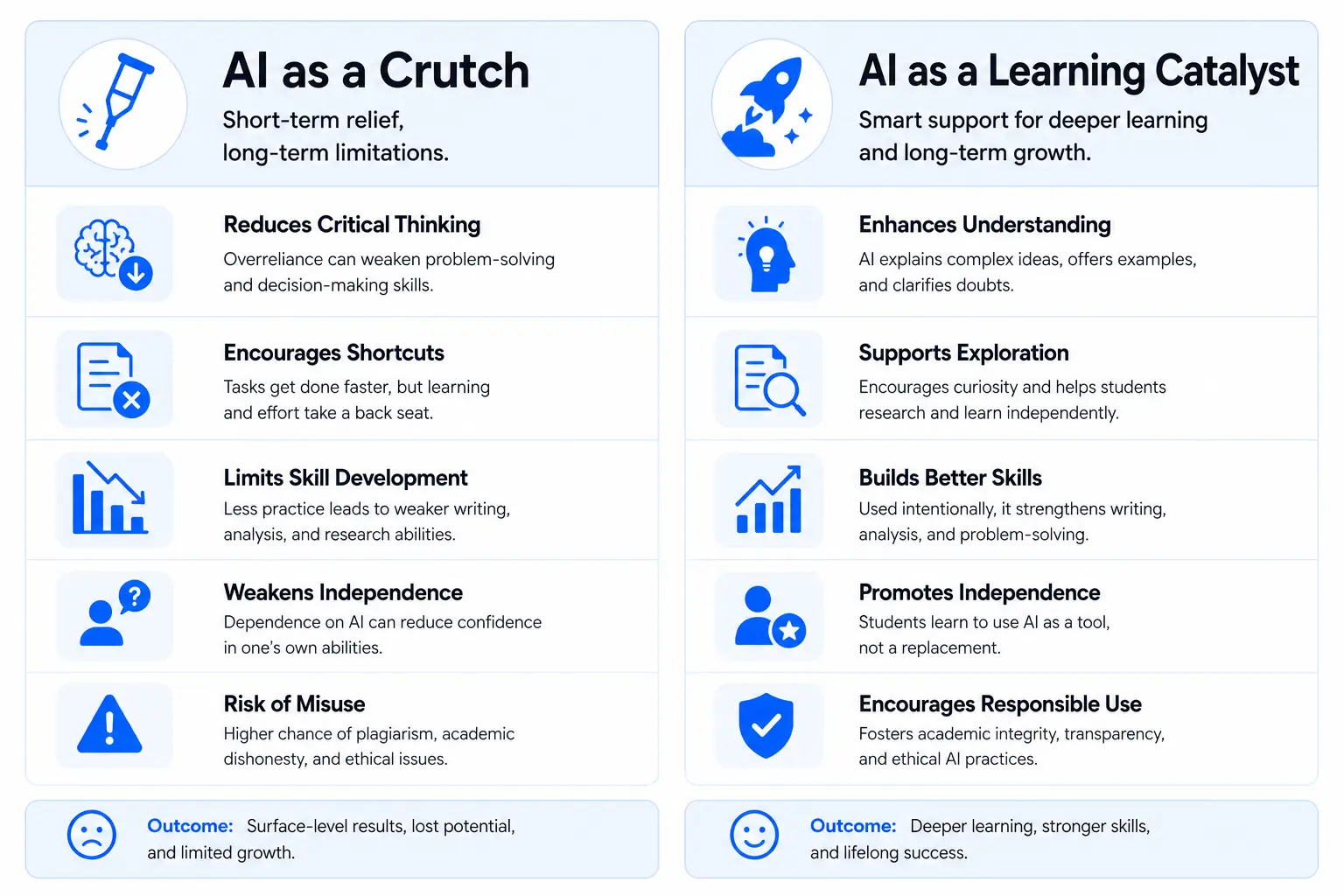
It's 11 PM. Your essay is due at 8 AM. You've been staring at the same blank page for two hours. So you open ChatGPT. Within seconds, it hands you a polished 600-word introduction. You paste it in, exhale, and go to bed. Problem solved — right?Not exactly. That moment of relief comes with a hidden cost most students don't notice until much later: the slow erosion of your own ability to think, argue, and write independently. ChatGPT didn't help you learn. It learned for you.But here's the thing — that doesn't have to be the story. Used the right way, ChatGPT is one of the most powerful learning tools available to students today. How to use ChatGPT for homework. The difference between using it as a crutch and using it as a catalyst comes down entirely to how you engage with it. Jump to our step-by-step framework to see exactly how.
What Is ChatGPT — and Why Are Students Drawn to It?
ChatGPT is a large language model (LLM) developed by OpenAI. Trained on vast amounts of text data, it can understand questions, explain complex concepts, generate essays, solve math problems, summarize research, and hold intelligent conversations on almost any topic — in seconds.
For students managing tight deadlines, heavy workloads, and complex subjects, the appeal is obvious. It answers instantly. It never gets impatient. And unlike a search engine, it doesn't send you hunting through links — it delivers explanations, drafts, and answers directly.
ChatGPT is an AI-powered learning assistant that can explain concepts, help structure essays, walk through problems step-by-step, and answer academic questions in plain language. Used responsibly, it's a powerful learning aid. Used carelessly, it replaces the thinking students need to develop. See practical use cases for how to apply it well.
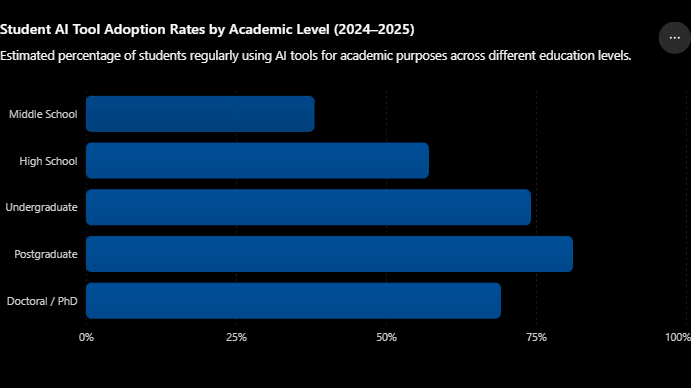
Surveys consistently show that over half of college students have used AI tools like ChatGPT for academic work. The question isn't whether students are using it — they are. The question is whether they're using it in a way that builds their capabilities or quietly hollows them out. Understanding academic integrity is a critical part of that answer.
The Real Problem: When ChatGPT Works Against You
The problem is never the tool. The problem is a specific behavioral pattern: outsourcing your thinking instead of using AI to sharpen it.
When you ask ChatGPT to write your essay, solve your homework, or summarize a chapter you haven't read, you skip something that's scientifically essential to learning — the productive struggle. Cognitive science has a name for this: desirable difficulty. It's the friction of grappling with hard material that actually rewires your brain and encodes knowledge.
Skip that struggle consistently, and the consequences show up in an exam room, in a job interview, or in a meeting where no AI is available and you're expected to think on your feet. The assignments looked fine. The learning never happened.
Submitting AI-generated content as your own work likely violates academic integrity policies at most schools and universities. Detection tools like Turnitin's AI Detector and GPTZero are actively used by institutions. Beyond policy, the real cost is your own skill development — no detection tool required. Read more in the Academic Integrity section.
Signs You're Using ChatGPT the Wrong Way
- Pasting ChatGPT answers directly without reading or understanding them
- Using it to skip assigned readings and primary sources
- Having it write your essays from scratch with no original thought
- Not attempting problems yourself before asking for solutions
- Accepting its answers as facts without independent verification
- Feeling anxious about doing schoolwork without AI access
How to Use ChatGPT for Homework the Smart Way
The core principle is simple: use ChatGPT to enhance your thinking, never to replace it. Here's that principle translated into a step-by-step framework any student can follow today. For subject-specific tips, jump to Practical Use Cases.
Always attempt the work yourself first
Before opening ChatGPT, spend at least 15–20 minutes genuinely engaging with the problem or assignment. Write a rough draft. Try the equation. Outline your argument. This activates prior knowledge and makes AI guidance dramatically more useful when you do seek it.
Use it to understand — not to complete
Ask ChatGPT to explain a concept you're struggling with, not to finish the task for you. "Explain the causes of the French Revolution in simple terms" is a learning prompt. "Write my 500-word essay on the French Revolution" is not. See prompting strategies for more examples.
Push deeper with follow-up questions
Don't accept the first answer. Challenge it. "Can you give me a concrete example?" "Why is that true?" "What's the strongest counterargument?" This mimics Socratic dialogue and forces real comprehension rather than passive reading.
Use it for feedback — not generation
Write your draft first. Then ask ChatGPT to critique it. "What are the weaknesses in my argument?" or "How can I strengthen this introduction?" is enormously valuable — and the work remains entirely yours. This is the gold-standard use case.
Verify everything independently
ChatGPT can state incorrect information with complete confidence — a known problem called "hallucination." For any statistic, citation, date, or specific claim, cross-check against reliable sources before including it in academic work. See our FAQ on accuracy.
Reflect in your own words after every session
After using ChatGPT on any topic, close it and write — without AI — what you now understand. This retrieval practice technique is backed by cognitive science as one of the most effective learning methods available. It cements what you just learned.
Practical Use Cases: Where ChatGPT Genuinely Helps Students
For Writing and Essay Assignments
Use ChatGPT to brainstorm angles on a topic, identify logical gaps in your argument, understand academic vocabulary, or get feedback on a draft you've already written. Let AI be your editor and thinking partner. Don't let it be your ghostwriter. Always follow your school's academic integrity policy.
✓ Smart Learning Use
"Here's my thesis. What are the weakest parts of this argument?"
✗ Undermines Learning
"Write me a 5-paragraph essay about climate change for my English class."
✓ Smart Learning Use
"Explain the difference between a primary and secondary source with examples."
✗ Undermines Learning
"Summarize Chapter 7 so I don't have to read it."
For Math and Science Problems
Ask ChatGPT to explain the process and method behind a type of problem — not to solve your specific homework problem. "Show me step-by-step how to approach this type of quadratic" teaches you a transferable skill. Asking it to complete ten problems teaches you nothing.
Better still: attempt the problem first, then ask ChatGPT where your reasoning went wrong. This error-analysis approach — step 5 in our smart-use framework — is highly effective for retention because you're forced to understand the gap in your thinking.
For Research and Reading Comprehension
If you're wrestling with a dense academic paper or confusing passage, ChatGPT is excellent at simplifying complex ideas on demand. Ask it to "explain this concept as if I'm a high school student" or "restate this idea without academic jargon." You're still engaging with the material — just with a capable translator helping you through the hard parts.
After ChatGPT explains something to you, say: "Now quiz me on what I just learned." This activates active recall — one of the most evidence-backed techniques in cognitive science. It turns passive AI-assisted reading into genuine practice and takes about 60 seconds to set up.
For Exam Preparation
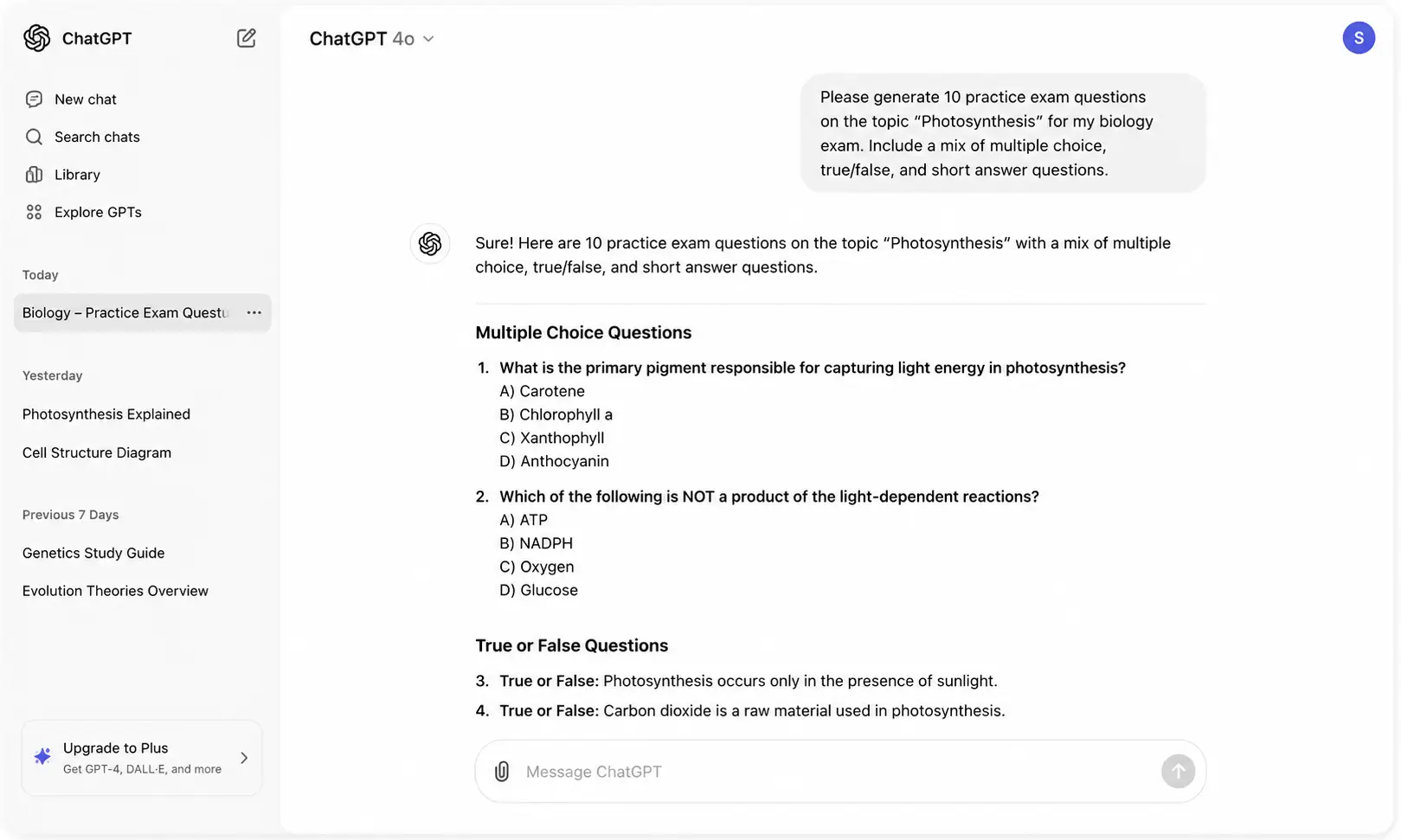
This is where ChatGPT genuinely shines as a study companion. Ask it to generate custom practice questions on your topic, hold a Socratic quiz session, create vocabulary flashcard sets, explain why your practice answer was wrong, or summarize the most important concepts to review. This is AI amplifying your effort — not bypassing it. See our prompting strategies for the exact prompts to use.
Understanding Academic Integrity in the Age of AI
Schools and universities are updating their academic integrity policies faster than most students realize. Some prohibit AI use entirely. Others permit it with disclosure. Many use tiered policies that vary by assignment type. Claiming you didn't know the rules is not considered a valid defense at most institutions.
Is using ChatGPT for homework cheating? It depends on your school's policy and how you use it. Using ChatGPT to understand concepts, get feedback, or practice material is generally considered appropriate. Using it to complete and submit work as your own, without disclosure, likely violates academic integrity policies at most institutions.
Beyond policy, there's a more important question worth sitting with: even if your school allows AI use freely, are you actually learning? The credential you earn at the end of your degree represents skills and knowledge you're supposed to have built. AI can help you build those things more efficiently — but only if you're actively engaged in the building. Cognitive science explains exactly why that matters.
What Cognitive Science Says About AI and Learning
Decades of research in cognitive science show that the mechanisms behind real learning are difficult to shortcut. Two findings are especially relevant for students using AI:
Retrieval practice — the act of trying to remember or reproduce something from memory — dramatically outperforms passive review for long-term retention. Every time you let ChatGPT retrieve information for you instead of retrieving it yourself, you miss a retrieval practice repetition. Over time, that compounds. Our exam prep tips are built directly around this principle.
The generation effect shows that information you actively produce — even in imperfect, rough-draft form — is encoded far more deeply than information you passively read or receive. Writing your own messy essay teaches you more than reading a polished AI-generated one. This is why step 1 of our smart-use framework insists you attempt the work first.
At SmartAIHuman.com, we believe the most capable students of the next decade won't be those who avoided AI. They'll be those who learned to use it without losing themselves in the process.
ChatGPT Prompting Strategies That Actually Work for Students
Most students use ChatGPT at a surface level. The students getting real value have learned to prompt it like a demanding tutor rather than a search engine. These strategies pair directly with the use cases covered above:
- Teach Me Mode: "Explain [concept] like I've never heard of it, then give me 3 concrete examples." — great for reading comprehension
- Socratic Mode: "Ask me questions about [topic] to test what I know. Correct me when I'm wrong and explain why." — ideal for exam prep
- Feedback Mode: "Here's my draft paragraph. Tell me what's unclear, what's missing, and what's the strongest part." — perfect for writing assignments
- Analogy Mode: "Help me understand [complex concept] by comparing it to something from everyday life."
- Devil's Advocate Mode: "I'm arguing that [position]. What are the three strongest counterarguments I need to address?"
- Study Plan Mode: "I have 4 days to study [subject]. Create a structured study plan that covers the key exam areas."
- Error Analysis Mode: "Here's my attempted solution to this problem. Where did my reasoning go wrong?" — ties directly to math and science tips
The Future: Students Who Master AI Will Define It
Here's an honest truth about the world you're entering: employers and institutions are not going to stop AI from being used. They're going to expect you to use it — and to use it with judgment, creativity, and integrity. The question won't be "did you use AI?" It will be "what did you bring to the table alongside it?"
Critical thinking, original judgment, nuanced communication, and creative problem-solving — these are the skills that AI cannot replicate. They're also the exact skills that erode when you outsource your thinking to an algorithm. Understanding why ChatGPT works against you when misused is the first step to avoiding that trap.
The students who will lead are those who develop a clear mental model: AI is a collaborator, not a substitute. It accelerates work. You provide the intelligence, the intention, and the integrity that make the output worth anything.
The best way to use ChatGPT for homework is as a smart, always-available tutor — one that helps you understand, practice, and refine your thinking. Review the 6-step framework and the prompting strategies to get started the right way.
Frequently Asked Questions
The Bottom Line
ChatGPT is not your enemy, and it's not a magic shortcut. It's a mirror — it reflects back the quality of what you bring to it. Ask shallow questions, get shallow results. Engage deeply, challenge the answers, write your own work and ask for honest feedback — and you'll find it's one of the most powerful learning tools any student has ever had access to.
The students who figure that out won't just survive the AI era. They'll define it. Start with the 6-step framework and the prompting strategies — that's all it takes to get on the right path.
Here's the question worth sitting with before you open ChatGPT next time: if it disappeared tomorrow, would you be more capable — or less — than when you started using it?

SmartAIHuman Editorial Team shares practical AI guides, tool reviews, productivity strategies, and beginner-friendly tech tutorials to help readers use AI effectively in everyday life.


Everyone loves what you guys tend to be up too. This sort of
clever work and coverage! Keep up the amazing works
guys I’ve added you guys to my personal blogroll.
Thank you for the support