
Best AI Writing Tools in 2026: The Only Guide You Need
We tested over 20 AI writing assistants across real content workflows. Here's an honest, hands-on breakdown of every tool worth your time — and the ones to avoid.

Picture this: it's 11 PM on a Sunday. You have a 1,500-word blog post due Monday morning, a product description still blank, and an email newsletter that hasn't gone out in three weeks. Your coffee's gone cold, and your cursor has been blinking at an empty page for the past hour.
If that scenario feels uncomfortably familiar, you're not alone. Content creation is one of the biggest time drains for bloggers, small business owners, marketers, and freelancers — not because people lack ideas, but because transforming ideas into polished, publish-ready writing is genuinely hard work.
That's exactly where AI writing tools have become something of a revolution. In 2026, these tools aren't the clunky, error-prone novelties they were a few years ago. They're fast, context-aware, and capable of producing surprisingly high-quality first drafts — when used correctly.
But here's the honest truth: not every AI writing tool is worth your time or money. The market is flooded. Some tools are glorified autocomplete. Others overpromise and underdeliver. And a handful of them are genuinely, legitimately useful in daily workflows.
This guide cuts through all of that. At SmartAIHuman.com, we spent weeks testing the most talked-about AI writing tools across real content tasks — blog posts, product descriptions, ad copy, long-form SEO articles, and email campaigns. What you'll find here is an honest, practical breakdown of what actually works in 2026.
What Is an AI Writing Tool?
An AI writing tool is software that uses large language models (LLMs) to help you generate, edit, improve, or repurpose written content. These tools are powered by models like GPT-4o, Claude 3, or proprietary systems trained on enormous amounts of text data.
In simple terms: you give the AI a prompt or topic, and it produces a draft. You then refine, edit, and publish it. The AI handles the heavy lifting of generating coherent sentences, logical structure, and contextually relevant content — you bring the creative direction, fact-checking, and brand voice.
What can AI writing tools do in 2026?
- Write blog posts, articles, and long-form SEO content
- Generate product descriptions and landing page copy
- Draft emails, newsletters, and outreach messages
- Rewrite and paraphrase existing content
- Create social media captions and ad copy
- Summarize long documents into concise takeaways
- Generate scripts for videos and podcasts
- Help with academic writing and research summaries
Our evaluation process was systematic and hands-on. We used each tool across multiple real-world content tasks over a period of several weeks. Every tool was assessed on the following criteria:
- Output quality: Grammar, coherence, readability, and depth of content
- Ease of use: Onboarding experience, UI clarity, and prompt flexibility
- Speed: Time taken to generate a 1,000-word draft
- SEO capability: Integration with SEO research tools and keyword optimization
- Tone control: Ability to match different brand voices and writing styles
- Pricing value: Output quality relative to subscription cost
- Accuracy: Factual reliability and hallucination frequency on tested prompts
Editorial note: This review is independent. We are not paid to recommend any tool, and our ratings reflect genuine evaluation results.
Quick Comparison: Best AI Writing Tools in 2026
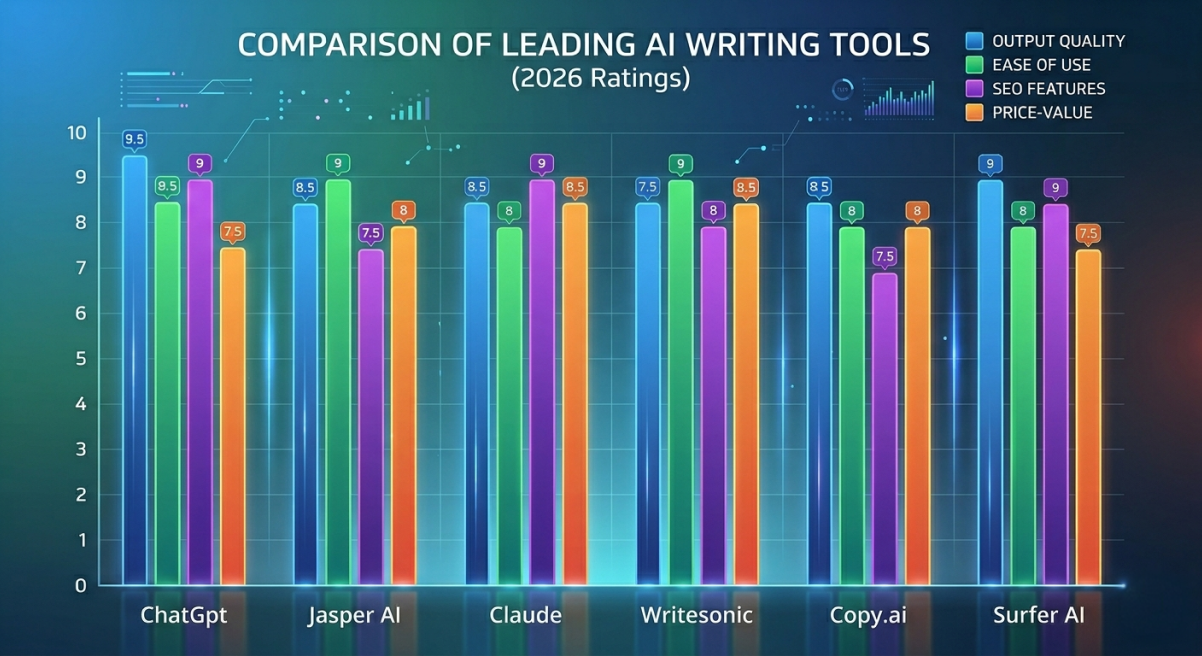
| Tool | Best For | Starting Price | SEO Features | Free Plan | Our Rating |
|---|---|---|---|---|---|
| ChatGPT | Versatility & general writing | $20/mo (Plus) | ✗ Basic | ✓ | 9.1/10 |
| Jasper AI | Marketing & brand copy | $39/mo | ✓ Advanced | ✗ | 8.7/10 |
| Claude | Long-form & nuanced writing | $20/mo (Pro) | ✗ Limited | ✓ | 9.0/10 |
| Writesonic | Bloggers & SEO writers | $16/mo | ✓ Strong | ✓ Limited | 8.5/10 |
| Copy.ai | Short-form & sales copy | $49/mo | ✗ Basic | ✓ | 8.2/10 |
| Surfer AI | SEO-first content | $79/mo | ✓ Best-in-class | ✗ | 8.8/10 |
Pricing shown is for individual/starter plans as of June 2026. Prices may vary. Visit each tool's official website for current pricing.
1. ChatGPT — Best Overall AI Writing Tool in 2026
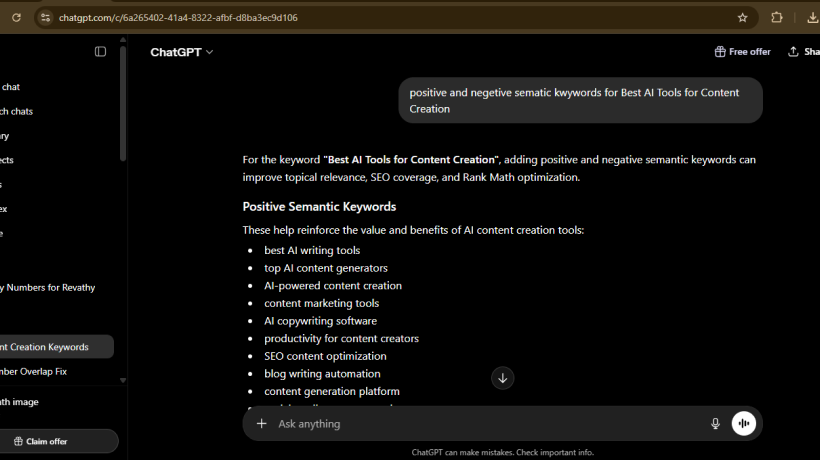
ChatGPT by OpenAI
Editor's Choice| Output Quality | 9.2 | |
| Ease of Use | 9.5 | |
| Versatility | 9.8 | |
| SEO Features | 6.0 | |
| Price Value | 9.0 |
- Exceptionally versatile across content types
- GPT-4o delivers near-human writing quality
- Custom GPTs allow specialized workflows
- Free tier available (GPT-3.5 / limited 4o)
- Browses the web for up-to-date content
- Memory feature remembers your preferences
- No native SEO keyword integration
- Can hallucinate facts on niche topics
- No built-in plagiarism checker
- Requires good prompting for best results
ChatGPT's GPT-4o model, which powers the Plus plan, has made a remarkable leap in writing coherence, creative range, and instruction-following accuracy. During our testing, it consistently produced well-structured first drafts with minimal factual errors on well-documented topics. The custom instructions feature lets you set a persistent brand voice and writing preferences, which saved a considerable amount of prompt repetition across sessions.
Where it struggles is on niche, highly technical, or recent events-based content. In those areas, you'll need to provide source material or verify its outputs carefully. For general-purpose writing across blogs, emails, social copy, and business documents, it's still the tool most professionals reach for first.
Pricing: Free (limited) | $20/month (Plus) | $25/month (Team)
2. Jasper AI — Best for Marketing Teams & Brand Copywriting
Jasper AI
Best for Marketing| Output Quality | 8.8 | |
| Ease of Use | 8.4 | |
| SEO Features | 8.6 | |
| Templates | 9.5 | |
| Price Value | 7.2 |
- Excellent brand voice customization
- 50+ marketing-focused templates
- Surfer SEO integration built-in
- Strong team collaboration features
- Jasper Chat for iterative refinement
- No free plan; relatively expensive
- Learning curve for template workflows
- Overkill for individual bloggers
Jasper has matured significantly since its early days as a template-heavy tool. Today, it functions as a full content intelligence platform. The brand voice feature is genuinely impressive — after training it on a few samples of your writing, it produces content that feels noticeably closer to your natural style than most competitors.
The Surfer SEO integration is a standout feature for content marketers. You can enter a target keyword and Jasper will optimize its output in real time against competitive content — a workflow that previously required switching between multiple tools.
Pricing: Creator $39/mo | Teams $99/mo | Business (custom pricing)
3. Claude by Anthropic — Best for Long-Form & Nuanced Writing
Claude (Anthropic)
Top for Long-Form- Exceptional long-form writing coherence
- 200K token context window for huge docs
- Follows nuanced tonal instructions well
- More thoughtful, less "AI-sounding" prose
- Strong at research synthesis & editing
- Limited native SEO or template features
- No image generation
- Can be overly cautious on some topics
Claude's strongest differentiator is tone and coherence across long documents. Where other tools start to drift in voice or lose narrative thread around the 1,000-word mark, Claude maintains consistent quality through 5,000+ word pieces. Its ability to process uploaded documents and summarize, rewrite, or extend them is genuinely powerful for research-heavy content workflows.
Pricing: Free (Claude.ai) | Pro $20/mo | Team plans available
4. Writesonic — Best AI Writing Tool for Bloggers & SEO
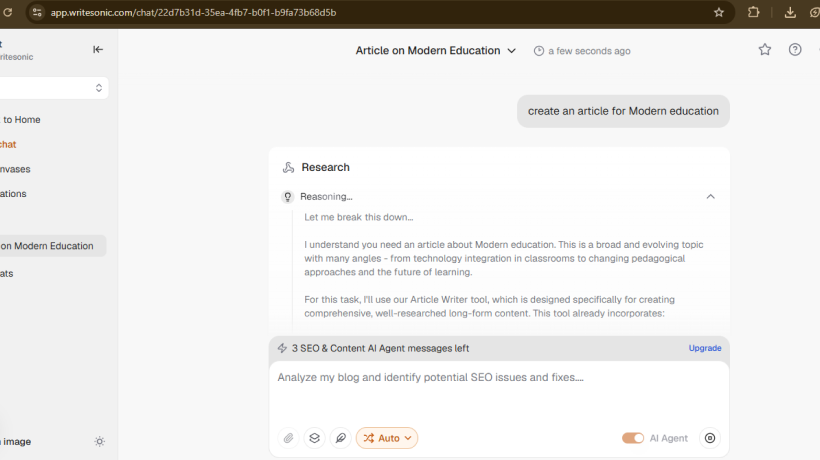
Writesonic
Best for SEO Bloggers- Built-in Surfer SEO & Google Search integration
- One-click article generation from a keyword
- Chatsonic: AI chat with real-time web access
- Affordable starter plan for solo creators
- Strong factual accuracy for evergreen topics
- Output can feel formulaic without custom prompts
- Limited brand voice training vs. Jasper
- Word limits on lower-tier plans
Pricing: Free (limited) | Individual $16/mo | Teams from $45/mo
5. Copy.ai — Best for Short-Form & Sales Copy
Copy.ai
Best for Sales Copy- Purpose-built for high-conversion copy
- Workflow automation for content pipelines
- Excellent for email and ad creative
- Strong free tier for casual use
- Not ideal for long-form articles
- Pro plan is pricey for what you get
- Occasional tonal inconsistency
Pricing: Free | Pro $49/mo | Teams $249/mo
6. Surfer AI — Best AI Writing Tool for SEO-First Content
Surfer AI
Best SEO Integration- Industry-leading SEO optimization layer
- Real-time NLP-based content scoring
- Auto-generates outlines from SERP data
- Internal linking suggestions built-in
- Strong ROI for content marketers
- Expensive relative to general AI tools
- Output quality alone is mid-tier without prompting
- Not designed for non-SEO content types
Pricing: Essential $79/mo | Scale $175/mo | Scale AI $219/mo
How to Choose the Right AI Writing Tool for You
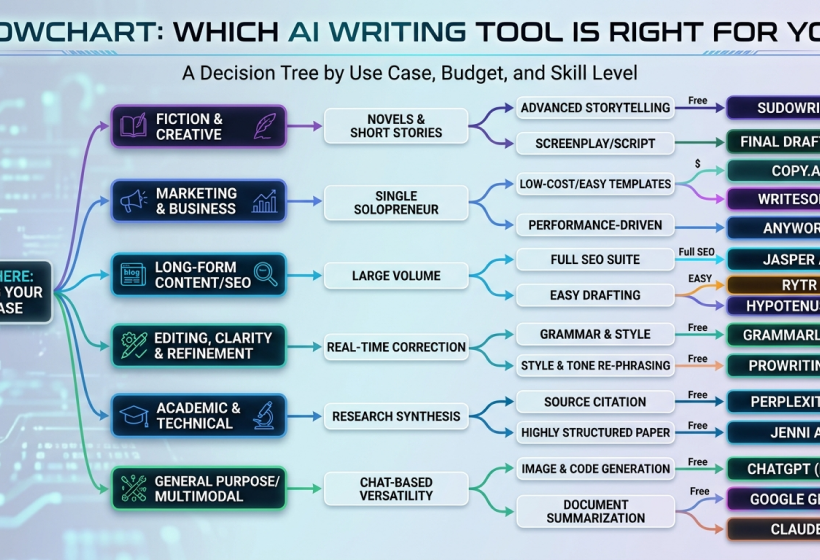
With so many options available, the best AI writing tool is always the one that fits your specific workflow — not the one with the most features. Here's a practical framework for making the right choice:
Choose ChatGPT if you:
- Need a versatile, all-purpose writing assistant
- Want the best free tier available
- Write across many content types (blogs, emails, scripts, research)
- Are comfortable with flexible prompt-based workflows
Choose Jasper if you:
- Lead or manage a marketing team
- Need strict brand voice consistency across content
- Want pre-built templates for marketing workflows
- Have a budget for a premium content platform
Choose Claude if you:
- Write long-form content (articles, reports, whitepapers)
- Value natural, less AI-sounding prose
- Need to process large documents for summarization or rewriting
Choose Writesonic or Surfer AI if you:
- Write content specifically to rank on Google
- Want built-in keyword optimization during drafting
- Measure success by organic traffic growth
Limitations of AI Writing Tools: What You Should Know
No responsible guide would be complete without addressing what AI writing tools cannot do well in 2026:
1. They can get facts wrong. AI models generate statistically probable text — they don't look things up the way a researcher would. Always verify statistics, dates, quotes, and technical claims before publishing.
2. They don't have a genuine voice. AI can approximate tone and style, but it doesn't have lived experience, original opinions, or genuine expertise. The best AI-assisted content uses the AI for structure and speed, with the human providing the insight and personality.
3. They can produce generic output by default. If your prompts are vague, your output will be forgettable. Specific, detailed prompts consistently produce better results. The quality of what you get out is closely tied to the quality of what you put in.
4. Google's position on AI content. Google's guidance, as of 2026, continues to center on content quality, helpfulness, and EEAT — not on whether content was AI-assisted. Well-edited, accurate, and genuinely useful AI-assisted content can rank well. Thin, unedited, mass-produced AI content is increasingly penalized.
The Future of AI Writing Tools: What's Coming in 2026 and Beyond
The AI writing tool landscape is evolving faster than any other software category. Several trends are shaping what these tools will look like in the next 12–24 months:
Agentic writing workflows are emerging as the next major capability leap. Rather than a human prompting for each section, AI writing agents will research, outline, draft, fact-check, and optimize content in a semi-autonomous pipeline. Early versions of this already exist in tools like Jasper and Writesonic, but the capability is becoming significantly more powerful.
Multimodal content creation — where AI generates text, images, and layout suggestions simultaneously — is moving from experimental to practical. The integration of AI-generated visuals directly into writing platforms will remove one of the major remaining friction points in content production.
Personalization at scale is another direction. Rather than producing one article for all readers, AI writing platforms are beginning to support dynamic content variants — adapting tone, examples, and depth based on reader context or intent signals.
🗝 Key Takeaways: Best AI Writing Tools in 2026
- ChatGPT remains the best all-rounder — versatile, capable, and reasonably priced
- Claude produces the most natural-sounding long-form prose of any tool we tested
- Jasper AI is the premium choice for marketing teams with brand consistency needs
- Surfer AI is unmatched for SEO-specific content strategy and execution
- Writesonic offers the best value for solo bloggers focused on organic search
- All AI tools require human editing — quality output demands human judgment and expertise
- Google rewards content quality and helpfulness, regardless of whether AI was used in its creation
Conclusion: The Right AI Writing Tool Changes Everything
The blank page problem isn't going away. Deadlines don't get more forgiving, and the demand for quality content continues to accelerate. But in 2026, the right AI writing tool in your workflow isn't just a time-saver — it's a competitive advantage.
The key is choosing deliberately. Not every tool fits every creator, and the worst outcome is paying for a premium platform and using it as an expensive autocomplete. The tools reviewed here represent the genuine best of what's available — but the one that will serve you most is the one that integrates naturally into how you already work.
Start with a free tier. Test it across your actual content tasks. Pay attention to how much editing the output requires. And remember: the goal isn't to remove the human from the process. It's to make the human part more creative, more strategic, and more impactful.
At SmartAIHuman.com, we'll continue testing new tools as they emerge and updating this guide accordingly. The landscape is moving fast — and we'll keep you ahead of it.
Ready to Start Writing Smarter?
Which of these tools sounds right for your workflow? Which pain point resonates most with you — speed, quality, SEO, or budget? We'd love to know in the comments below.
- OpenAI — openai.com/chatgpt — ChatGPT product documentation
- Anthropic — anthropic.com/claude — Claude AI overview
- Jasper AI — jasper.ai — Platform features and pricing
- Writesonic — writesonic.com — Feature documentation
- Copy.ai — copy.ai — Product details and use cases
- Surfer SEO — surferseo.com — Surfer AI overview
- Google Search Central — Google Helpful Content Guidelines
- HubSpot — State of Marketing Report 2026 — hubspot.com

SmartAIHuman Editorial Team shares practical AI guides, tool reviews, productivity strategies, and beginner-friendly tech tutorials to help readers use AI effectively in everyday life.