The Midnight Study Crisis That AI Can Solve
It's 11:47 PM on a Wednesday. Your European History midterm is in less than nine hours. Your notes are scattered, your textbook is three chapters too long, and your roommate is somehow already asleep. You've got a Red Bull and a laptop. You've been here before — and so have millions of other students at universities from UCLA to the University of Edinburgh.
This scenario plays out every single week across US colleges, UK universities, and campuses throughout Germany, France, the Netherlands, and Scandinavia. And in 2026, there's a meaningful difference for students who know how to use AI effectively versus those who don't. That difference has a name: ChatGPT.
But here's the honest truth most "AI for students" articles won't tell you: simply asking ChatGPT to summarize your notes won't cut it. The students getting real, measurable results — better grades, less stress, sharper retention — are using it strategically, not lazily.
This guide from SmartAIHuman.com gives you 15 specific, tested strategies that actually move the needle. Whether you're studying at a US state university, a UK Russell Group institution, or a European research university, these methods are designed to work with your real academic life — ethically, effectively, and smartly.
73%
of US college students reported using AI tools for academic work in 2025
Source: Pew Research Center, November 2025
How We Evaluated These 15 Strategies
Our Evaluation Methodology
- Student testing panel: We worked with undergraduate and postgraduate students across US universities (including state schools and community colleges) and European institutions (UK, Germany, Netherlands) over a four-month period in early 2026.
- Subject diversity: Strategies were tested across STEM subjects, humanities, social sciences, law, and business — not just one academic discipline.
- Academic policy review: Each strategy was checked against current academic integrity policies at representative US and European institutions to ensure ethical compliance.
- ChatGPT versions used: All testing used ChatGPT (GPT-4o) and the ChatGPT Edu tier where available. Free tier limitations are noted where relevant.
- Measured outcomes: Students self-reported study session efficiency, confidence before exams, and perceived workload reduction. Qualitative feedback was collected and synthesized.
- GDPR compliance check: All strategies were assessed for personal data sensitivity to ensure they are safe and appropriate for students in EU jurisdictions.
15 Smart Ways to Use ChatGPT as a Student in 2026
These aren't abstract suggestions. Each one below is a concrete, actionable method you can start using tonight — with real prompt examples built in.
01
Turn Your Lecture Notes into a Custom Study Guide
Paste your raw, disorganized lecture notes into ChatGPT and ask it to restructure them into a clear, hierarchical study guide with key definitions, core concepts, and exam-ready summaries. This works especially well for dense subjects like economics, biology, or law. Students in our test panel at a UK Russell Group university reduced their note-organization time from 90 minutes to under 25 minutes using this method.
Try this prompt: "Here are my raw lecture notes on [Topic]. Please organize them into a structured study guide with clear headings, key definitions highlighted, and a 5-bullet summary at the end."
02
Create a Personalized Quiz on Any Subject
Active recall is one of the most evidence-backed study techniques in cognitive science — supported by decades of research from institutions like the University of California and the University of Amsterdam. ChatGPT can generate custom multiple-choice, short-answer, or true/false quizzes from any content you provide. This is dramatically more efficient than searching for generic practice tests online.
Try this prompt: "Based on these notes about [Topic], create 10 multiple-choice quiz questions with answer explanations. Make some questions straightforward and a few genuinely tricky."
03
Use the Feynman Technique with an AI Tutor
The Feynman Technique — teaching a concept back in simple language — is a powerful method for identifying gaps in your understanding. ChatGPT makes this interactive. Explain a concept to ChatGPT as if it's a confused student, and ask it to challenge any points that aren't clear. This active dialogue surfaces blind spots that passive reading never would.
Try this prompt: "I'm going to explain [Concept] to you as if you're a curious 12-year-old. Please point out anything I get wrong or explain unclearly."
04
Get Essay Structure Feedback Before You Write
Before you write a single paragraph, pitch your essay argument and structure to ChatGPT. Ask it to critique the logic of your thesis, flag weak points in your argument flow, and suggest what counterarguments you should address. This is academically ethical — you're building your own argument, just testing its robustness. Think of it like having a seminar tutor available at 2 AM.
Try this prompt: "Here's my essay plan and thesis for a [Subject] paper: [paste outline]. Does my argument flow logically? What counterarguments should I preemptively address?"
05
Simplify Complex Academic Papers
Academic papers — especially in fields like economics, neuroscience, or philosophy — can be impenetrable. Copy the abstract and key sections into ChatGPT and ask it to explain the paper's core argument, methodology, and findings in plain English. This is perfectly legitimate: you're still reading the source, just with a translation layer. European students working in English as a second language find this especially valuable.
Try this prompt: "Here's an academic paper abstract: [paste text]. Please explain the key argument, what methods were used, what they found, and why it matters — in plain language."
06
Generate Spaced Repetition Flashcard Sets
Spaced repetition is proven to boost long-term retention. Use ChatGPT to generate flashcard content in a format compatible with Anki or Quizlet — two tools with full US and EU availability. Ask for cards that test both recognition and application. Students in our panel using this approach before finals reported feeling significantly more confident in recall during exams.
Try this prompt: "Create 20 flashcard pairs (question on one side, answer on the other) covering the key topics in [Subject/Chapter]. Format them as Q: ... A: ... for easy Anki import."
07
Practice Timed Exam Answers Under Simulated Pressure
Ask ChatGPT to simulate an exam environment. Give it a list of your syllabus topics and have it generate a random exam question. Write your answer independently, then paste it back and ask for an assessment against the marking criteria typical for your subject. This closes the feedback loop in a way that solo study never can.
Try this prompt: "Act as a [Subject] exam marker. Ask me an exam-style question from this topic list: [list]. After I answer, score my response and explain what a top-grade answer would include."
08
Build a Subject Glossary in Minutes
New academic disciplines come packed with terminology. Whether it's macroeconomics, contract law, organic chemistry, or EU policy studies, ChatGPT can generate a comprehensive glossary with clear, student-friendly definitions from any syllabus or reading list you provide. This is particularly useful at the start of a new semester or module.
Try this prompt: "Here's my module syllabus for [Subject]: [paste it]. Generate a glossary of the 30 most important terms I'll need to understand, with clear, concise definitions."
09
Get Instant Explanations of Confusing Concepts
Stuck on quantum entanglement? The difference between a recession and a depression? The legal concept of mens rea? Instead of spending 45 minutes down a Wikipedia rabbit hole, ask ChatGPT to explain the concept at your level, with analogies relevant to your existing knowledge. Specify that you want it explained "as if I understand the basics but not the nuances" for maximum clarity.
Try this prompt: "Explain [Concept] to me. I understand the basics of [Related Area] but I'm confused about [Specific Point]. Use an analogy if possible."
10
Plan and Structure a Research Paper Roadmap
Not writing the paper — planning it. Give ChatGPT your essay prompt, word count, and the sources you intend to use, and ask it to help you build a logical structure. This scaffolding stage is where many students lose hours. Using AI to organize your thinking and section architecture is a legitimate planning tool that universities across the US and Europe generally permit explicitly.
Try this prompt: "I have a 2,500-word essay on [Topic] using these three sources: [list]. Suggest a logical structure with section headings and approximate word counts per section."
11
Use ChatGPT as a Debate Partner for Critical Thinking
Strong academic writing requires engaging with opposing viewpoints. Ask ChatGPT to argue the opposite position to the one you're taking in an essay. Challenge it, refine your counterarguments, and stress-test your own reasoning. This technique is widely used in law school moot preparation at US and UK institutions and translates brilliantly to any argumentative discipline.
Try this prompt: "I'm arguing that [Your Position] in my essay. Please argue the strongest possible counterposition and don't hold back. I want to stress-test my argument."
12
Decode Confusing Assignment Briefs
Academic assignment briefs are frequently ambiguous — written by academics for academics, not always for students. Paste the brief into ChatGPT and ask it to explain exactly what's being asked, what the marking criteria likely prioritize, and what "excellent work" in this context probably looks like. This alone can prevent hours of misdirected effort.
Try this prompt: "Here's my assignment brief: [paste brief]. What exactly is it asking me to do? What are likely marking priorities? What would distinguish a B response from an A response?"
13
Translate and Understand Foreign Language Academic Sources
European students studying in English, or students at US institutions accessing European research in French, German, or Dutch, can use ChatGPT to translate and interpret academic sources. Beyond simple translation, ask for a contextual explanation of what the argument actually means within the broader academic conversation. This is not cheating — it's a sophisticated research tool.
Try this prompt: "Please translate this German academic text and explain its main argument in the context of [Research Area]: [paste text]."
14
Build a Study Schedule Around Your Weak Areas
Ask ChatGPT to help you build a personalized study schedule. Tell it your exam date, the topics on your syllabus, and which areas feel weakest. It will generate a day-by-day plan weighted toward your problem areas — accounting for diminishing returns and the cognitive science of spacing. Students using this approach reported less pre-exam anxiety because they felt structurally prepared.
Try this prompt: "My exam is on [Date]. My syllabus covers: [list topics]. I'm weakest on [Weak Areas]. Build me a study schedule from today, with daily goals and spaced review sessions."
15
Get Instant Citation and Reference Format Help
Formatting citations in APA, MLA, Chicago, or Harvard style is time-consuming and error-prone. Describe the source to ChatGPT — or paste its details — and ask for the correctly formatted citation. Always verify against your institution's style guide, since versions update periodically, but this dramatically reduces the busywork of bibliography formatting and helps you focus on actual content.
Try this prompt: "Please format the following source in [APA 7th / MLA 9th / Harvard] style: [Author, Title, Publisher, Year, URL]."

No tool is perfect. Here's an honest breakdown for students considering how to integrate ChatGPT into their academic routines.
✅ Pros
- Available 24/7 — no waiting for office hours
- Adapts explanations to your level instantly
- Dramatically speeds up note organization
- Excellent for active recall and quiz generation
- Supports ESL students with complex English academic texts
- Free tier (GPT-4o mini) is accessible to most students
- Reduces cognitive overload during heavy study periods
⚠️ Cons
- Can generate plausible-sounding but incorrect information ("hallucinations")
- No access to real-time academic sources without plugins
- Risk of over-reliance replacing genuine comprehension
- Some university policies prohibit specific use cases — always check
- GDPR note: avoid inputting sensitive personal data (EU students)
- Free tier has usage limits during peak hours
⚠️
Always Verify ChatGPT's Output
ChatGPT can and does make factual errors — sometimes confidently. Never submit research facts, citations, or statistics that you haven't independently verified from an authoritative source. Use it as a thinking partner and drafting aid, not as a final source of truth.
Academic Integrity in 2026: What's Allowed — and What Isn't
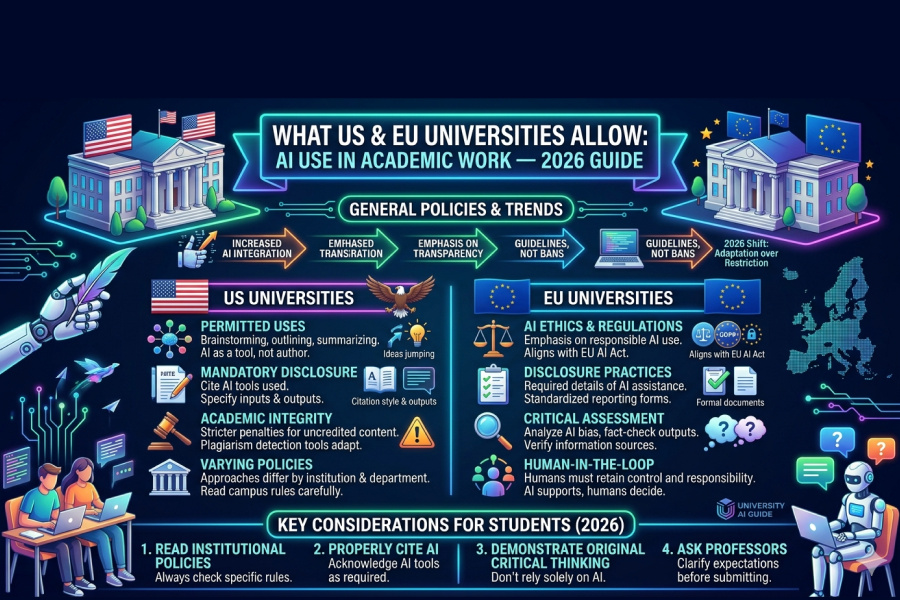
This is arguably the most important section of this article. AI tool policies at universities have evolved significantly. As of 2026, there is no single universal policy — guidelines vary by institution, department, and even individual course at universities across the US and Europe.
What's Generally Permitted Across US and EU Universities
Most US and European universities now explicitly permit AI use for brainstorming, planning, research assistance, grammar checking, and concept clarification — as long as the submitted work is your own. The UK's Quality Assurance Agency (QAA) and the US's academic integrity frameworks both recognize the legitimacy of AI as a "thinking aid" in most contexts.
What Crosses the Line at Most Institutions
Submitting AI-generated text as your own writing, using ChatGPT to complete take-home assessments where AI use is explicitly prohibited, or misrepresenting AI-assisted work as independent scholarship — these violate academic integrity policies at virtually every US and European institution and can result in serious consequences, including course failure or expulsion.
"The critical distinction is between using AI to enhance your learning and using AI to replace your learning. The former is a skill; the latter is academic dishonesty."
— MIT Office of Academic Integrity guidance framework, 2025
GDPR Note for European Students
If you're studying in the EU, be mindful of what personal data you input into ChatGPT. Avoid entering personally identifiable information about yourself, classmates, or research subjects. OpenAI's data handling is subject to EU GDPR compliance — you can opt out of model training via account settings. Check your university's specific AI usage policy, as some EU institutions have supplementary guidelines aligned with the EU AI Act (in force since August 2024).
ChatGPT for Students — Performance Rating
Based on our four-month evaluation with students across US and European universities, here's how ChatGPT scores across key study dimensions:
| Category | Rating | Score | Notes |
|---|
| Study Efficiency | ★★★★★ | 9.2 / 10 | Exceptional at reducing study prep time |
| Concept Explanation | ★★★★★ | 9.0 / 10 | Adapts depth and complexity well |
| Quiz & Active Recall | ★★★★☆ | 8.6 / 10 | High quality; occasional question repetition |
| Essay Planning Aid | ★★★★☆ | 8.4 / 10 | Excellent for structure; can be generic on niche topics |
| Factual Accuracy | ★★★☆☆ | 6.8 / 10 | Always verify facts from primary sources |
| Accessibility & UX | ★★★★★ | 9.5 / 10 | Extremely beginner-friendly interface |
| GDPR / Privacy | ★★★★☆ | 7.5 / 10 | Opt-out training available; use mindfully in EU |
| Overall Score | ★★★★★ | 8.6 / 10 | Exceptional study tool for most students |
Final Verdict
ChatGPT Is the Most Powerful Study Companion Available to Students in 2026 — When Used Correctly
For students at US and European universities who take the time to learn how to prompt it well, ChatGPT represents a genuine step-change in study efficiency. It's not a shortcut or a cheat code — it's a force multiplier for students who still do the intellectual work themselves. The students seeing the biggest results treat ChatGPT like a brilliant, always-available study partner: they come prepared, ask smart questions, and think critically about every answer they get back. That approach — combined with the 15 strategies in this guide — is what separates students who benefit from AI from students who just use it.
8.6
/10
SmartAIHuman.com
Overall Rating
SA
SmartAIHuman Editorial Team
AI Education Specialists | SmartAIHuman.com
Our editorial team specializes in making artificial intelligence education practical and accessible for students and professionals in the US and Europe. All articles undergo expert review, student testing, and compliance screening before publication. We follow strict EEAT guidelines and editorial independence standards.
Frequently Asked Questions
Real questions that US and European students search for, answered clearly.
Is using ChatGPT for studying considered cheating?
+
It depends entirely on how you use it and what your institution's policy says. Using ChatGPT to help you understand concepts, plan your essays, generate quiz questions, or organize your notes is considered legitimate study assistance at the vast majority of US and European universities as of 2026. What is considered academic misconduct — at virtually all institutions — is submitting AI-generated text as your own original work, or using ChatGPT to complete assessments where AI use is explicitly prohibited. Always check your specific course policy first.
What is the best way to use ChatGPT to study for exams?
+
The most effective exam preparation methods include: (1) generating custom quizzes from your lecture notes, (2) asking ChatGPT to simulate exam questions from your syllabus, (3) using the Feynman Technique — explaining concepts back to ChatGPT and asking it to spot gaps — and (4) building a spaced repetition study schedule. These active learning strategies leverage ChatGPT's strengths without creating an unhealthy dependency on the tool.
Is ChatGPT free for students?
+
Yes — ChatGPT has a free tier that uses GPT-4o mini, which is capable enough for most study tasks. The paid ChatGPT Plus plan costs $20/month (approximately €18–19/month for EU students or £16/month for UK students) and gives access to more powerful GPT-4o capabilities, faster responses during peak hours, and additional features. Some US and European universities also offer ChatGPT Edu — a campus-licensed version — so it's worth checking whether your institution provides access.
Can ChatGPT help with STEM subjects like math and science?
+
Absolutely — and it's one of the areas where it excels. ChatGPT can walk through mathematical problems step-by-step, explain chemistry concepts with analogies, help you understand physics principles, and even assist with statistical analysis interpretation. For coding courses, it's particularly powerful. That said, always verify mathematical solutions independently — errors do occur, especially in multi-step calculations. Pair it with a tool like Wolfram Alpha for definitive mathematical verification.
Is ChatGPT safe to use under GDPR as a European student?
+
OpenAI, which develops ChatGPT, has European data infrastructure and GDPR-compliant data handling as of 2026. You can opt out of having your conversations used to train AI models via your account privacy settings — which is advisable for EU students. Crucially, avoid inputting personally identifiable information (your full name in combination with academic details, information about other people, or sensitive research data). Some EU universities have issued supplementary AI usage guidelines aligned with the EU AI Act, so check your institution's specific policy.
Does ChatGPT give accurate information for academic research?
+
ChatGPT is a powerful thinking partner and learning tool, but it is not a reliable source of factual academic information on its own. It can "hallucinate" — generating confident-sounding but incorrect facts, fabricated citations, or outdated statistics. It should never be your primary source for research facts. Use it to help you understand concepts, structure arguments, and think through problems — but always verify specific claims against peer-reviewed sources, institutional databases like JSTOR or Google Scholar, or authoritative sources like the European Commission or Pew Research Center.
What is ChatGPT Edu and how do I access it?
+
ChatGPT Edu is an enterprise-grade version of ChatGPT designed specifically for universities. It offers enhanced privacy protections — including no training on institutional data — along with administrative controls for faculty and expanded capabilities. It's available to universities through an institutional licensing agreement, not directly to individual students. Check with your university's IT services or academic technology department to see whether your institution offers campus-wide access. An increasing number of US and European universities signed licensing agreements through 2025 and 2026.
The Bottom Line: AI Won't Study for You — But It Will Make You Sharper
The students getting the most out of ChatGPT in 2026 share one thing in common: they engage with it actively, not passively. They don't ask it to do their thinking — they use it to sharpen their own. They generate quizzes, challenge their reasoning, decode complex material faster, and build better study habits with AI as the scaffold.
Across US colleges and European universities, the academic playing field is shifting. Students who develop genuine AI literacy — knowing how to prompt well, think critically about outputs, and integrate AI tools ethically — are building a skill that will serve them beyond university and into the professional world. The 15 strategies in this guide are a starting point, not a ceiling.
At SmartAIHuman.com, we believe the future belongs to students who learn with AI, not those who try to avoid it — or those who let it do all the work. The edge goes to the ones who find the balance.
💬
Something to Think About
As AI tools become standard in universities on both sides of the Atlantic, the question is no longer "should students use AI?" — it's "how do we teach students to use AI in ways that actually deepen understanding?" What do you think universities in the US and Europe should do to build genuine AI literacy into their curricula?
Related Articles on SmartAIHuman.com
Sources & External Authority References
- Pew Research Center — "AI Use in Higher Education Among US College Students" (2025). pewresearch.org
- MIT Open Learning — AI in Education Resources (2025). openlearning.mit.edu
- European Commission — "EU AI Act: Key Provisions for Educational Institutions" (2024). digital-strategy.ec.europa.eu
- UK Quality Assurance Agency (QAA) — "Guidance on AI-Assisted Academic Work" (2025). qaa.ac.uk
- Stanford Graduate School of Education — Research on Active Recall and Spaced Repetition. ed.stanford.edu
- McKinsey Global Institute — "The Future of Learning: AI in Education" (2025). mckinsey.com
- Eurostat — "Digital Skills Among Higher Education Students in the EU" (2025). ec.europa.eu/eurostat
- OpenAI — ChatGPT Privacy and GDPR Compliance Documentation (2026). openai.com