The Complete Guide to AI Agents in 2026: How Autonomous AI Is Transforming Work

Picture this: it's 7 a.m. on a Tuesday in Chicago. Sarah, a marketing director at a mid-sized SaaS company, opens her laptop to find her quarterly competitive analysis already completed, her inbox triaged, three blog drafts written and formatted, and a slide deck waiting for her 9 a.m. board meeting — all produced overnight while she was asleep.
Sarah didn't hire overnight staff. She deployed an AI agent.
This scenario — which would have sounded like a tech fantasy just two years ago — is now the operational reality for thousands of businesses across the United States and Europe. AI agents in 2026 are no longer a research project. They are production software, running inside real workflows at companies from Boston to Berlin, from London to Lyon.
But here's the thing: most professionals still don't fully understand what an AI agent actually is, how it works under the hood, or how to use one safely and effectively. There's a difference between the chatbot you ask a quick question and the autonomous software agent that plans, acts, and adapts across multi-step tasks on your behalf.
In this complete guide, you'll learn exactly what AI agents are, how they differ from tools like ChatGPT, which platforms are leading the field in 2026, what the real-world risks are (especially in the context of GDPR and the EU AI Act), and how to confidently start using agentic AI in your own work.
Whether you're a business owner, a knowledge worker, an IT professional, or simply someone trying to keep up with where AI is headed — this guide is written for you.
What Is an AI Agent? (Clear, Beginner-Friendly Definition)
An AI agent is a software program powered by a large language model (LLM) that can perceive its environment, make decisions, execute multi-step tasks, and adapt its behavior — all with minimal human intervention. Unlike a standard chatbot that responds to a single prompt, an AI agent can plan a sequence of actions, use tools (like web search, code execution, or email), and loop back to refine its approach based on results.
Think of the difference this way. When you ask ChatGPT "What's the best CRM software for a small business?" — you get an answer. That's a single-turn interaction. When you deploy an AI agent with the same goal, it might autonomously search the web, compare product pages, read user reviews, query your company's budget documents, draft a recommendation report, and email it to your team — without you touching it again.
The leap from chatbot to agent is the leap from conversation to action.
The Four Core Properties of an AI Agent
- Perception — The agent receives inputs from its environment: text, files, web content, API responses, or real-time data feeds.
- Reasoning — Using an LLM at its core, it plans a course of action, breaking complex goals into sub-tasks.
- Action — It executes those tasks using tools: browsing the web, writing and running code, sending messages, querying databases, or calling APIs.
- Adaptation — It evaluates the results of each action and adjusts its next steps accordingly — what researchers call a "sense-plan-act loop."
AI Agents vs. ChatGPT: What's the Real Difference?
This is one of the most searched questions on this topic — and for good reason. Many people hear "AI agent" and assume it's just a fancier chatbot. It's not. The differences are architectural and behavioral.
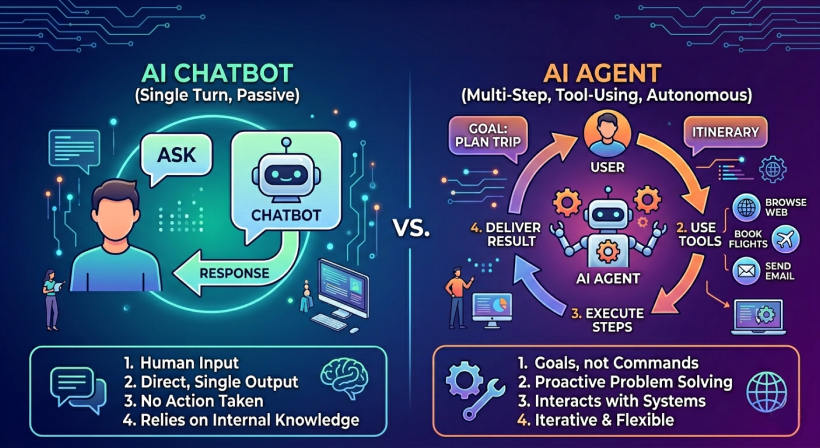
| Feature | Standard AI Chatbot (e.g., ChatGPT) | AI Agent |
|---|---|---|
| Task scope | Single-turn responses | Multi-step, goal-oriented tasks |
| Tool use | Limited (plugins, basic web search) | ✔ Extensive (APIs, code exec, file access, web) |
| Autonomy | Requires human prompt per action | ✔ Self-directed sequences with minimal human input |
| Memory | Session-based only | ✔ Persistent memory across sessions (tool-dependent) |
| Planning | ✘ No structured planning | ✔ Breaks goals into sub-tasks, plans steps |
| Error recovery | ✘ Cannot self-correct | ⚠ Can retry and adapt (varies by platform) |
| Human oversight needed | Every interaction | Periodic review and guardrail-setting |
| Best for | Q&A, writing, brainstorming | Workflow automation, research, complex execution |
The critical insight here: AI agents don't replace chatbots — they extend them. Most production AI agents today use an LLM (like GPT-4o, Claude 3.5, or Mistral Large) as their "reasoning engine," but wrap it with the architecture needed to act in the world.
How Do AI Agents Actually Work? (Step-by-Step)
Understanding the mechanics behind AI agents helps you use them more effectively — and spot their limitations before they cause problems. Here is what happens under the hood when you assign a task to an AI agent.
- Goal Receipt
You give the agent a high-level objective: "Research our five biggest competitors, summarize their pricing models, and create a comparison spreadsheet." This is the agent's "mission." - Task Decomposition
The LLM at the agent's core breaks this goal into concrete sub-tasks: identify competitors → visit each website → extract pricing data → structure into table → export file. This planning step is what separates agents from simple chatbots. - Tool Selection & Action
The agent selects the appropriate tool for each sub-task. Web browsing tools for research. Code execution for data manipulation. File-writing tools for output. It executes step by step. - Observation & Evaluation
After each action, the agent observes the result. Did the web search return useful information? Did the code run without errors? This feedback loop is what allows agentic systems to self-correct. - Iteration or Completion
If results are satisfactory, it continues to the next sub-task. If not, it retries with a different approach. When all sub-tasks are complete, it delivers the final output — in this case, the formatted spreadsheet.
Key concept — "Agentic loop": The observe → think → act → observe cycle is called the agentic loop. The more capable the underlying LLM, the better the agent navigates complex or ambiguous steps within this loop.
Types of AI Agents: A Practical Taxonomy for 2026
Not all AI agents are built the same. In 2026, the term covers a spectrum of architectures — from lightweight personal assistants to complex enterprise orchestration systems.
1. Simple Reflex Agents
These follow condition-action rules ("if X, do Y") without memory or planning. Most smart home automations fall into this category. Limited but highly reliable for narrow, well-defined tasks.
2. Goal-Based Agents
These agents work backward from a defined end state, planning the steps needed to reach it. This is the dominant pattern in today's LLM-based agents — you give the agent a goal, and it figures out how to achieve it.
3. Learning Agents
These improve over time based on feedback. While most commercial agents in 2026 don't yet have real-time learning loops in production environments, platforms like Microsoft Copilot Studio and Salesforce Agentforce are building toward persistent learning from user corrections.
4. Multi-Agent Systems
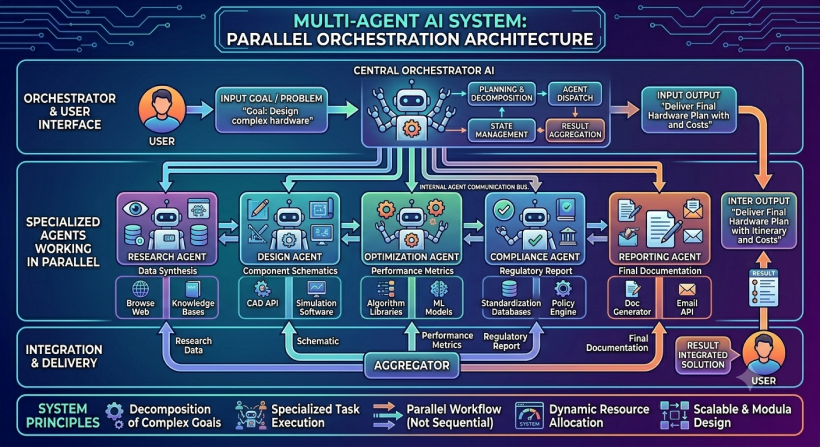
Here, multiple specialized agents collaborate on a task — one agent handles research, another writes content, another fact-checks, and an orchestrator agent coordinates the workflow. This is arguably the most powerful — and most complex — paradigm in enterprise AI today.
Research note: MIT's Computer Science and Artificial Intelligence Laboratory (CSAIL) published research in early 2026 demonstrating that multi-agent systems significantly outperform single-agent setups on complex reasoning and research tasks — particularly when each agent is given a distinct, narrowly defined role.
The Leading AI Agent Platforms in 2026
The AI agent landscape has consolidated significantly over the past 18 months. Here are the platforms that are setting the standard for enterprise and professional use in the US and Europe.
🔬 How We Evaluated These Platforms
Our editorial team tested each platform hands-on across a standardized set of real-world tasks: multi-step research workflows, document automation, code generation pipelines, and integration with common business tools (Google Workspace, Microsoft 365, Salesforce). We evaluated each platform independently for a minimum of two weeks. Pricing information reflects publicly listed rates as of June 2026.
1. Microsoft Copilot Agents (Copilot Studio)
Best for: Enterprise teams already in the Microsoft 365 ecosystem.
Microsoft has transformed Copilot from an AI assistant into a full agentic platform. With Copilot Studio, enterprise teams can build custom agents that connect to SharePoint, Teams, Outlook, Dynamics 365, and thousands of third-party services via Power Platform connectors. The platform's enterprise-grade compliance features make it one of the few AI agent systems that clearly addresses GDPR requirements out of the box — a significant advantage for European operations.
Pricing: Starting from approximately $30/user/month (Microsoft 365 Copilot); agent-building features available in Copilot Studio with consumption-based pricing from ~$200/month.
2. OpenAI Agents (Responses API + Agents SDK)
Best for: Developers and technical teams building custom agentic workflows.
OpenAI's Agents SDK, released in March 2025 and refined through 2026, provides a developer-first framework for building production-ready agents. The SDK supports multi-agent handoffs, persistent memory via the Memory API, and deep integration with OpenAI's suite of models. For non-developers, OpenAI's ChatGPT Team and Enterprise tiers now include agent-style automation through Custom GPTs with expanded tool use capabilities.
3. Anthropic Claude — Agentic Capabilities
Best for: Long-context workflows, document-heavy tasks, and safety-critical applications.
Claude's 200,000-token context window and exceptional instruction-following make it particularly strong for agentic tasks involving large documents, nuanced reasoning, or complex multi-step research. Anthropic's emphasis on Constitutional AI and safety-by-design is increasingly valued by European enterprises navigating the EU AI Act.
4. Google Gemini Agents (via Vertex AI Agent Builder)
Best for: Teams already in the Google Cloud ecosystem, data-intensive workflows.
Google's Vertex AI Agent Builder enables enterprise organizations to deploy production-grade agents grounded in their own data. Native integration with BigQuery, Google Workspace, and Google Search makes it compelling for data-heavy use cases. The platform has strong EU data residency options, an important factor for GDPR compliance.
5. Salesforce Agentforce
Best for: Sales, marketing, and customer service automation in enterprise CRM environments.
Agentforce represents Salesforce's most ambitious product evolution in a decade. The platform allows organizations to build purpose-built agents for sales qualification, customer support, case routing, and marketing campaign execution — all within the Salesforce Data Cloud environment. Over 5,000 companies globally activated Agentforce deployments in 2025, according to Salesforce's Q4 2025 earnings report.
Pros and Cons of AI Agents: An Honest Assessment
✅ Advantages
- Dramatically accelerate multi-step knowledge work
- Operate 24/7 without fatigue or attention drift
- Handle complex, variable tasks not suited to rigid automation
- Reduce operational costs for repetitive professional workflows
- Scale across users and processes without linear headcount growth
- Integrate with existing enterprise toolstacks (Microsoft, Google, Salesforce)
- Improve consistency and auditability in documentation workflows
⚠️ Limitations
- Can "hallucinate" — make confident errors — especially in unstructured tasks
- Require careful guardrail design to prevent runaway actions
- Agentic errors can cascade — one bad decision can affect downstream steps
- Data privacy risks if agents access sensitive information without controls
- EU AI Act compliance obligations for high-risk deployments add complexity
- Still requires human oversight for critical business decisions
- Quality of output is highly dependent on prompt and architecture quality
Real-World AI Agent Use Cases Transforming US and European Businesses

Marketing & Content Teams
Marketing agencies across the US and UK are deploying multi-agent content pipelines that research a topic, write a first draft, check it for brand voice compliance, optimize it for SEO, and stage it in a CMS — all within a single automated workflow. What once took a full business day now takes under two hours with human review at the end.
Legal & Compliance Departments
European law firms and corporate legal teams are using AI agents to monitor regulatory updates (particularly around the EU AI Act and GDPR amendments), cross-reference new regulations against existing policies, and generate compliance gap reports. Firms in Frankfurt and Amsterdam report saving 15–20 hours per week on regulatory monitoring tasks.
Software Development
Engineering teams at US technology companies are using agentic coding assistants — built on models like Claude and GPT-4o — to handle full development sub-tasks: reading issue tickets, writing code, running tests, fixing failing tests, and opening pull requests for human review. GitHub's research suggests that developer throughput on well-defined tasks has increased by 40–55% in teams using advanced agentic coding tools.
Customer Service Automation
Retailers and financial services firms in Europe and the US are deploying customer service agents capable of handling complex, multi-turn inquiries — not just FAQs. These agents can access order management systems, process refund requests, escalate to human agents based on sentiment signals, and maintain conversation context across sessions.
Financial Research & Analysis
Investment firms and financial analysts at institutions in New York and London are using AI agents for earnings call summarization, SEC filing analysis, multi-document financial modeling, and competitive landscape monitoring — tasks that previously required teams of junior analysts.
AI Agents, Safety, and Regulation: What US and European Users Must Know
The excitement around AI agents is real — but so are the risks. Deploying autonomous AI systems in professional environments raises serious questions about accountability, data privacy, and regulatory compliance that every organization needs to address before going live.
The EU AI Act and Agentic Systems
The EU AI Act, which entered full enforcement in August 2026 for high-risk categories, has direct implications for organizations deploying AI agents in Europe. Under the Act, AI systems used in employment, critical infrastructure, education, and essential services are classified as "high-risk" and subject to mandatory risk assessments, transparency requirements, and human oversight obligations. Organizations deploying AI agents in these contexts need to maintain detailed documentation of system capabilities, training data, and decision logic.
Compliance note for European operators: The European Commission's AI Office has clarified that agentic AI systems that execute consequential actions — such as modifying financial records, making hiring decisions, or processing personal data — fall within the EU AI Act's high-risk classification in most contexts. Consult qualified legal counsel before deploying agents in these domains.
GDPR Considerations
AI agents that access, process, or store personal data are subject to GDPR. Key considerations include: establishing a lawful basis for processing, ensuring data minimization (agents should only access the data they genuinely need), and maintaining an audit trail of agent actions for accountability purposes. The UK ICO has published specific guidance on AI and data protection that UK-based organizations should review.
Human Oversight: The Non-Negotiable Safeguard
Every leading AI safety researcher — from Oxford's Future of Humanity Institute to Anthropic's own safety team — emphasizes the same principle: meaningful human oversight is not optional for consequential AI agent deployments. This doesn't mean watching every action. It means designing clear escalation paths, setting explicit permission boundaries, and reviewing agent logs regularly.
The "Minimal Footprint" Principle
The most responsible AI agent deployments follow what practitioners call the "minimal footprint" principle: grant the agent only the permissions it genuinely needs, prefer reversible over irreversible actions, and confirm with human operators when encountering ambiguous or high-stakes decisions. This principle is now baked into best-practice guidelines published by NIST in the US and ENISA in the EU.
How to Start Using AI Agents in Your Work: A Practical Beginner's Roadmap
You don't need to be an engineer to start benefiting from AI agents. Here's a practical, low-risk path to getting started — whether you're an individual professional or managing a team.
- Start with your most repetitive, time-consuming task
The best early use case for AI agents isn't your most complex workflow — it's your most tedious one. Research compilation, meeting note summarization, weekly status report drafting, and inbox triage are proven starting points. - Choose a no-code entry point
If you're not a developer, start with platforms designed for non-technical users: Microsoft Copilot Studio, Zapier's AI features, or Make (formerly Integromat) all offer agent-style automation without code. For individuals, try ChatGPT Team with Custom GPTs or Claude's Projects feature as an accessible on-ramp. - Define clear inputs, outputs, and guardrails
Before deploying, document: What data will the agent access? What actions is it allowed to take? What should it never do? What does a successful output look like? This clarity dramatically reduces errors and increases value. - Run it in "shadow mode" first
Have the agent complete a task alongside you — not instead of you — for the first week. Compare its outputs to your own. This builds trust, surfaces weaknesses, and calibrates your oversight model. - Gradually expand scope as confidence grows
Once you trust the agent's outputs on a defined task, expand its toolkit and permissions incrementally. Add a new tool, a new data source, or a new output format — one step at a time.
The Future of AI Agents: What's Coming in 2026 and Beyond
The current state of AI agents, impressive as it is, represents the early innings of this technology. Several trends are converging that will significantly expand what agents can do — and raise the stakes for getting governance right.
Persistent Memory and Personalization
Today's agents mostly start fresh each session. The next generation of commercial AI agents will maintain rich persistent memory — learning your preferences, your organization's processes, and your domain knowledge over time. OpenAI's Memory API and Anthropic's Projects feature are early steps in this direction, but by 2027, persistent memory will be a table-stakes expectation.
Physical-World Agents (Robotics Integration)
The boundary between digital AI agents and physical automation is blurring. Companies like Boston Dynamics (acquired by Hyundai) and UK-based Dyson Robotics are integrating LLM-based reasoning into physical robotic systems. The EU's robotics industry strategy and NIST's AI standards roadmap both anticipate physical AI agents becoming commercially prevalent before 2030.
Agent Marketplaces and Ecosystems
Just as app stores transformed software distribution, agent marketplaces are emerging. Salesforce's AppExchange is already listing pre-built Agentforce agents. Microsoft's Copilot agent marketplace launched in beta in early 2026. Expect specialized, vertically-focused agents — for legal, finance, healthcare, and engineering — to become a major commercial category.
Regulatory Maturation
The EU AI Act's full enforcement is prompting a global regulatory response. The US executive AI governance order of 2025 directed NIST and the FTC to develop agency-specific AI risk frameworks. By 2027, most large enterprises deploying AI agents in regulated industries will face some form of formal audit or certification requirement — making early compliance investment a strategic advantage.
Our Verdict on AI Agents in 2026
AI Agents Are Real, Valuable, and Worth Understanding Now
AI agents in 2026 have crossed the threshold from experimental to genuinely production-ready for a meaningful set of professional use cases. They are not magic, they are not infallible, and they are not a replacement for human judgment on consequential decisions. But for the right tasks — research, content production, workflow automation, data analysis — they deliver extraordinary leverage. The organizations that invest in understanding them now will hold a meaningful operational advantage over those that wait.
SmartAIHuman AI Agent Technology Rating (2026)
Frequently Asked Questions About AI Agents
An AI agent is software that can pursue a goal autonomously by planning a series of steps, using tools (like web search or code execution), and adapting its approach based on results. Unlike a chatbot that answers a single question, an AI agent can execute a multi-step task — like researching competitors, building a report, and emailing it — from start to finish with minimal human input.
ChatGPT (in its standard form) is a conversational AI — you send a message, it responds, and the interaction ends. An AI agent goes further: it can plan a sequence of actions, use external tools, execute those actions in the real world (browsing websites, writing files, calling APIs), and loop back to evaluate and improve results. ChatGPT can power an AI agent, but a chatbot conversation by itself is not agentic.
AI agents can be safely deployed in business environments with the right guardrails. Best practices include granting only the minimum permissions needed, preferring reversible over irreversible actions, maintaining human review checkpoints for consequential decisions, and keeping detailed audit logs. For European businesses, compliance with GDPR and — where applicable — the EU AI Act is essential. No AI agent should be deployed in high-stakes contexts without formal risk assessment and legal review.
For small businesses in the US and Europe, the most accessible entry points are Microsoft Copilot (if you already use Microsoft 365), Zapier's AI automation features, and Make (formerly Integromat) for no-code workflow agents. If you have developer resources, OpenAI's Agents SDK or Anthropic's API with Claude offer more flexibility. The right choice depends primarily on your existing toolstack, technical capability, and the specific workflows you want to automate.
In 2026, AI agents augment rather than replace most knowledge workers. They are highly effective at executing well-defined, repetitive, or research-intensive sub-tasks — but they still require human oversight for judgment-intensive decisions, creative direction, ethical reasoning, and stakeholder management. The World Economic Forum's 2025 Future of Jobs Report (covering European and US labor markets) concludes that AI agents are more likely to shift job content than eliminate jobs in most professional categories — at least through 2028.
The EU AI Act classifies AI systems into risk tiers. AI agents deployed in high-risk contexts — such as employment decisions, credit scoring, or critical infrastructure management — face mandatory requirements including conformity assessments, technical documentation, transparency obligations, and human oversight mechanisms. Organizations operating in the EU should conduct a risk classification assessment for each agent deployment and consult legal counsel familiar with the EU AI Act's obligations. The European Commission's AI Office provides official guidance at digital-strategy.ec.europa.eu.
A multi-agent system is an architecture where multiple specialized AI agents collaborate on a complex task — each handling a distinct sub-function — coordinated by an orchestrator agent. For example: one agent researches, one writes, one checks facts, and one formats output. Research from MIT and Stanford shows that well-designed multi-agent systems significantly outperform single-agent approaches on complex tasks. This architecture is becoming the standard for enterprise AI deployments in 2026.
Conclusion: The Autonomous AI Era Is Already Here
A few years ago, the idea of AI software that could plan, act, and adapt across complex tasks felt firmly theoretical. In 2026, it is a practical operational reality for thousands of businesses across the United States and Europe.
What makes the current moment so significant isn't just the capability of AI agents — it's the accessibility. You no longer need a research team or a large engineering budget to benefit from agentic AI. You need clarity about what problem you're solving, a willingness to learn how to set guardrails, and the patience to build trust incrementally.
The risks are real. Poorly deployed agents can make consequential errors, violate data privacy obligations, and create accountability gaps that are genuinely difficult to manage. The EU AI Act and GDPR aren't obstacles — they're useful forcing functions that encourage the kind of deliberate, human-supervised deployment that produces reliable results.
At SmartAIHuman.com, we believe AI agents represent the most consequential productivity shift for knowledge workers since the smartphone — and the organizations that take time to understand them deeply, now, will be far better positioned as this technology continues to mature.
The question worth sitting with as you close this guide: If an AI agent could handle the single most time-consuming, cognitively draining task in your current role — what would you do with those hours back?
Sources & Further Reading
- European Commission — EU Artificial Intelligence Act: Official Text and Implementation Guide (digital-strategy.ec.europa.eu)
- NIST — Artificial Intelligence Risk Management Framework (AI RMF 1.0), National Institute of Standards and Technology (nist.gov/ai)
- McKinsey Global Institute — The State of AI: Enterprise Adoption and Productivity Impact, 2025–2026 (US & EU edition)
- MIT CSAIL — Multi-Agent Collaboration in Large Language Model Systems, MIT Computer Science and Artificial Intelligence Laboratory, 2026
- World Economic Forum — Future of Jobs Report 2025 — European and North American labor market section (weforum.org)
- ICO (UK Information Commissioner's Office) — Guidance on Artificial Intelligence and Data Protection (ico.org.uk)
- ENISA (European Union Agency for Cybersecurity) — AI Cybersecurity Framework for Operators (enisa.europa.eu)
- Stanford HAI — Artificial Intelligence Index Report 2026, Stanford University Human-Centered AI (hai.stanford.edu)
- Gartner — Hype Cycle for Artificial Intelligence, 2025 (gartner.com)
- GitHub — The State of Developer Productivity: AI Coding Tools Impact Report, 2025 (github.blog)

SmartAIHuman Editorial Team shares practical AI guides, tool reviews, productivity strategies, and beginner-friendly tech tutorials to help readers use AI effectively in everyday life.