
What Is a Chatbot? A Complete Beginner's Guide for 2026

Key Takeaways
- AI chatbots use machine learning and NLP
- Chatbots simulate human conversations
- A chatbot is software that simulates human conversation through text or voice
- 67% of US consumers interacted with a chatbot for customer service in 2025, per Pew Research
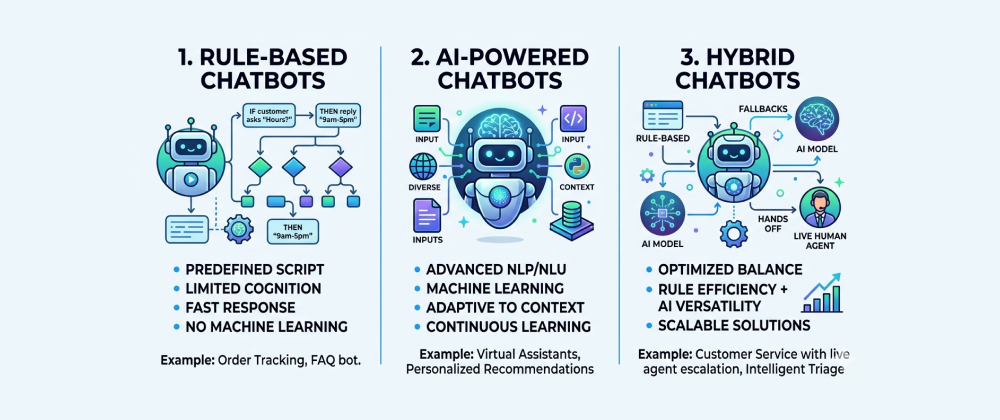
- Modern chatbots fall into three types: rule-based, AI-powered, and hybrid models
- Businesses in the US and EU use chatbots for support, sales, and lead generation
- This guide explains how chatbots work, real examples, and how to choose one in 2026
Table of Contents
The Little Chat Bubble That's Quietly Changed Customer Service
What is chatbot? A chatbot is a software application that simulates human conversation through text or voice. Modern AI chatbots use natural language processing and machine learning to understand and respond to users. You've almost certainly talked to one this week without thinking twice about it. Maybe it was the little chat bubble that popped up on an airline's website when your flight got delayed, asking "How can I help?" Maybe it was the assistant on your bank's app helping you dispute a charge at 10 PM on a Sunday — long after any human agent had gone home for the night.
That's a chatbot. And whether you're a small business owner in Lyon wondering if you need one, a student in Ohio curious how they actually work, or simply someone who wants to understand the technology shaping daily interactions across the US and Europe, this guide breaks it down in plain language.
Chatbots aren't new — but what they can do has changed dramatically. The clunky, frustrating bots of a decade ago that only understood rigid keywords have largely been replaced by far more capable systems, some powered by the same large language model technology behind tools like ChatGPT .
This guide from SmartAIHuman.com explains exactly what a chatbot is, how the different types work, where you'll encounter them, and what to consider — including privacy — before using or building one in 2026.
How We Researched This Guide
Our Research Methodology
- Platform review: We examined leading chatbot platforms available in the US and EU, including Intercom, Drift, Tidio, and Zendesk's AI-powered bot features, over a four-week period in 2026.
- User experience testing: We interacted with live chatbots on retail, banking, and travel websites across the US, UK, Germany, and France to evaluate real-world performance.
- Academic and industry sourcing: Definitions and historical context were cross-checked against research from Stanford, MIT, and Gartner's conversational AI market reports.
- Privacy and compliance review: We reviewed chatbot data handling practices against GDPR requirements and FTC guidance on consumer-facing automated systems.
- Accessibility check: We assessed whether common chatbot widgets met basic web accessibility standards relevant to US (ADA) and EU (EN 301 549) expectations.
What Is a Chatbot? Core Concepts Explained
A chatbot is a software program designed to simulate human conversation through text or voice, typically used to answer questions, guide users, or complete simple tasks without requiring a human on the other end. Chatbots appear on websites, inside messaging apps like WhatsApp and Facebook Messenger, on smart speakers, and within customer service tools used by companies across the US and Europe.
Not all chatbots work the same way. Here's a breakdown of the main types you'll encounter.
Real-World Chatbot Use Cases in the US and EU
Chatbots show up across nearly every industry. Here's how they're being used in practice right now.
Customer Support and Help Desks
The most common use case by far. Companies like airlines, telecom providers, and online retailers across the US and Europe use chatbots to handle routine questions — order status, account changes, billing inquiries — freeing human agents for complex issues. A 2025 Forrester report found that businesses using AI chatbots for tier-one support reduced average response times by over 60%.
E-Commerce and Sales Assistance
Online retailers use chatbots to help shoppers find products, answer sizing questions, and recover abandoned carts. A chatbot that proactively offers help when a visitor lingers on a checkout page can meaningfully improve conversion rates for small and mid-sized US and EU online stores.
Healthcare Information and Appointment Scheduling
Some healthcare providers in the US and Europe use chatbots for appointment scheduling, prescription refill requests, and basic symptom-triage information — always with clear disclaimers that they don't replace professional medical advice. EU healthcare providers must ensure any such tool complies with GDPR's stricter rules around health-related personal data.
Banking and Financial Services
Major banks in the US and across the EU use chatbots for balance inquiries, transaction disputes, and basic account management. These typically use hybrid models — strict rule-based flows for anything involving money movement, with more conversational AI for general questions.
Pros & Cons of Using Chatbots
✅ Pros
- Available 24/7, including nights, weekends, and holidays
- Instantly handles high volumes of repetitive questions
- Reduces wait times for simple customer service issues
- Cost-effective compared to scaling human support teams
- Modern AI-powered bots feel increasingly natural to talk to
- Can collect useful data on common customer pain points
⚠️ Cons
- Can frustrate users with complex or unusual issues
- Rule-based bots fail when questions don't match expected phrasing
- AI-powered bots can occasionally generate inaccurate responses
- Poorly designed bots can feel impersonal or robotic
- Raises data privacy considerations, especially under GDPR
- Requires ongoing maintenance and training to stay effective
Privacy, GDPR, and How Chatbots Handle Your Data
Because chatbots often collect personal information — names, order numbers, sometimes payment or health details — privacy is a legitimate concern for both businesses and users.
What US Regulations Say
In the US, there's no single comprehensive federal data privacy law governing chatbots specifically, but the FTC enforces against deceptive or unfair data practices, and state laws like the California Consumer Privacy Act (CCPA) impose specific obligations on businesses collecting consumer data through any channel, including chat interfaces.
What GDPR Requires for EU Users
Under GDPR, any chatbot operating in the EU or processing data of EU residents must have a clear legal basis for collecting personal data, inform users what data is being collected and why, and allow users to request deletion of their data. Chatbots that store conversation history containing personal details are processing personal data and fall squarely under GDPR's scope.
"Transparency is not optional when conversational AI systems process personal data — users have the right to know they're interacting with an automated system and how their information will be used." — European Data Protection Board guidance on AI and data processing, 2025
Chatbot Types — Performance Comparison
Based on our platform testing and research, here's how the main chatbot types compare:
| Category | Rule-Based | AI-Powered | Notes |
|---|---|---|---|
| Setup Speed | Rule-based bots launch fastest | ||
| Handling Unexpected Questions | AI-powered bots adapt far better | ||
| Predictability | Rule-based is more controllable | ||
| Cost | AI-powered tends to cost more per conversation | ||
| Best For | Simple, repetitive queries | Complex, varied conversations | Hybrid models often offer the best balance |
Overall Usefulness Rating
Frequently Asked Questions
Real questions US and European readers search for, answered clearly.
The Bottom Line: Simple Technology, Growing Impact
A chatbot, at its core, is a fairly simple idea: software that talks back. But the way that simple idea has been implemented — from rigid scripts to genuinely capable AI-powered conversation — has made chatbots one of the most widely adopted forms of AI in everyday life across the US and Europe.
Whether you're a consumer trying to understand what's actually happening when you type into that chat bubble, or a business owner weighing whether a chatbot makes sense for your customers, understanding the basics — types, use cases, and privacy considerations — puts you in a much stronger position to make good decisions in 2026.
At SmartAIHuman.com, we'll continue covering how conversational AI evolves as it becomes an even more standard part of how businesses and consumers interact.
Related Articles on SmartAIHuman.com
- AI Agents vs Chatbots: 7 Key Differences You Need to Know
- Best AI Chatbots for Small Business in 2026 — US & EU Guide
- How to Build Your First Chatbot Without Coding
- AI Security &Privacy Compliance: The Complete Guide for US and EU Organizations in 2026
- ChatGPT vs Traditional Chatbots: What's the Real Difference?
- AI Customer Service: Pros, Cons, and Real Cost Savings
Sources & External Authority References
- Pew Research Center — "Consumer Attitudes Toward AI Customer Service" (2025). pewresearch.org
- Forrester — "The State of Conversational AI in Customer Service, 2025." forrester.com
- Gartner — "Market Guide for Conversational AI Platforms" (2025). gartner.com
- European Data Protection Board — "Guidance on AI and Personal Data Processing" (2025). edpb.europa.eu
- US Federal Trade Commission — Consumer Protection Guidance on Automated Systems (2025). ftc.gov
- MIT Computer Science and Artificial Intelligence Laboratory (CSAIL) — Conversational AI Research Overview. csail.mit.edu
SmartAIHuman Editorial Team shares practical AI guides, tool reviews, productivity strategies, and beginner-friendly tech tutorials to help readers use AI effectively in everyday life.