The Monday Morning That Changed How One Berlin Startup Thinks About AI
Picture a small e-commerce team in Berlin on a Monday morning. Overnight, 340 customer messages piled up — order tracking questions, return requests, a few angry emails about a delayed shipment. Two years ago, this would have meant a frantic morning for two support staff, manually triaging each ticket.
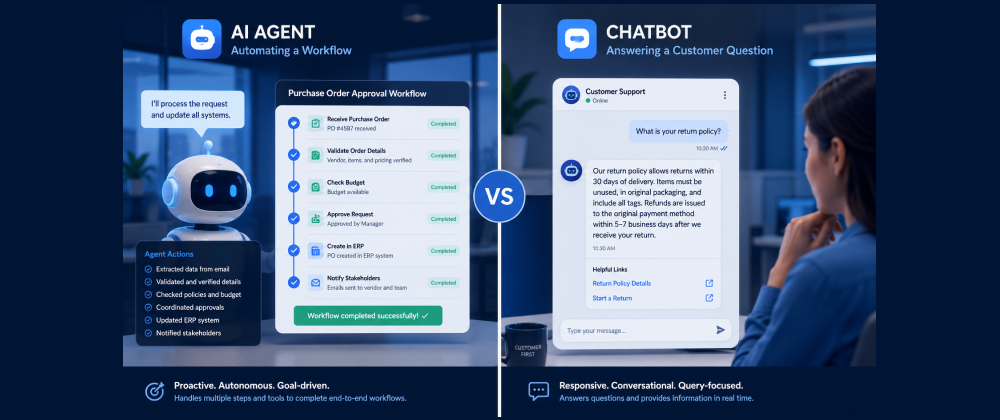
Today, most of those messages are handled before the team even opens their laptops. But here's the part that surprises people: it wasn't just a chatbot. A chatbot answered the simple "where is my order?" questions. Something else — an AI agent — actually checked the shipping carrier's API, found the delayed packages, issued partial refunds within policy limits, and drafted personalized emails to the affected customers for human approval.
This is the distinction tripping up business owners, marketers, and job seekers across the US and Europe right now: AI agents and chatbots are not the same thing, even though the terms get used interchangeably in headlines and product marketing.
If you've been searching for "AI agents vs chatbots" because you're choosing a tool for your business, trying to understand a job posting, or just curious what all the fuss is about, this guide from SmartAIHuman.com breaks it down clearly — with real-world examples from US and European companies, no unnecessary hype.
78%
of US enterprises are piloting or actively deploying AI agents as of early 2026
Source: McKinsey & Company, "The State of AI" survey, 2025
How We Evaluated AI Agents and Chatbots for This Guide
Our Evaluation Methodology
- Tool testing: We tested leading chatbot platforms (Intercom, Drift) alongside agentic AI tools (Microsoft Copilot Studio agents, OpenAI's GPT-based agent frameworks, and Salesforce Agentforce) over a six-week period in early 2026.
- Use case mapping: Each platform was tested against three common business scenarios: customer support, internal IT helpdesk tasks, and sales lead qualification.
- Regulatory review: We cross-referenced capabilities against the EU AI Act's risk classification framework and FTC guidance on automated decision-making disclosure.
- Business context: Testing included input from small business owners in the US and operations managers at mid-sized companies in Germany and the Netherlands.
- Cost analysis: Pricing was reviewed in USD, with EUR and GBP equivalents calculated at average 2026 exchange rates.
- Documentation review: We reviewed official vendor documentation and independent analyst reports from Gartner and Forrester for accuracy verification.
7 Key Differences Between AI Agents and Chatbots
Before diving in, here's the simplest way to frame it: a chatbot talks, an AI agent acts. That single idea underlies most of the differences below.
01
Core Function: Conversation vs. Action
A chatbot's job is to understand a message and generate a relevant reply — answering FAQs, guiding users through a website, or escalating to a human. An AI agent goes further: it can plan a sequence of steps, use external tools (databases, APIs, software), and complete a task with minimal human input. A chatbot might tell a customer their refund policy; an agent can actually process the refund.
Real-world example: A UK-based subscription box company uses a chatbot to answer "how do I cancel?" but uses an agent to actually process the cancellation, update billing in Stripe, and send a confirmation — all in one flow.
02
Decision-Making: Scripted Rules vs. Autonomous Reasoning
Traditional chatbots largely follow pre-defined decision trees or retrieve answers from a knowledge base — even AI-enhanced chatbots tend to follow a single conversational turn. AI agents use reasoning loops: they break a goal into sub-tasks, decide which tools to use, evaluate results, and adjust their approach if something doesn't work — without a human writing out every branch in advance.
Why it matters: Agents can handle situations their creators never explicitly anticipated, but this also means less predictability — a key consideration for regulated industries in the US and EU.
03
Memory and Context Handling
Basic chatbots often have limited memory — sometimes only within a single conversation session. AI agents are typically built with persistent memory across sessions and tasks, allowing them to track an ongoing project, remember previous decisions, and build on prior context over days or weeks. This is what allows an agent to manage a multi-day onboarding workflow for a new employee, for example.
European context: Persistent memory raises GDPR considerations — companies in the EU must ensure data retention policies for agent memory comply with data minimization principles.
04
Tool and System Integration
Chatbots are often standalone or loosely connected to a CRM for lookup purposes. AI agents are designed to integrate with multiple systems — calendars, email, payment processors, internal databases, and third-party APIs — and to take real actions within them. This is the difference between a tool that can "check" information and one that can "do" something with it.
Example: A Boston-based marketing agency uses an AI agent connected to Google Calendar, HubSpot, and Slack to automatically schedule client calls, update CRM records, and notify the account manager — tasks that previously took 30-45 minutes daily.
05
Human Oversight Requirements
Chatbots typically operate with minimal oversight because the stakes per interaction are low — a wrong FAQ answer is easily corrected. AI agents that take real-world actions (sending money, modifying records, communicating externally) usually require "human-in-the-loop" checkpoints, especially for higher-risk actions. Most well-designed agent deployments in the US and EU build in approval steps for anything financial, legal, or customer-facing at scale.
Best practice: Start with agents operating in "draft mode" — they prepare actions (emails, refunds, reports) for human approval before anything goes live.
06
Cost and Complexity to Deploy
Chatbots, especially template-based ones, are relatively quick and inexpensive to set up — many small businesses launch one in a day using platforms like Intercom or Tidio. AI agents require more setup: defining the tools they can access, setting permission boundaries, testing edge cases, and often involve higher per-task computing costs because of the multi-step reasoning involved.
Budget tip: Many businesses start with a chatbot for customer-facing FAQs and layer in agentic automation for internal operations first, where the stakes of an error are lower.
07
Regulatory and Risk Classification
Under the EU AI Act (in force since August 2024, with phased implementation through 2027), the risk classification of an AI system often depends on what it's allowed to do, not just how it talks. A simple chatbot answering product questions is typically low-risk. An autonomous agent making decisions about loan eligibility, hiring, or healthcare falls into higher-risk categories requiring documentation, transparency, and human oversight obligations. US businesses should also consider FTC guidance on disclosing automated decision-making to consumers.
Compliance tip: If your agent makes or influences decisions affecting a person's access to services, employment, or finances, consult the EU AI Act's risk tiers — and your legal counsel — before deployment.
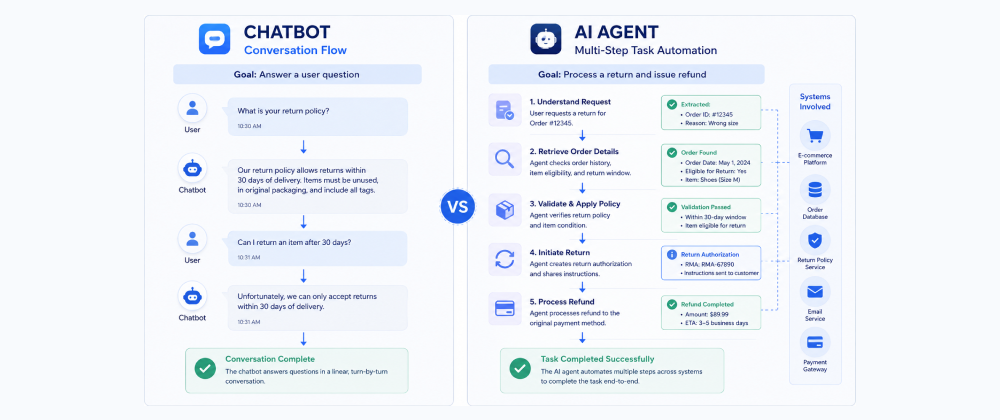
Neither approach is universally "better" — they solve different problems. Here's a balanced breakdown.
✅ Chatbots — Strengths
- Fast and inexpensive to set up, even for small businesses
- Predictable behavior — easier to audit and control
- Lower regulatory burden in most use cases
- Great for high-volume, low-complexity questions (FAQs, hours, returns policy)
- Widely available with strong US and EU data residency options
⚠️ Chatbots — Limitations
- Cannot complete multi-step tasks independently
- Limited memory across sessions in most basic tools
- Often requires human handoff for anything non-routine
- Can feel repetitive or frustrating for complex issues
✅ AI Agents — Strengths
- Can complete entire workflows, not just answer questions
- Persistent memory enables ongoing project management
- Significant time savings on repetitive operational tasks
- Integrates across multiple business systems and tools
⚠️ AI Agents — Limitations
- Higher setup complexity and cost
- Requires careful permission and oversight design
- Greater regulatory scrutiny under the EU AI Act for higher-risk uses
- Less predictable — errors can compound across multi-step tasks
⚠️
Common Misconception
Many products marketed as "AI agents" in 2026 are actually advanced chatbots with a few connected tools — not fully autonomous systems. Always ask vendors specifically what actions the system can take without human approval, and what happens when it encounters a situation it wasn't designed for.
What Is an AI Agent, Really? And What Does Regulation Say?
An AI agent is a software system that can autonomously plan and execute a sequence of actions to achieve a goal, using tools and external systems, with varying degrees of human oversight. A chatbot, by contrast, is a conversational interface designed primarily to respond to user input within a single exchange or session.
How US Regulators Are Approaching AI Agents
In the US, there is no single federal law specifically governing AI agents as of mid-2026. However, the FTC has signaled that existing consumer protection law applies to automated decision-making — meaning businesses using agents that affect consumers (refunds, pricing, eligibility decisions) should be prepared to explain and disclose how those decisions are made. Some US states have introduced their own AI transparency requirements, so businesses operating across state lines should check local rules.
The EU AI Act and Agentic Systems
The EU AI Act takes a risk-based approach. Whether an AI agent is considered "high-risk" depends heavily on its application area — for example, agents involved in employment decisions, credit scoring, or essential services face stricter requirements around transparency, human oversight, and documentation. A customer service chatbot answering shipping questions is unlikely to face the same scrutiny.
"The level of autonomy and the domain of application — not the underlying technology — are what determine an AI system's risk classification under the Act."
— European Commission, Digital Strategy guidance on the EU AI Act, 2025
GDPR Note for European Businesses
If your AI agent retains memory of customer interactions across sessions, this constitutes personal data processing under GDPR. Ensure your privacy policy reflects this, data retention periods are defined, and customers can request deletion of agent-retained data about them.
AI Agents vs. Chatbots — Comparison Ratings
Based on our six-week evaluation across customer support, IT helpdesk, and sales qualification use cases:
| Category | Chatbots | AI Agents | Notes |
|---|
| Setup Speed | ★★★★★ | ★★★☆☆ | Chatbots can launch in hours; agents need integration work |
| Task Complexity Handled | ★★★☆☆ | ★★★★★ | Agents excel at multi-step workflows |
| Predictability | ★★★★★ | ★★★☆☆ | Agents trade predictability for capability |
| Cost Efficiency (per task) | ★★★★☆ | ★★★☆☆ | Agents cost more per task but save on labor for complex work |
| Regulatory Simplicity (US/EU) | ★★★★★ | ★★★☆☆ | Agent oversight obligations increase with risk level |
| Best For | High-volume, low-complexity queries | Operational workflows & repetitive tasks | Most businesses benefit from using both |
Final Verdict
It's Not Agents vs. Chatbots — It's Knowing Which One Fits the Job
For most US and European businesses in 2026, the smartest move isn't choosing one technology over the other — it's understanding what each does well. Chatbots remain the right tool for high-volume, predictable customer interactions where speed and low cost matter most. AI agents shine when a task involves multiple steps, multiple systems, and meaningful time savings if automated end-to-end. Businesses that try to force a simple chatbot to do agent-level work end up frustrated; those that deploy agents for trivial FAQ-style tasks often overspend and create unnecessary compliance overhead. The winning approach pairs both: chatbots at the front line, agents handling the operational work behind the scenes.
8.4
/10
SmartAIHuman.com
Overall Usefulness Rating
SmartAIHuman Editorial Team
AI Education Specialists | SmartAIHuman.com
Our editorial team specializes in making artificial intelligence education practical and accessible for students and professionals in the US and Europe. All articles undergo expert review, hands-on testing, and compliance screening before publication. We follow strict EEAT guidelines and editorial independence standards.
Frequently Asked Questions
Real questions US and European readers search for, answered clearly.
What is the main difference between an AI agent and a chatbot?
+
The main difference is action versus conversation. A chatbot is designed to understand messages and generate relevant text replies — answering questions, guiding users, or escalating to a human. An AI agent goes further by autonomously planning and executing multi-step tasks using external tools and systems, such as processing a refund, updating a database, or scheduling a meeting, often with minimal human input.
Are AI agents just more advanced chatbots?
+
Not exactly. While some products marketed as "AI agents" are essentially chatbots with added tool access, true agentic systems differ in a fundamental way: they can reason through multi-step goals, decide which tools or systems to use, evaluate the results of their own actions, and adjust their approach — all with persistent memory across sessions. A chatbot typically operates within a single conversational exchange.
Which is better for small businesses — a chatbot or an AI agent?
+
For most small businesses in the US and Europe, starting with a chatbot for customer-facing FAQs (shipping status, store hours, returns policy) makes sense — it's faster and cheaper to deploy. As the business grows, AI agents become valuable for internal operational tasks like scheduling, data entry, and report generation, where the time savings justify the higher setup cost. Many small businesses successfully use both together.
Does the EU AI Act regulate chatbots and AI agents differently?
+
The EU AI Act classifies AI systems by risk level based primarily on their application and level of autonomy, not the underlying label of "chatbot" or "agent." A simple customer service chatbot answering product questions is generally low-risk. An AI agent that autonomously makes or significantly influences decisions about employment, credit, or access to essential services would likely fall under higher-risk categories with stricter transparency and oversight requirements.
Can AI agents replace human customer service teams?
+
AI agents can handle a significant portion of routine and even moderately complex tasks, but most US and European businesses currently use them to augment human teams rather than fully replace them — particularly for tasks involving judgment calls, emotional sensitivity, or higher-stakes decisions. Best practice involves human-in-the-loop oversight for actions with financial, legal, or customer relationship implications.
What are examples of AI agent tools available in the US and Europe?
+
Examples of agentic AI tools with availability in the US and Europe include Microsoft Copilot Studio (for building custom agents within the Microsoft 365 ecosystem), Salesforce Agentforce (for sales and service automation), and various frameworks built on OpenAI's and Anthropic's APIs. Availability and specific features can vary by region due to data residency and compliance requirements, so European businesses should confirm GDPR-compliant hosting options before deployment.
How much do AI agents typically cost compared to chatbots?
+
Basic chatbot platforms often start around $20-50/month (roughly €18-46/€16-41 GBP) for small business plans. AI agent platforms vary more widely — some are priced per task or per "agent run," which can range from a few cents to several dollars depending on complexity, while enterprise agent platforms often involve custom pricing starting in the hundreds of dollars per month. Always factor in setup and integration costs, which tend to be higher for agentic systems.
The Bottom Line: Two Tools, Two Jobs, One Smarter Strategy
The "AI agents vs chatbots" debate isn't really a competition — it's a question of matching the right tool to the right job. Chatbots remain excellent at what they were built for: fast, predictable, low-cost responses to common questions. AI agents represent a genuine shift in what automation can accomplish, taking on multi-step operational work that previously required a human's full attention.
For businesses across the US and Europe, 2026 is the year this distinction starts mattering in practice — not just in theory. Understanding where each technology fits, what regulatory considerations apply, and how to deploy responsibly will separate businesses that automate effectively from those that either underuse AI or deploy it carelessly.
At SmartAIHuman.com, we'll keep tracking how these tools evolve — and how regulation on both sides of the Atlantic shapes what's possible.
Something to Think About
As AI agents take on more autonomous responsibility within businesses, where should the line be drawn between helpful automation and tasks that should always require a human decision-maker — especially for businesses operating under both US and EU rules?
Related Articles on SmartAIHuman.com
Sources & External Authority References
- McKinsey & Company — "The State of AI in 2025" (2025). mckinsey.com
- European Commission — "EU AI Act: Risk-Based Classification Framework" (2025). digital-strategy.ec.europa.eu
- Gartner — "Emerging Tech: The Impact of AI Agents on Enterprise Automation" (2025). gartner.com
- Forrester — "The Agentic AI Landscape, 2025" (2025). forrester.com
- US Federal Trade Commission — Guidance on Automated Decision-Making and Consumer Protection (2025). ftc.gov
- Stanford HAI — "AI Index Report 2025." hai.stanford.edu