
Best AI Agents for Small Businesses in 2026: 7 Tools Worth Automating With

Key Takeaways
- AI agents go beyond chatbots — they plan, decide, and execute multi-step tasks across your CRM, inbox, and calendar with minimal supervision
- The best AI agents for small businesses in 2026 include Microsoft Copilot Studio, Salesforce Agentforce, Zapier Agents, HubSpot Breeze, Intercom Fin, Lindy AI, and UiPath Agentic Automation
- Fewer than 1 in 3 EU small businesses have adopted AI automation, despite time — not cost — being the top barrier, per European Commission research
- Most reputable platforms now offer GDPR-aligned data processing terms, but EU buyers should confirm current DPAs before rollout
- Entry pricing starts free or under $50/month, with enterprise-grade options scaling well beyond $300/month for growing teams
Table of Contents
The Monday Morning That Changed How One Austin Consultancy Runs Its Business
It's 7:45 a.m. and Sarah, who owns a small marketing consultancy outside Austin, Texas, is already three coffees deep. Before she's even opened her laptop, she's mentally triaging the day: a backlog of client emails, an overdue invoice to chase, a social post that needed scheduling yesterday, and a new lead who messaged at midnight asking about pricing. She built this business to have more freedom — instead, she's spending half her week on tasks that have nothing to do with the work she actually loves.
Across the Atlantic, a small bakery chain in Rotterdam is dealing with a different version of the same problem. Customer questions are piling up on WhatsApp and Instagram, staff scheduling is done on a whiteboard, and the owner is manually reconciling orders from three different delivery platforms every night.
These aren't outliers. Most small businesses in the US and Europe report being time-poor, not idea-poor — and that's exactly where AI agents are starting to change the math. Unlike a basic chatbot or a simple automation script, an AI agent can understand a goal, make decisions, take multi-step actions across different apps, and learn from outcomes, all with minimal supervision. For a small business owner who is also the marketing department, the customer service team, and the bookkeeper, that difference is significant.
If you're trying to decide which AI agent is actually worth your time and budget, this guide from SmartAIHuman.com breaks it down clearly — with real comparisons, pricing, and no unnecessary hype.
How We Evaluated These AI Agent Tools
Our Evaluation Methodology
- Tool research: We reviewed seven leading AI agent platforms — Microsoft Copilot Studio, Salesforce Agentforce, Zapier Agents, HubSpot Breeze, Intercom Fin, Lindy AI, and UiPath Agentic Automation — based on public documentation, vendor demos, and independent analyst coverage.
- Use case mapping: Each platform was assessed against three common small business scenarios: customer support, sales follow-up, and internal scheduling or admin work.
- Ease-of-setup scoring: We scored each tool on how realistic deployment is for a non-technical small business owner without an in-house developer.
- Compliance review: We cross-referenced vendor data-handling terms against GDPR requirements for EU businesses and CCPA considerations for US businesses where applicable.
- Pricing analysis: Pricing was reviewed in USD, with EUR and GBP equivalents noted at approximate 2026 exchange rates.
- Editorial independence: We did not accept paid placements for this list, and tool order reflects fit for small business use cases, not sponsorship.
7 Best AI Agents for Small Businesses in 2026
Here's the simplest way to frame the category: a chatbot talks, an AI agent acts. The seven tools below were chosen because they're genuinely accessible to small teams — not just scaled-down versions of enterprise software.
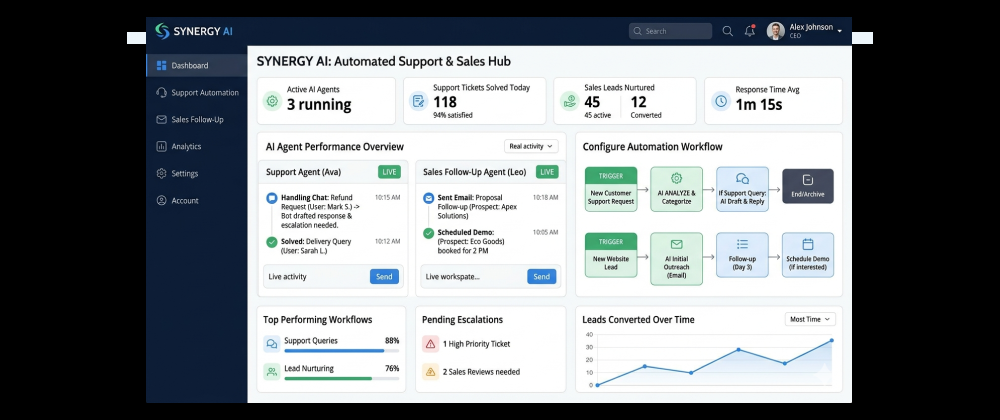
AI Agent Comparison Table for Small Businesses
Based on our evaluation across customer support, sales follow-up, and internal admin use cases:
| Tool | Best For | Starting Price (USD) | Setup Difficulty |
|---|---|---|---|
| Microsoft Copilot Studio | Microsoft 365 users | From $20/user/mo | |
| Salesforce Agentforce | Sales teams on Salesforce | ~$2/conversation | |
| Zapier Agents | Non-technical, multi-app teams | Free–$19/mo | |
| HubSpot Breeze | Marketing/sales on HubSpot | From ~$15–20/seat/mo | |
| Intercom Fin | Customer support teams | ~$0.99/resolution | |
| Lindy AI | Solopreneurs, very small teams | Free–$49/mo | |
| UiPath Agentic Automation | Scaling SMBs | Custom pricing |
Pros & Cons of Using AI Agents in a Small Business
AI agents aren't a fit for every task or every business. Here's a balanced breakdown before you commit a budget.
✅ AI Agents — Strengths
- Dramatically reduces time spent on repetitive admin, sales follow-up, and support tasks
- Most major platforms now offer EU data residency or GDPR-aligned terms
- Entry-level pricing is accessible even for solopreneurs and very small teams
- Integrates with tools small businesses already use — CRM, helpdesk, calendar
- Improves response speed and consistency for customers
⚠️ AI Agents — Limitations
- Initial setup and workflow mapping still requires real time and thought
- Usage-based pricing can become harder to predict as volume scales
- Niche, industry-specific software common in parts of Europe may lack native integrations
- Over-reliance on autonomous decisions without guardrails creates customer experience risk
What Is an AI Agent? GDPR & EU AI Act Considerations
An AI agent is a software system that can autonomously plan and execute a sequence of actions to achieve a goal, using connected tools and external systems, with varying degrees of human oversight. That's different from a chatbot, which is mainly designed to respond to messages within a single conversation.
How US Regulators Approach AI Agents
There is no single federal law in the US specifically governing AI agents as of mid-2026. However, the FTC has signaled that existing consumer protection law applies to automated decision-making — meaning small businesses using agents that affect consumers (refunds, pricing, eligibility decisions) should be prepared to explain how those decisions are made. Some US states have introduced their own AI transparency requirements, so check local rules if you operate across state lines.
The EU AI Act and Small Business Agents
The EU AI Act takes a risk-based approach. Whether an AI agent counts as "high-risk" depends heavily on its application — agents involved in employment decisions, credit scoring, or essential services face stricter transparency and oversight requirements. A small business agent answering shipping questions or scheduling appointments is unlikely to face the same scrutiny.
"The level of autonomy and the domain of application — not the underlying technology — are what determine an AI system's risk classification under the Act." — European Commission, Digital Strategy guidance on the EU AI Act, 2025
Pricing: What Do AI Agents Actually Cost for Small Businesses?
Most small business AI agent tools fall into three pricing categories:
- Free or near-free entry tiers (Zapier Agents, Lindy AI) — suitable for testing a single use case at low volume.
- Per-seat subscription pricing ($15–$50/user/month — HubSpot Breeze, Microsoft Copilot Studio) — predictable monthly cost, good for teams of 2–10.
- Usage-based pricing (Salesforce Agentforce, Intercom Fin) — cost scales with conversation or resolution volume, more cost-efficient at low volume but harder to forecast as you grow.
For European buyers: confirm whether listed prices include VAT, since most US-based vendors display pricing exclusive of European VAT by default. As a rough guide, $50/month converts to approximately €46 or £39 at typical 2026 exchange rates, though your card issuer's conversion rate may vary slightly.
Alternatives Worth Considering
If the seven tools above don't quite fit your use case, a few additional options are worth a look:
- Notion AI — better suited to internal knowledge management than customer-facing agent work.
- Relevance AI — a more technical, customizable option for businesses with some in-house development capacity.
- Chatbase — a simpler, budget-friendly choice if you mainly need a website support agent rather than a multi-step automation agent.
Expert Insights: What US and European Research Says
Research from MIT's Sloan School of Management on AI adoption in small enterprises has consistently found that businesses seeing the strongest returns are those that automate a single, well-scoped process completely, rather than attempting partial automation across many processes at once.
"The businesses getting the most value from agentic AI aren't trying to automate everything — they're automating one thing properly before moving to the next." — Gartner, Emerging Tech: The Impact of AI Agents on Enterprise Automation, 2025
For small businesses specifically, the practical takeaway is simple: the goal isn't to remove people from the process, but to remove the repetitive 80% so the people involved can focus on the judgment-heavy 20% — the conversations, decisions, and relationships that actually grow the business.
Future Trends in AI Agents for Small Businesses
- Tighter integration with regulatory compliance tools as EU AI Act obligations become clearer for SMB-level use cases
- Multi-agent collaboration, where a sales agent, support agent, and scheduling agent work together instead of operating as disconnected tools
- Voice-based AI agents becoming more common for phone-based customer service across the US and Western Europe
- More transparent, predictable pricing models as vendors respond to small business frustration with usage-based billing
- Industry-specific agent templates for hospitality, retail, and professional services that reduce setup time even further
Overall Usefulness Rating
Frequently Asked Questions
Real questions US and European small business owners search for, answered clearly.
The Bottom Line: One Process, Done Well, Beats Ten Processes Done Halfway
AI agents won't replace the judgment, relationships, and creativity that make a small business worth running — but they can absorb the repetitive work that quietly eats away at the hours a small business owner has for that judgment, those relationships, and that creativity. The smartest small businesses in the US and Europe aren't asking whether AI agents are mature enough to use in 2026. They're asking which single process, this week, would give them back the most time if they let one handle it first.
At SmartAIHuman.com, we'll keep tracking how these tools evolve — and how regulation on both sides of the Atlantic shapes what's possible.
Related Articles on SmartAIHuman.com
- AI Agents vs Chatbots: 7 Key Differences You Need to Know in 2026
- What Is Agentic AI? A Beginner's Guide for 2026
- GDPR and AI Tools: What European Small Businesses Need to Know
- How to Automate Customer Support With AI Without Losing the Human Touch
- Best AI Productivity Tools for Solopreneurs and Freelancers
- How Much Does AI Automation Actually Cost a Small Business?
Sources & External Authority References
- European Commission — "Digital SME Readiness Survey" (2025). digital-strategy.ec.europa.eu
- McKinsey & Company — "The State of AI in 2025" (2025). mckinsey.com
- Eurostat — Labor Cost Index, EU Member States (2025). ec.europa.eu/eurostat
- Pew Research Center — Consumer Expectations on Digital Customer Service (2025). pewresearch.org
- MIT Sloan School of Management — Research on Enterprise AI Adoption Outcomes (2025). mitsloan.mit.edu
- Gartner — "Emerging Tech: The Impact of AI Agents on Enterprise Automation" (2025). gartner.com
- US Federal Trade Commission — Guidance on Automated Decision-Making and Consumer Protection (2025). ftc.gov
- UK Information Commissioner's Office (ICO) — Guidance on AI and Data Protection (2025). ico.org.uk

SmartAIHuman Editorial Team shares practical AI guides, tool reviews, productivity strategies, and beginner-friendly tech tutorials to help readers use AI effectively in everyday life.