What Is an AI Agent? A Beginner's Guide to How AI Agents Work in 2026

It's a Tuesday morning in Denver, and Maria, a marketing manager at a mid-sized software company, opens her laptop to find her inbox already organized, three follow-up emails drafted for her review, and a competitor research summary waiting in her project folder. She didn't ask for any of it the night before — at least not directly. She'd simply told a tool, once, what her weekly priorities were.
Across the Atlantic, in Rotterdam, a small e-commerce business owner is having a similar experience. Customer support tickets are being triaged, refund requests under €50 are processed automatically, and a short summary of "issues that need a human" lands in his Slack channel each morning.
Neither of these people wrote a single line of code. What they're using is often described with one buzzy term: an Ai Agent .
If you've seen this phrase everywhere lately — in tech newsletters, on LinkedIn, in your company's all-hands meeting — but you're still not entirely sure what makes an AI agent different from a chatbot or a regular AI assistant, you're not alone. This guide breaks it down in plain English, with real examples from the US and Europe, so you can understand exactly what AI agents are, how they work, who's already using them, and how to take your first step.
Key Takeaways
- An AI agent can plan, act, and adjust across multiple steps to complete a goal — unlike a chatbot, which mostly answers one question at a time.
- Major platforms used across the US and EU — including Microsoft Copilot Studio, Salesforce Agentforce, SAP Joule, UiPath, and Zapier — now offer built-in agent features.
- AI agents work best on repetitive, well-defined tasks — with a human reviewing anything involving customer data, money, or hiring decisions.
- The EU AI Act and GDPR shape how AI agents can be used in Europe, especially for "high-risk" use cases like hiring or credit decisions.
- You can start using an AI agent today through tools your business may already pay for — no coding required.
What Is an AI Agent?
An Ai Agent is a software program that can perceive information, make decisions, and take actions on its own — across multiple steps — in order to complete a goal, with little or no human input along the way.
Unlike a basic chatbot, which mostly responds to one message at a time, an AI agent can plan a sequence of actions, use external tools (like your calendar, email, or a database), check its own progress, and adjust if something doesn't go as expected.
AI Agent vs. AI Assistant vs. Chatbot
These three terms get used interchangeably, which causes a lot of confusion. Here's a side-by-side comparison that should clear things up.
| Feature | Chatbot | AI Assistant | AI Agent |
|---|---|---|---|
| Typical interaction | One question, one answer | Conversational, can remember context | Given a goal, works through multiple steps |
| Uses external tools | Rarely | Sometimes (e.g., calendar lookup) | Frequently — apps, APIs, browsers, databases |
| Decision-making | Pre-scripted responses | Limited, mostly reactive | Plans, executes, and adapts independently |
| Example use case | Answering FAQs on a website | Setting a reminder or answering a question | Researching, drafting, and scheduling a client follow-up sequence |
Why AI Agents Matter in 2026
AI agents matter now because the underlying technology has crossed a practical threshold: the AI models powering them have become reliable enough to follow multi-step instructions, and the business software people already use — Microsoft 365, Salesforce, SAP, Google Workspace — has started building agent features directly into everyday tools.
For US businesses, this shift is arriving at a moment when remote and hybrid work have made async, self-managing workflows the norm rather than the exception. An agent that triages your inbox overnight fits naturally into a culture where teams are spread across time zones.
For European businesses, the timing overlaps with the rollout of the EU AI Act, which means companies adopting agentic AI now are also building the documentation and oversight habits they'll need for compliance — making early, careful adoption a genuine competitive advantage rather than just a productivity perk.
Analysts at Gartner have highlighted agentic AI as one of the defining enterprise technology trends shaping strategic planning for the next several years, with organizations expected to increasingly delegate routine decision-making to AI systems under human governance.
Main Features and Core Concepts
While the underlying technology can get complex, most AI agents follow a similar four-part cycle. Understanding this loop is the key to understanding everything else in this guide.
- Perceive: The agent receives information — this could be a written instruction from you, data from an app, an email, or a sensor reading.
- Reason and plan: Using a large language model (LLM) as its "brain," the agent breaks the goal down into smaller steps and decides what needs to happen first.
- Act: The agent takes action — this might mean searching the web, writing a document, sending an email, updating a spreadsheet, or calling another piece of software through an API.
- Learn and adjust: The agent checks the result of its action. If something is missing or incorrect, it revises its plan and tries again, often without asking you first.
This cycle can repeat dozens of times for a single task. For example, an AI agent asked to "prepare a competitor pricing report" might search several websites, extract pricing data, organize it into a table, and flag anything unusual — all in one continuous run.
 AI agent workflow infographic illustrating the continuous perceive, plan, act, and learn cycle.
Types of AI Agents
Not all AI agents are built the same way. Here are the main categories you'll encounter, ranked from simplest to most advanced.
- Simple reflex agents: React to specific inputs with pre-defined responses — no memory, no planning. A thermostat that turns on heating below a set temperature is a basic (non-AI) example of this concept.
- Model-based agents: Keep an internal "model" of their environment, allowing decisions based on context rather than just the current input — like a smart home system that adjusts lighting based on time of day and occupancy.
- Goal-based agents: Given an end goal, they work backward to figure out the steps needed to reach it. Most modern AI agents — including those built into Microsoft Copilot Studio or Salesforce Agentforce — fall here.
- Learning agents: Improve their performance over time based on feedback. If a learning agent's draft emails are repeatedly edited the same way, it can adjust its future writing style to match.
- Multi-agent systems: Instead of one agent doing everything, multiple specialized agents work together — one might research, another writes, and a third checks for errors — coordinating like a small team.
Benefits of AI Agents
For both individuals and businesses across the US and Europe, AI agents offer a meaningful step up from traditional automation and basic chat tools.
- Significant time savings on repetitive, multi-step tasks like research, reporting, and scheduling.
- Cross-tool coordination — an agent can move between your inbox, calendar, and CRM without manual handoffs.
- Around-the-clock progress, which suits flexible and remote work cultures common across the US and EU.
- Fewer manual errors in routine processes such as data entry and invoice matching.
- Scalability for small teams, allowing growing businesses to handle more volume without immediately hiring.
Real-World Use Cases
The use cases for AI agents vary by industry, but a few patterns are showing up consistently across American and European companies.
- Customer support triage: Agents categorize incoming tickets, resolve simple requests, and route complex issues to human agents — common among UK and German e-commerce companies.
- Sales and marketing research: Agents gather information on prospects, draft personalized outreach, and update CRM records automatically.
- HR and recruiting support: Agents screen resumes against job criteria and schedule interviews, while still requiring human sign-off for compliance with EU employment law.
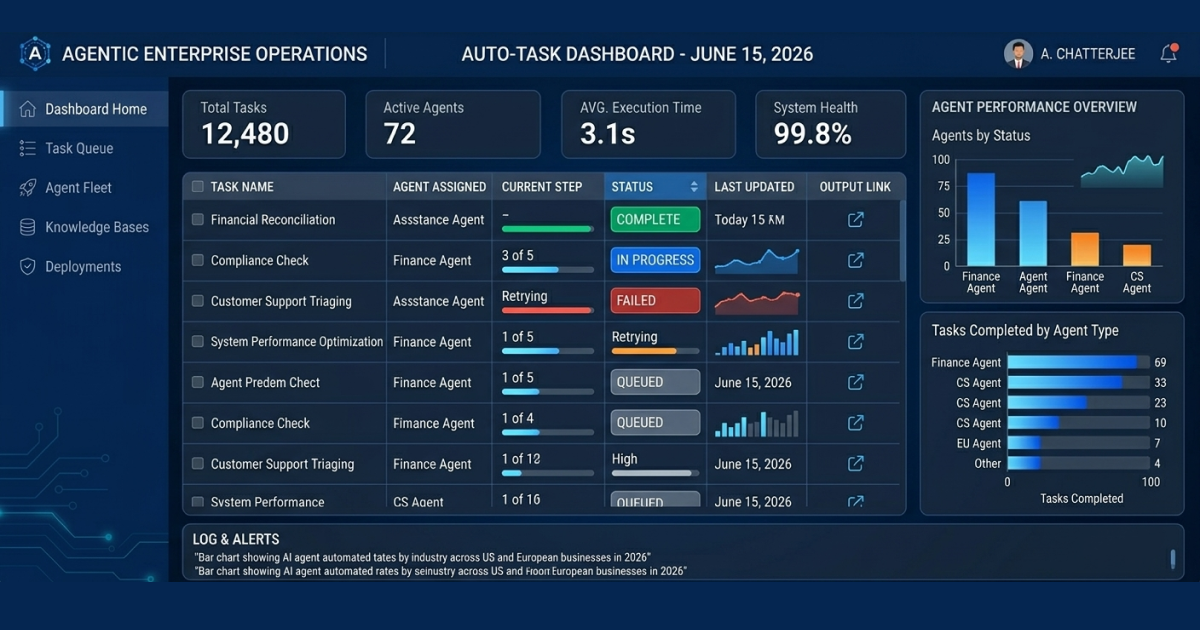
- Finance and operations: Agents reconcile invoices, flag anomalies, and prepare draft reports for finance teams in companies across the US and continental Europe.
- Student and personal productivity: University students in the US and UK are increasingly using agent-style tools to organize research, summarize readings, and manage study schedules.
How to Get Started with AI Agents
If you're ready to try an AI agent for yourself or your business, here's a simple way to begin without feeling overwhelmed.
- Start with one repetitive task. Pick something you do often, like sorting emails or drafting weekly reports.
- Choose a tool already connected to your workflow. Many businesses begin with agent features inside tools they already use, such as Microsoft 365 or Salesforce.
- Set clear boundaries. Define what the agent can and cannot do without your approval — especially for anything involving money, customer data, or sending messages externally.
- Review the first few results closely. Treat the first week like training a new team member — check the work before trusting it fully.
- Document what works. Keep notes on which tasks the agent handles well, so you can expand its responsibilities gradually.

Best Tools and Solutions for AI Agents
The tools below are all fully available to US and European users and represent some of the most practical entry points into agentic AI, ranging from enterprise platforms to small-business-friendly automation tools.
Microsoft Copilot Studio
Lets businesses build custom agents that work across Microsoft 365 — summarizing meetings, drafting follow-up tasks, and automating approvals. A natural starting point for organizations already using Microsoft 365 in the US or EU.
Salesforce Agentforce
Built for customer service and sales teams, Agentforce handles routine inquiries autonomously and escalates complex issues to human staff, integrating directly with existing Salesforce CRM data.
SAP Joule
Developed by SAP, headquartered in Walldorf, Germany, Joule brings agentic capabilities into SAP's enterprise resource planning software, helping European businesses automate finance and supply chain tasks.
UiPath Agentic Automation
UiPath combines its established robotic process automation (RPA) platform with AI agents to handle end-to-end business processes, from invoice processing to compliance checks, with strong adoption across US and EU enterprises.
Zapier Agents
A more accessible entry point for small businesses, Zapier's agent features let non-technical users connect everyday apps (email, spreadsheets, calendars) and assign an agent to handle multi-step workflows between them.
Comparison Table: Top AI Agent Platforms
| Platform | Best For | Key Strength | Setup Difficulty |
|---|---|---|---|
| Microsoft Copilot Studio | Teams already using Microsoft 365 | Deep integration with Outlook, Teams, and Office apps | Moderate |
| Salesforce Agentforce | Sales and customer service teams | Native CRM data access | Moderate to High |
| SAP Joule | Mid-size to large enterprises on SAP | Finance and supply chain automation | High (enterprise rollout) |
| UiPath Agentic Automation | Process-heavy industries (finance, logistics) | Combines RPA reliability with AI reasoning | Moderate to High |
| Zapier Agents | Small businesses and solo professionals | Easiest no-code setup | Low |
Pros and Cons of AI Agents
Like any technology, AI agents come with real advantages — and real limitations worth understanding before you rely on them for important work.
Pros
- Saves significant time on repetitive, multi-step tasks
- Works across multiple apps and tools without manual handoffs
- Operates outside normal working hours, suiting flexible/remote work cultures
- Reduces human error in routine processes like data entry
- Scales easily for small teams and growing businesses
Cons
- Can make confident-sounding mistakes that require human review
- Requires careful setup of permissions and data access
- Raises data privacy questions, especially under GDPR in the EU
- May need ongoing oversight to avoid "automation drift" over time
- Not all agents integrate well with legacy business software
Pricing: What AI Agent Tools Cost
Pricing for AI agent platforms varies widely depending on whether you're an individual, a small business, or an enterprise. The figures below are general starting ranges as of mid-2026 — always confirm current pricing directly with the vendor, since enterprise quotes are often customized.
| Tool | Typical Starting Price (USD) | Approx. EUR / GBP | Notes |
|---|---|---|---|
| Zapier Agents | From around $19.99–$69/month | ~€18–64 / £16–55 | Agent features included in higher-tier plans |
| Microsoft Copilot Studio | Add-on pricing, often $200+/month per tenant | ~€185+ / £160+ | Usually requires an existing Microsoft 365 subscription |
| Salesforce Agentforce | Consumption-based, often quoted per conversation | Varies by contract | Priced on top of existing Salesforce licenses |
| SAP Joule | Bundled into enterprise contracts | Custom quote | Typically included with SAP S/4HANA Cloud agreements |
| UiPath Agentic Automation | Custom enterprise pricing | Custom quote | Often priced per automation/process volume |
Alternatives to AI Agents
If a full AI agent feels like too big a step right now, there are simpler alternatives that still offer meaningful productivity gains:
- Traditional automation (RPA without AI): Tools that follow fixed, pre-programmed steps — predictable, but unable to adapt when something changes.
- AI assistants and chatbots: Conversational tools that answer questions or draft text on request, without taking multi-step actions on their own.
- Workflow templates and checklists: Standardizing a repetitive process manually before automating it often makes the eventual transition to an AI agent smoother.
- Virtual assistant services: For businesses not ready for AI-driven automation, human virtual assistants remain a flexible option, particularly for tasks requiring nuanced judgment.
Expert Insights
Researchers at institutions including MIT and Stanford have studied how autonomous AI systems plan and execute multi-step tasks, noting that while these systems show strong capabilities in structured environments, performance can vary significantly when tasks require judgment calls or incomplete information. Industry analysts at firms such as Gartner have also pointed out that organizations adopting agentic AI tend to see the best results when they pair automation with clear human oversight processes — a theme echoed throughout this guide.
Future Trends
Several developments are shaping how AI agents will evolve over the next few years for US and European users:
- More multi-agent collaboration: Instead of a single general-purpose agent, expect to see teams of specialized agents working together on complex projects.
- Tighter integration with everyday software: Email clients, browsers, and productivity suites are increasingly building agent capabilities directly into their products.
- Stronger emphasis on transparency: Driven partly by the EU AI Act, expect agent platforms to offer clearer logs of what actions an agent took and why.
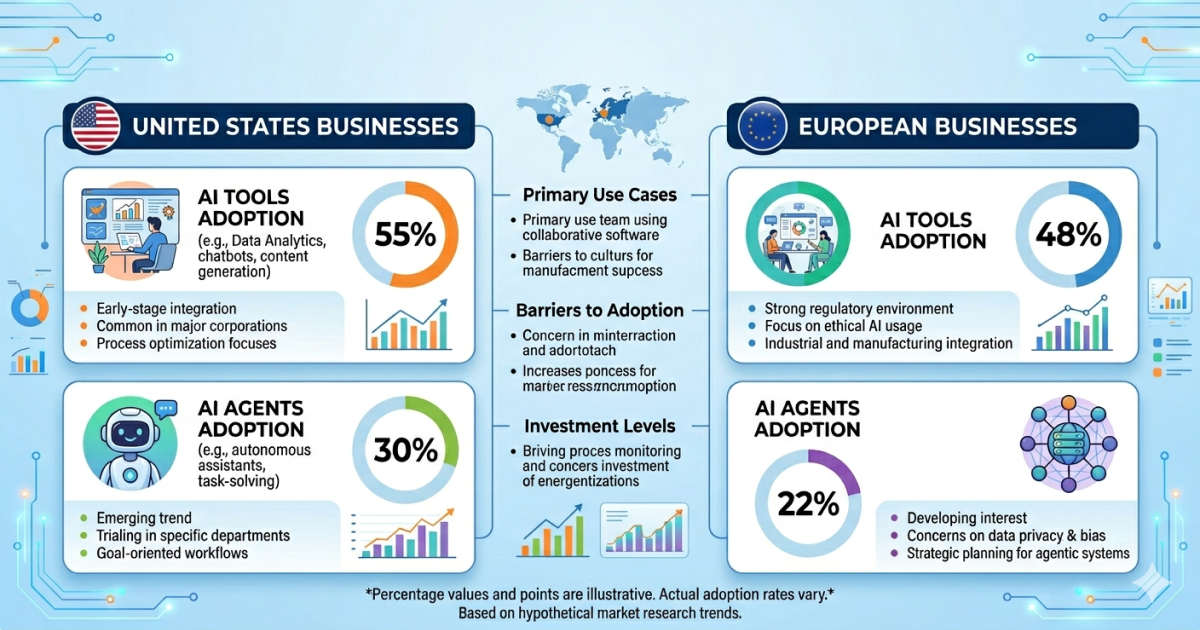
- Wider adoption among small businesses: As tools become more affordable and easier to set up, smaller companies across the US and Europe are expected to adopt agentic AI for day-to-day operations, not just large enterprises.
Frequently Asked Questions
Not exactly. ChatGPT is primarily a conversational AI tool that responds to prompts. An AI agent can be built using a model like the one behind ChatGPT, but it goes further by taking multi-step actions — like browsing, using apps, or completing tasks — without needing a new prompt for every step.
They can be, when set up with clear permissions and human review for sensitive actions. For businesses in the EU, this also means ensuring any AI agent handling personal data complies with GDPR. Starting with low-risk, repetitive tasks is the safest approach.
No. Many AI agent tools available to US and European users — including features built into Microsoft 365, Salesforce, and Zapier — are designed for non-technical users through visual setup screens and natural-language instructions.
Traditional robotic process automation (RPA) follows fixed, pre-programmed steps. AI agents add reasoning — they can interpret goals, adapt when something changes, and make decisions within boundaries you set, rather than simply repeating a fixed script.
AI agents are generally best suited to handling repetitive components of a role rather than entire jobs. Most current adoption in the US and EU focuses on freeing up time for higher-value work, though the long-term impact on specific roles will depend on the industry and how organizations choose to implement the technology.
Yes, particularly for AI agents used in higher-risk areas such as hiring, credit scoring, or essential public services. The EU AI Act introduces a risk-based framework, and businesses operating in or serving the EU should expect additional transparency and documentation requirements for these use cases.
A good starting point is email or calendar management — for example, having an agent draft replies to common questions or summarize your inbox each morning. It's low-risk, easy to review, and gives you a feel for how the technology behaves before expanding to more complex tasks.
Final Verdict
Our Take
AI agents represent a meaningful step beyond simple chatbots and assistants — they can plan, act, and adjust across multiple steps with minimal supervision. For US and European individuals and businesses, the technology is genuinely useful today for well-defined, repetitive tasks, but it works best as a collaborator with oversight, not a fully unsupervised replacement for human judgment — particularly where customer data, finances, or compliance are involved.
| Criteria | Assessment | Rating (out of 5) |
|---|---|---|
| Ease of understanding for beginners | Concept is approachable once broken into the perceive-plan-act-learn cycle | 4.5 |
| Practical usefulness (current state) | Strong for repetitive, well-defined tasks across business and personal use | 4.3 |
| Regulatory clarity (US/EU) | Improving, but evolving — especially under the EU AI Act | 3.6 |
| Accessibility for small businesses | Increasingly available through existing software subscriptions | 4.2 |
Conclusion
AI agents aren't science fiction — they're already quietly handling parts of the workday for professionals in Denver, Rotterdam, Manchester, and countless other cities across the US and Europe. The core idea is simple: instead of asking AI a question and waiting for an answer, you're handing it a goal and letting it work through the steps, with you staying in control of the boundaries.
As tools become more accessible and regulations like the EU AI Act bring more clarity, the gap between "people who use AI agents" and "people who don't" is likely to widen — much like the gap between people who learned to use spreadsheets early and those who didn't. The real question worth sitting with is this: what's one repetitive task in your week that you'd be comfortable handing off first?
For more beginner-friendly breakdowns of AI tools and concepts, explore the growing library of guides on SmartAIHuman.com.
Sources and Further Reading
- European Commission — EU Artificial Intelligence Act overview
- ICO (UK Information Commissioner's Office) — Guidance on AI and data protection
- US Federal Trade Commission (FTC) — Guidance on AI and consumer protection
- MIT — Research on autonomous AI systems and task planning
- Gartner — Reports on enterprise adoption of agentic AI
- Eurostat — Digital economy and AI adoption statistics for the EU

SmartAIHuman Editorial Team shares practical AI guides, tool reviews, productivity strategies, and beginner-friendly tech tutorials to help readers use AI effectively in everyday life.