
AI and NVIDIA: How One Chipmaker Became the Engine of the AI Boom
Key Takeaways
- NVIDIA’s GPUs, networking gear and CUDA software together form the default platform used to train and run modern AI models.
- In the quarter it reported on August 26, 2026, NVIDIA posted $96.2 billion in revenue, including $89.0 billion from Data Center, up 117% year over year (Source: NVIDIA).
- Networking is a growth engine too: in the prior quarter, NVIDIA’s data center networking revenue hit $14.8 billion, up 199% year over year.
- Competition is real but uneven: AMD, Google’s TPUs and Amazon’s Trainium are gaining ground, yet IDC’s estimate, as reported, still puts NVIDIA near 81% of the AI accelerator market.
- Europe is buying in on its own terms: sovereign AI clouds such as Deutsche Telekom’s Industrial AI Cloud keep data in-region while running on NVIDIA hardware.
- Electricity is the real bottleneck: the IEA projects global data centre demand reaching roughly 945 TWh by 2030, and about 20% of planned projects could face grid-related delays.
Table of Contents
Why Does Every AI Story Seem to Lead Back to One Chipmaker?
Picture an operations manager at a mid-sized machine-parts maker near Stuttgart. Her board has just asked for an “AI strategy.” Within a week, every deck she opens (the cloud provider’s, the ERP vendor’s, the robotics startup’s) carries the same name somewhere in the fine print: NVIDIA.
She doesn’t build chips. She doesn’t train models. Yet this one company’s roadmap seems to decide what her AI projects will cost, how fast they will run and when they can start. The same feeling hits a student in Ohio choosing a machine-learning course, or a founder in Manchester pricing GPU time for a prototype.
Most explanations don’t help much. They are either stock-market chatter or engineering jargon, and neither answers the practical questions: what does NVIDIA actually sell, why does AI depend on it, and where are the weak spots? This guide answers all three in plain English. And the surprising part of the story isn’t the chip at all. It’s everything wrapped around it.
How We Researched This Guide
Our Research Methodology
- Primary financial sources: We reviewed NVIDIA’s first- and second-quarter fiscal 2027 earnings releases and call transcripts (published May 20 and August 26, 2026) in October 2026.
- Cross-checking: Every figure was compared against independent trade and financial coverage. Where reports differed, we used NVIDIA’s own release and labeled third-party numbers as estimates.
- Industry and academic framing: Energy and infrastructure claims were checked against the International Energy Agency’s Energy and AI analysis; competitive claims against IDC’s reported market-share estimate and company announcements.
- Compliance review: We checked the EU AI Act timeline after the 2026 Digital Omnibus agreement and the GDPR angle of sovereign cloud offerings.
- Transparency note: This is a desk-research guide. We did not benchmark hardware ourselves, and our star ratings in the comparison table are editorial judgments, not lab results.
What Is NVIDIA’s Role in AI? The Core Concepts Explained
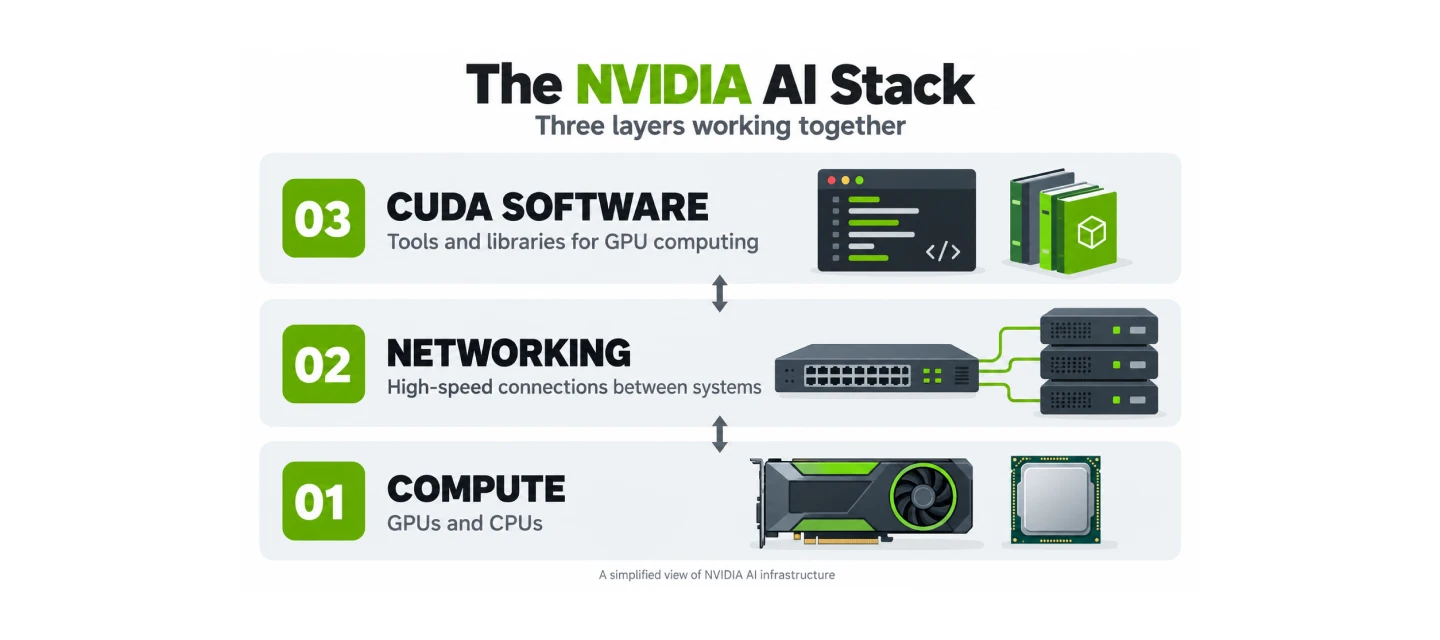
NVIDIA is a US computing company whose graphics processing units (GPUs), networking hardware and CUDA software make up the main platform used to train and run today’s AI models. It started in video-game graphics and became the backbone of AI because neural networks need huge numbers of simple calculations done at the same time, which is exactly what GPUs were built to do.
Three layers work together, and understanding them explains almost every headline you’ll read about the company.
Why AI and NVIDIA Matter in 2026
The scale has changed. NVIDIA reported $81.6 billion in revenue for the quarter ended April 26, 2026, then $96.2 billion for the next quarter, and guided to about $108 billion, plus or minus 2%, for the one after. That outlook assumes no Data Center compute revenue from China, so the growth comes from everywhere else.
Behind those numbers is spending by the biggest cloud companies. On its August call, NVIDIA’s finance chief pointed to hyperscaler capital expenditure of nearly $800 billion in 2026 and about $1.3 trillion in 2027 among the top five customers, and the company described its own outlook for fiscal 2028 (roughly 70% growth) as supply-constrained. In other words, demand is currently outrunning what can be built.
Benefits of the NVIDIA AI Platform for US and EU Businesses
You don’t have to buy a single chip to benefit from this ecosystem. Most readers will meet NVIDIA hardware indirectly, through the clouds and tools they already use.
- Availability everywhere: The same platform runs at the big US clouds, at European providers and in sovereign setups, so skills and code transfer between them.
- Deep talent pool: Because CUDA is so widespread, hiring or training people who can work on it is easier than for newer alternatives.
- Mature tooling: Frameworks, libraries and pretrained models are routinely optimized for NVIDIA first.
- Data-residency options in Europe: Providers such as Deutsche Telekom host NVIDIA-based AI inside Germany, which helps with GDPR-driven data-location requirements.
- Roadmap visibility: NVIDIA publishes a multi-year architecture roadmap, which helps larger buyers plan capacity.
Real-World Use Cases in the US and Europe
Hyperscale Cloud and AI Model Building
The biggest buyers are the major US clouds. NVIDIA reported hyperscale revenue of about $48.7 billion in the quarter reported in August 2026, roughly half of Data Center sales. These clouds then rent that capacity to startups, researchers and enterprises by the hour.
European Industrial AI and Digital Twins
Deutsche Telekom and NVIDIA launched the Industrial AI Cloud in Germany, built on up to 10,000 NVIDIA GPUs. Siemens has said it will use it, and Mercedes-Benz and BMW are expected to run AI-driven digital-twin simulations on it, speeding up vehicle development without sending sensitive engineering data outside Europe.
Sovereign AI and European Model Builders
In France, Mistral AI announced a phased deployment of 18,000 NVIDIA Grace Blackwell systems. In the UK, cloud providers Nebius and Nscale plan roughly 14,000 Blackwell GPUs. NVIDIA says its “AI clouds, industrial and enterprise” customer group, which includes sovereign and regional cloud buyers, grew 138% year over year to about $40 billion in the August 2026 quarter.
How to Get Started with AI Built on NVIDIA
Step-by-Step
- Decide what you actually need: Using AI apps, renting GPU time to fine-tune a model, and owning hardware are three very different projects with very different budgets. Most small and mid-sized teams should start with the first two.
- Start with rented capacity: Test your workload on a major US cloud or a European provider by the hour before committing to anything long-term.
- Check where your data may live: If you handle personal data of EU residents, confirm hosting location and processing terms under GDPR, and consider a sovereign option if your sector requires it.
- Build on portable frameworks: Use widely supported frameworks rather than hand-written GPU code, so you keep the option to move later.
- Measure cost per task: Track cost per document processed or per answer generated, not just cost per GPU hour. It is the number that tells you whether the project works.
Best NVIDIA Products and Solutions for AI in 2026
Blackwell Ultra (B300 and GB300 Systems)
This is the current production data center generation. The B300 carries 288GB of HBM3e memory, about 50% more than the B200 it follows. It is what most clouds are deploying today, and NVIDIA credits its ramp for much of the 2026 growth. Best for: training and large-scale inference through cloud providers.
Vera Rubin Platform
Rubin is the GPU that follows Blackwell, paired with Vera, an Arm-based CPU with 88 custom cores, and 288GB of HBM4 memory per GPU. NVIDIA has said the platform is on track for the second half of 2026, with Rubin Ultra following in the second half of 2027. Treat dates as targets: some analysts expect broad customer deployment to land in early 2027.
CUDA and NVIDIA AI Software
The software stack is arguably the strongest asset. It includes CUDA, libraries and NVIDIA’s own open models such as Nemotron, Cosmos and GR00T (for robotics). Best for: teams that want the widest compatibility with existing tools.
RTX PRO Workstation GPUs
For developers who want to prototype locally, the RTX PRO 6000 Blackwell is the top workstation option as of mid-2026. Best for: fine-tuning smaller models and testing before moving to the cloud.
AI and NVIDIA: Comparison Table
Per our methodology above, these are editorial assessments based on public information, not benchmarks.
| Category | NVIDIA | AMD Instinct | Google TPU | Notes |
|---|---|---|---|---|
| Software ecosystem | CUDA has years of head start; AMD’s ROCm is improving | |||
| Availability to buyers | TPUs are mainly reached through Google Cloud | |||
| Price-performance on focused inference | Custom chips can win on specific, high-volume workloads | |||
| Proven at massive scale | AMD’s big deployments are only beginning in late 2026 | |||
| Best For | Most teams, most workloads | Large buyers diversifying supply | Google Cloud-centric teams | Match the chip to your software, not the headline |
Pros & Cons of Relying on NVIDIA for AI
✅ Pros
- Broadest software and developer ecosystem
- Available across every major US cloud and European sovereign providers
- Full stack of chips, networking and software from one vendor
- Clear multi-year product roadmap
- Largest installed base, so help and talent are easy to find
⚠️ Cons
- Premium pricing, with gross margins around 75%
- Supply remains constrained, per NVIDIA’s own outlook
- Very high power demand per rack
- Customer concentration: hyperscalers are about half of Data Center revenue
- Software lock-in makes switching costly
- Export controls remove China data center compute from guidance
Alternatives to NVIDIA for AI Workloads
No serious buyer is standing still. Large customers are building a second and third source, and some of those options are real by late 2026.
- AMD Instinct MI450: AMD’s next-generation accelerator, with a reported first gigawatt-scale deployment for OpenAI starting in the second half of 2026.
- Google TPU 8t and 8i: Eighth-generation chips announced at Google Cloud Next 2026, split between training and inference, and increasingly offered beyond Google’s own cloud.
- Amazon Trainium: Amazon’s in-house chips, though AWS is still expanding its NVIDIA footprint at the same time.
- Qualcomm AI200 series: A newer entrant targeting data center inference from 2026.
Expert Insights
“A typical AI-focused data centre consumes as much electricity as 100 000 households.” — International Energy Agency, “Energy and AI,” 2025
Future Trends: AI and NVIDIA Beyond 2026
Expect four shifts. First, the next hardware generation: Vera Rubin is targeted for the second half of 2026, with Rubin Ultra planned for the second half of 2027. Second, a push into CPUs, with NVIDIA saying it wants to become a leading data center CPU supplier. Third, more custom silicon from the big clouds, which will keep pressure on pricing.
Fourth, power and policy. The IEA’s base case has global data centre electricity use around 1,200 TWh by 2035, and Europe accounted for about 15% of data centre consumption in 2024. On regulation, the EU AI Act’s rules for general-purpose AI models have applied since August 2025, while its high-risk obligations were pushed back under the 2026 Digital Omnibus to December 2, 2027 (standalone systems) and August 2, 2028 (AI embedded in regulated products). The Act regulates models and applications rather than the chips themselves, but it shapes what customers will build on them.
Overall Rating
Frequently Asked Questions
Real questions US and European readers search for, answered clearly.
The Real Takeaway: Think in Layers, Not Logos
The simplest way to understand AI and NVIDIA is to stop thinking of it as a chip story. It is a stack: compute, networking and software, sold as one platform and rented through nearly every cloud. That is why its lead has been so durable, and why rivals have to beat the ecosystem, not just the silicon.
It is also why smart buyers keep their options open. Power supply, customer concentration, financing and custom chips are real pressures, even in a record year. The best position for a business is to use what works today while keeping its code and contracts flexible. At SmartAIHuman.com, that balance of using the boom without being captive to it is how we think about every AI infrastructure decision.
Related Articles on SmartAIHuman.com
- AI Agents for Everyday People: A Beginner’s Guide to Getting Real Help From AI
- GPU Cloud Pricing Compared: What You’re Really Paying For in 2026
- AI Infrastructure Startups: The Complete 2026 Guide for US and EU Businesses
- What Is Physical AI? The Next Big AI Shift After Chatbots — Explained Simply
- World Models: The Next Frontier of AI After Large Language Models
Sources & External Authority References
- NVIDIA — “Financial Results,” Q1 and Q2 Fiscal 2027 (2026). investor.nvidia.com
- NVIDIA — Q2 Fiscal 2027 Earnings Call Transcript, August 26, 2026. s201.q4cdn.com
- International Energy Agency — “Energy and AI” (2025). iea.org
- NVIDIA Blog — “Deutsche Telekom and NVIDIA Launch Industrial AI Cloud” (2025). blogs.nvidia.com
- Gibson Dunn — “EU AI Act Omnibus Agreement — Postponed High-Risk Deadlines and Other Key Changes” (May 27, 2026). gibsondunn.com
- Winston Taylor — “AI Act rules on high-risk AI delayed as AI Digital Omnibus agreed” (August 4, 2026). winstontaylor.com
- DatacenterDynamics — “Nvidia announces Vera Rubin Superchip for late 2026.” datacenterdynamics.com
- Yahoo Finance — “Meet the Biggest Threat to Nvidia’s AI Dominance” (reporting IDC’s market-share estimate). finance.yahoo.com

SmartAIHuman Editorial Team shares practical AI guides, tool reviews, productivity strategies, and beginner-friendly tech tutorials to help readers use AI effectively in everyday life.