
World Models: The Next Frontier of AI After Large Language Models
Key Takeaways
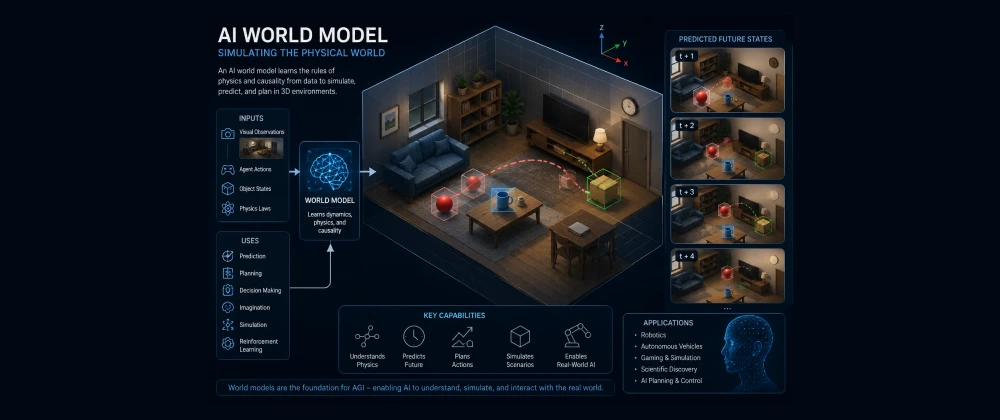
- A world model is an AI system trained to build an internal, predictive simulation of how the physical world behaves, rather than just predicting the next word in text.
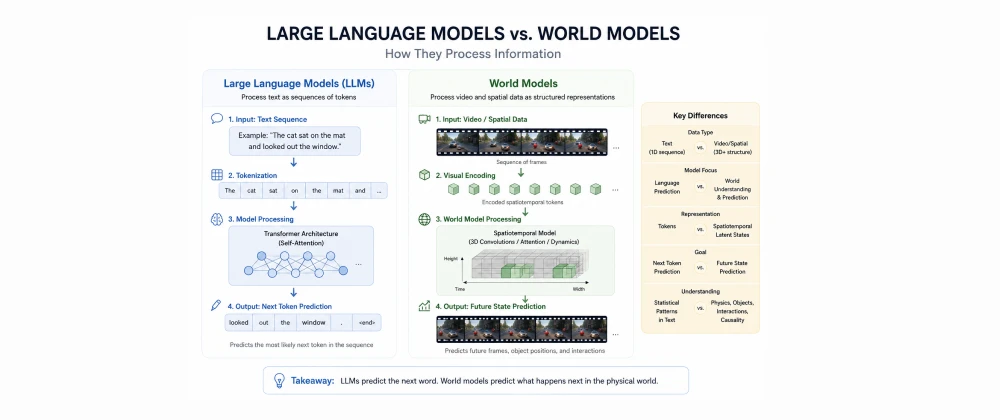
- Unlike large language models, world models learn cause-and-effect and spatial reasoning primarily from video, sensor, and interaction data, not text.
- Google DeepMind's Genie, Meta's V-JEPA, and NVIDIA's Cosmos platform are the most prominent US-developed world model efforts as of 2026.
- Researchers including Yann LeCun have argued publicly that world models, not larger LLMs, are the more promising path toward machines with genuine physical common sense.
- The clearest early commercial use cases are autonomous driving, robotics, and generative video and game environments, all of which require predicting what happens next in physical space.
- World models remain expensive to train and difficult to evaluate, and no consensus benchmark exists yet — comparable to where LLMs stood several years before ChatGPT.
Table of Contents
A Warehouse Robot in Munich Kept Bumping Into Things It Had Never Learned to Predict
An automation engineer at a logistics facility outside Munich spent weeks troubleshooting a robotic picking arm that behaved perfectly in simulation but kept misjudging real-world object stacks — nudging boxes that looked stable, then watching them topple in ways its training data had never shown it. The robot wasn't bad at recognizing objects. It was bad at predicting what would physically happen next. That distinction is exactly what a growing number of AI researchers argue large language models were never built to solve.
For the past several years, the loudest AI progress story has been language: bigger models, longer context windows, better reasoning over text. But text-based models have a structural blind spot — they've never watched a box teeter, felt gravity, or predicted where a ball will land. A newer category of AI, called world models, is built specifically to close that gap by learning to simulate the physical world itself.
This guide from SmartAIHuman.com explains what world models actually are, why researchers in the US and EU increasingly see them as the next major AI frontier, and where the technology realistically stands today — separate from the hype.
How We Researched This Guide
Our Research Methodology
- Literature review: Examined public research publications and technical blog posts from Google DeepMind, Meta AI Research, and NVIDIA describing their respective world model architectures.
- Comparative analysis: Contrasted the training approach, data requirements, and stated goals of world models against those of large language models to identify genuine architectural differences.
- Industry application scan: Reviewed how world model techniques are currently applied in US and EU robotics and autonomous vehicle companies, including UK-based Wayve.
- Expert commentary review: Cross-checked claims against public statements from AI researchers who have written specifically about world models as a research direction, including Yann LeCun's published position papers.
- Terminology accuracy check: Verified that "world model" claims in marketing materials matched the underlying technical definition used in peer-reviewed and preprint AI research.
What Is a World Model? Core Concepts Explained
A world model is an AI system trained to build an internal representation of how the physical world works, so it can predict future states of an environment based on past observations and actions. Instead of learning statistical patterns in text, a world model typically learns from video, simulated environments, or robotic sensor data, forming something closer to an internal "mental simulation" than a language predictor.
The term isn't new — researchers have used "world model" since at least the late 2010s in reinforcement learning research — but it has taken on new momentum as labs apply the concept at much larger scale, using techniques similar to those that made LLMs powerful.
Why World Models Matter in 2026
Large language models have hit a well-documented limitation: they reason about the world only through the text humans have written about it, which means they inherit gaps and biases in that text and struggle with tasks requiring genuine spatial or physical understanding — predicting how a liquid will spill, how a robot arm should grip an irregular object, or how traffic will flow around an obstacle. world models are a direct response to that gap, and 2026 has seen the first wave of world-model-native products reach real users, from AI-generated interactive game worlds to autonomous vehicle planning systems built around predictive simulation rather than rule-based logic.
Benefits of World Models for US and EU Businesses and Researchers
world models aren't just an academic curiosity — they offer practical advantages over text-only AI for a specific and growing set of applications.
- Enable robots and vehicles to plan actions by simulating outcomes before acting, reducing costly real-world trial and error.
- Support far more data-efficient training for physical tasks, since models learn general physical principles rather than memorizing specific scenarios.
- Open new generative media applications, including interactive AI-generated game worlds and video content with physically consistent motion.
- Provide a plausible path toward AI systems with genuine common-sense physical reasoning, a well-documented weakness of text-only LLMs.
- Give US and EU robotics and automotive companies a distinct R&D differentiator as the technology matures ahead of full commercialization.
Real-World Use Cases in the US and Europe
Autonomous Vehicle Planning
UK-based Wayve has published research describing how world-model-style prediction lets its driving systems simulate multiple possible futures for a traffic scene, improving decision-making in ambiguous situations like an oncoming cyclist's uncertain path — without needing hand-coded rules for every scenario.
Robotics Training in Simulation
US robotics labs increasingly use world models to pre-train manipulation policies entirely in simulated, predicted environments before deploying to physical hardware, cutting the amount of expensive real-world trial-and-error training needed.
Interactive Generative Media
Google DeepMind's Genie research demonstrates generating consistent, explorable 2D game-like environments from a single image or text prompt, pointing toward a future where game and simulation environments are generated on the fly rather than hand-built by designers.
How to Get Started Learning About World Models
Step-by-Step
- Start with the core distinction: Understand that world models predict physical/visual states, while LLMs predict text tokens — everything else follows from that difference.
- Read primary research, not just headlines: Public papers from Google DeepMind (Genie), Meta AI (V-JEPA), and NVIDIA (Cosmos) are openly published and written for a technically curious, non-specialist audience in their summaries.
- Watch the robotics and autonomous vehicle sector: These industries are the clearest near-term proving ground for world model claims, since results are measurable against physical outcomes.
- Track compute and funding signals: Because world models are compute-intensive to train, funding and infrastructure announcements from major US and EU labs are a reliable indicator of where the field is heading.
Best Tools / Solutions for World Models in 2026
Google DeepMind Genie
A research system that generates interactive, playable environments from images or text prompts, demonstrating action-conditioned world simulation at a scale that drew significant attention across the AI research community.
Meta V-JEPA
Meta AI's video joint embedding predictive architecture learns physical common sense by predicting abstract video representations rather than raw pixels, reflecting Yann LeCun's broader research thesis on efficient world modeling.
NVIDIA AI
A platform of world foundation models designed specifically to help robotics and autonomous vehicle developers generate synthetic training data and simulate physical scenarios at scale.
World Models vs. Large Language Models — Comparison Table
Based on the architectural differences and use cases described above, here's how the two approaches compare directly.
| Category | World Models | Large Language Models | Notes |
|---|---|---|---|
| Physical/Spatial Reasoning | World models are purpose-built for this; LLMs reason about physics only secondhand through text. | ||
| Language & Text Reasoning | LLMs remain far stronger for language tasks by design. | ||
| Maturity / Commercial Readiness | World models are roughly where LLMs were several years before mainstream products emerged. | ||
| Best For | Robotics, autonomous vehicles, generative environments | Writing, coding, conversational tasks | Increasingly likely to be combined, not compete directly. |
Pros & Cons of World Models as an AI Research Direction
✅ Pros
- Directly addresses LLMs' well-known physical and spatial reasoning gaps
- Highly data-efficient once trained, compared to trial-and-error robotics training
- Clear, measurable commercial applications in robotics and autonomous vehicles
- Backed by serious research investment from Google DeepMind, Meta, and NVIDIA
⚠️ Cons
- Extremely compute- and data-intensive to train at meaningful scale
- No widely agreed-upon benchmark exists yet to measure "world model quality"
- Still largely confined to research labs and narrow commercial pilots
- Marketing use of "world model" often outpaces the underlying technical substance
Alternatives to Consider
Organizations evaluating whether world model research is relevant to them have a few adjacent paths worth knowing.
- Classical physics-based simulation: Traditional, hand-coded physics engines remain more reliable for well-understood, narrow physical systems than learned world models today.
- Multimodal LLMs: Models that combine text with image and video understanding offer some spatial reasoning improvement without the full architectural shift to a dedicated world model.
Expert Insights
"Machines will not exhibit human-level intelligence until they have the ability to learn models of the world in a self-supervised manner, similar to how infants develop an understanding of physical reality." — Meta AI Research, published research position on self-supervised world models, 2024
Future Trends: World Models Beyond 2026
Expect the next 18–24 months to bring the first serious attempts at standardized world model benchmarks, similar to how GLUE and later evaluation suites gave the LLM field a shared way to measure progress. US labs are likely to continue leading foundational research, while EU robotics and automotive companies — building on strong existing manufacturing and automotive engineering bases — are well positioned to lead in applied, industrial deployment of the technology. Expect continued blending of the two paradigms as well, with multimodal systems that combine language reasoning and world-model-style physical prediction in a single architecture, rather than world models fully replacing LLMs.
Overall Rating
Frequently Asked Questions
Real questions US and European readers search for, answered clearly.
Why This Shift Is Worth Watching Now
The warehouse robot outside Munich eventually improved — not through a bigger language model, but through better physical prediction training closer to what world model research aims to solve at scale. That's the practical thread running through this entire field: it's not about making AI sound smarter, but about making it understand consequences in physical space before acting.
World models won't replace the language-based AI tools most businesses use today. But for any organization working in robotics, logistics, autonomous systems, or physical simulation, understanding this shift now — rather than after it matures — is a genuine competitive advantage.
At SmartAIHuman.com, we'll continue tracking world model research as it moves from lab demonstrations toward measurable, benchmarked commercial deployment.
Related Articles on SmartAIHuman.com
Sources & External Authority References
- Google DeepMind — "Genie: Generative Interactive Environments" (2024). deepmind.google
- Meta AI Research — "V-JEPA: Video Joint Embedding Predictive Architecture" (2024). ai.meta.com
- NVIDIA — "Cosmos World Foundation Models for Physical AI" (2025). nvidia.com
- Wayve — "Learning to Drive with World Models" (2024). wayve.ai
- Yann LeCun — "A Path Towards Autonomous Machine Intelligence" (position paper, Meta AI, 2022, with continued public commentary through 2025–2026). openreview.net
- Crunchbase — "AI Funding Data, Robotics and World Model Startups" (2026). crunchbase.com

SmartAIHuman Editorial Team shares practical AI guides, tool reviews, productivity strategies, and beginner-friendly tech tutorials to help readers use AI effectively in everyday life.