
What Is Agentic AI? A Beginner's Guide for 2026

The Moment AI Stopped Waiting to Be Told What to Do
Imagine you're a project manager at a mid-sized company in Amsterdam. Your Monday starts with 47 unread emails, three overdue reports, a client follow-up you keep pushing back, and a meeting you completely forgot to reschedule. By 9:30 AM you're already behind.
Now imagine something different: while you slept, an AI system read those emails, drafted responses to the routine ones, pulled the relevant data for your reports, flagged the client email as urgent, and rescheduled your meeting — all without being told to do any of it.
That's not science fiction. That's agentic AI, and in 2026, it's rapidly moving from research labs to real business workflows across the United States and Europe.
If you've heard terms like "AI agents," "autonomous AI," or "agentic systems" lately and wondered what they actually mean, you're in the right place. This guide explains exactly what agentic AI is, how it works, why it matters, and how to start using it — whether you're a student in Edinburgh, a startup founder in Austin, or a business professional in Berlin.
No technical background needed. Let's get into it.
⚡ Key Takeaways
Agentic AI refers to AI systems that can plan, make decisions, and take multi-step actions autonomously — without needing constant human input at each step.
Unlike traditional chatbots that respond to single prompts, agentic AI uses tools, memory, and reasoning loops to complete complex, real-world tasks.
Major US and European companies — from Salesforce and Microsoft to SAP and Siemens — are already deploying agentic AI in production environments.
The EU AI Act directly regulates certain uses of agentic AI, particularly in high-risk domains — making responsible deployment a legal priority for European businesses.
Beginners can start exploring agentic AI today using tools like Microsoft Copilot Studio, Salesforce Agentforce, or n8n — no coding required for basic use cases.
What Is Agentic AI?
Agentic AI is a type of artificial intelligence that can independently pursue goals, take sequences of actions, use external tools, and adapt its approach based on feedback — all with minimal human guidance once a task is initiated.
The word "agentic" comes from the concept of "agency" — the ability to act independently in the world toward a purpose. An AI system with agency doesn't just answer questions; it actively works toward outcomes.
Simple Definition: If a regular AI is like a vending machine (you press a button, you get one thing), then agentic AI is like a skilled personal assistant — you tell it what you need accomplished, and it figures out the steps, uses whatever tools it needs, and gets it done.
The Core Difference: Reactive vs. Agentic
To understand agentic AI, it helps to see what makes it different from traditional AI tools you might already be familiar with.
| Feature | Traditional AI (e.g., ChatGPT prompt) | Agentic AI |
|---|---|---|
| How it works | Responds to one prompt at a time | Plans and executes multi-step sequences |
| Memory | Limited or none across sessions | Maintains context across tasks and time |
| Tool use | Usually none without configuration | Uses web search, APIs, apps, databases |
| Human input | Required for every step | Minimal — sets goals, AI executes |
| Error handling | Stops at first failure | Retries, adjusts, finds alternatives |
| Real-world action | Text output only | Can take actions: book, send, edit, deploy |
Key Terms You'll Need to Know
- AI Agent: A single agentic AI unit designed to complete a specific type of task (e.g., a customer service agent, a research agent, a coding agent).
- Multi-Agent System: Multiple AI agents working together, each handling a different part of a complex task.
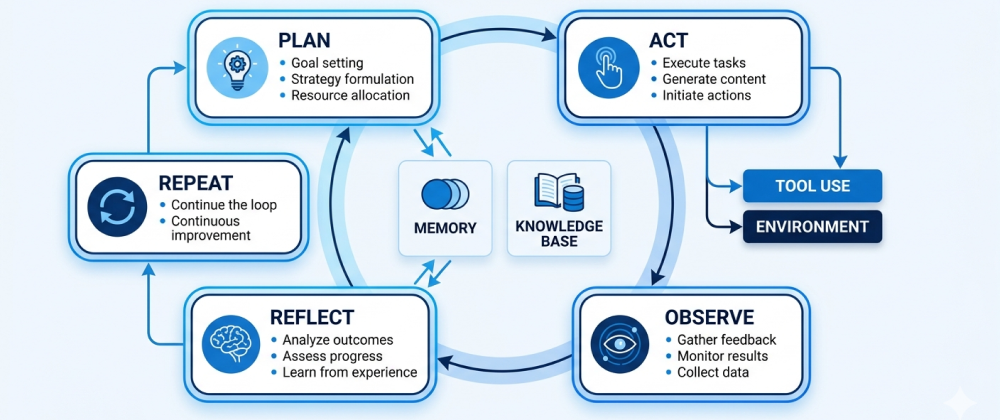
- Reasoning Loop: The process an agent uses to think, decide, act, and then evaluate the result — then repeat.
- Tool Use: The ability of an agent to connect to external tools like search engines, calendars, code editors, and databases.
- Orchestrator: A "manager" agent that coordinates other agents and assigns them subtasks.
Why Agentic AI Matters in 2026
The shift from reactive AI to agentic AI is arguably the most significant development in applied artificial intelligence since the launch of large language models. Here's why it's a big deal right now.
The reason agentic AI is surging right now comes down to three converging factors:
- LLMs got smarter. The underlying large language models powering agents — like GPT-4, Claude, Gemini, and Mistral — have become capable enough to reason through complex multi-step problems reliably.
- Tool connectivity exploded. Standardized protocols (like Anthropic's Model Context Protocol, or MCP) now allow AI agents to securely connect to thousands of apps and services — from Google Calendar to enterprise ERPs.
- Businesses are ready. After years of experimenting with AI chatbots that produced mixed results, US and European businesses are now demanding AI that actually completes tasks, not just suggests them.
EU AI Act Alert: The EU AI Act (effective August 2024, enforcement rolling out through 2026) classifies some agentic AI systems as "high-risk" — particularly those used in hiring, credit decisions, healthcare triage, or law enforcement. European businesses must ensure compliance before deployment. See European Commission guidance for details.
How Agentic AI Works: Core Concepts Explained
Understanding agentic AI doesn't require a computer science degree. Here are the building blocks that make it tick.
The Reasoning Loop (How an Agent "Thinks")
Most agentic AI systems follow some version of this cycle:
Receive a Goal
The user provides a high-level objective — for example, "Research the top five competitors in our market and create a summary report."
Plan the Steps
The agent breaks the goal into a sequence of smaller tasks: search the web, identify companies, gather data, compare metrics, write summary.
Take Action Using Tools
The agent executes each step — using a web search tool, a data analysis tool, or a document creation tool as needed.
Observe Results
It checks whether each action produced the expected output. If a search returns irrelevant results, it adjusts the query and tries again.
Reflect and Adapt
The agent evaluates overall progress toward the goal and adjusts its plan if needed before moving on to the next step.
Deliver the Result
Once the goal is achieved, the agent delivers the output — a report, a sent email, a completed booking — to the user.
The Four Pillars of Agentic AI
Reasoning
The agent can think through a problem, weigh options, and decide what to do next — not just retrieve a pre-written answer.
Memory
Short-term memory (within a task) and long-term memory (across sessions) let the agent build context and learn from past interactions.
Tool Use
Access to external tools — browsers, APIs, calendars, databases, code interpreters — lets the agent take real-world actions.
Agent Collaboration
In multi-agent systems, specialized agents hand off tasks to each other — like a team of specialists coordinated by a manager.
The Benefits of Agentic AI
Agentic AI isn't just a technical curiosity. For businesses and individuals across the US and Europe, it delivers measurable, practical advantages.
- Dramatic time savings: Tasks that previously took hours of human effort — research, data aggregation, report writing — can be completed in minutes.
- 24/7 operation: Unlike human employees, AI agents don't sleep, take breaks, or work limited hours. They can execute tasks overnight and across time zones — critical for US-EU cross-border business operations.
- Consistency and accuracy: Agents follow defined processes precisely and don't suffer from cognitive fatigue, reducing the error rates common in repetitive human tasks.
- Scalability: A single deployment can run hundreds of parallel agent instances, handling volume spikes without additional headcount.
- Knowledge synthesis: Agents can simultaneously process and synthesize information from multiple sources — something even expert humans struggle to do efficiently.
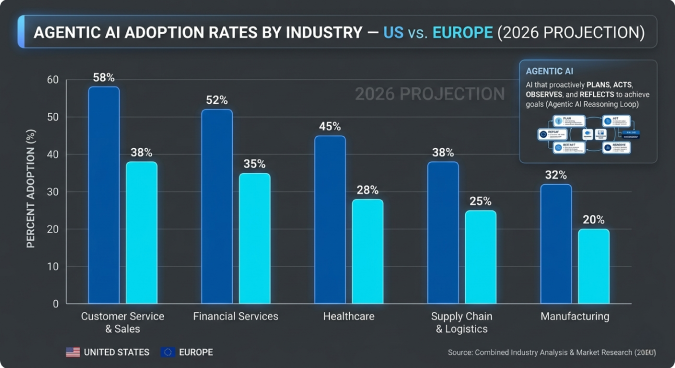
- Cost reduction: McKinsey estimates that US and European companies deploying AI agents in knowledge work can reduce operational costs by 20–40% in targeted departments.
Real-World Example: UK-based insurer Aviva deployed an agentic AI system to handle claims pre-processing in 2025. The result: claims assessment time dropped from an average of 4 days to under 6 hours, while customer satisfaction scores improved by 31%.
Real-World Use Cases: Agentic AI in Action
Agentic AI is already at work in dozens of industries across the US and Europe. Here are some of the most impactful examples happening right now.

Automated Compliance Monitoring
Banks and fintech firms in Germany and the US are deploying agents that continuously scan transactions for regulatory violations — flagging issues in real time rather than weekly batch reviews.
Patient Record Summarization
NHS trusts in England are piloting agentic AI to pull together patient records from multiple systems, create pre-consultation summaries, and flag relevant drug interactions — saving clinicians 30+ minutes per patient.
Contract Review at Scale
US and UK law firms are using agentic AI to review large volumes of contracts, identify non-standard clauses, flag risks, and prepare redline summaries — work that previously required junior associates billing hundreds of hours.
End-to-End Order Management
European retailers like Zalando are experimenting with agentic AI that monitors inventory, identifies low-stock alerts, automatically triggers reorders, updates product listings, and notifies logistics partners — all without human approval.
Personalized Outreach at Scale
Sales teams in the US are using agents to research prospects, personalize outreach emails, schedule follow-ups, and update CRM records — compressing days of work into hours.
Autonomous Coding Assistants
Developer platforms like GitHub Copilot Workspace (used heavily across the US and EU) use agentic AI to take a feature request, write the code, run tests, identify bugs, and generate pull requests — autonomously.
How to Get Started with Agentic AI
You don't need to be a software engineer to start benefiting from agentic AI. Here's a practical path for beginners in the US and Europe.
Identify a repetitive, multi-step task in your work
Think about processes that currently take you 30–60 minutes of structured steps: weekly reporting, inbox management, research briefs, meeting prep, data entry. These are ideal agent candidates.
Choose a beginner-friendly agentic AI tool
Start with a no-code or low-code platform (see Best Tools section below). Microsoft Copilot Studio and Salesforce Agentforce are strong starting points for professionals in the US and EU.
Define the goal, not the steps
Write your task as an outcome: "Every Monday morning, pull last week's sales data, compare it to the prior week, and create a 3-paragraph summary with key highlights." Let the agent figure out the steps.
Run a supervised pilot
For the first few runs, stay close. Review every output and catch any errors before the agent has unsupervised access to critical systems or external communications.
Expand thoughtfully
Once you trust the output quality, expand the agent's scope — add more tools, connect more data sources, or let it operate with less supervision on well-defined tasks.
For EU/UK readers: Before connecting an agentic AI tool to any data containing personal information about customers or employees, review your GDPR obligations. Ensure the tool vendor has signed a Data Processing Agreement (DPA) and that data isn't being transferred outside the EEA without appropriate safeguards.
Best Agentic AI Tools and Platforms in 2026
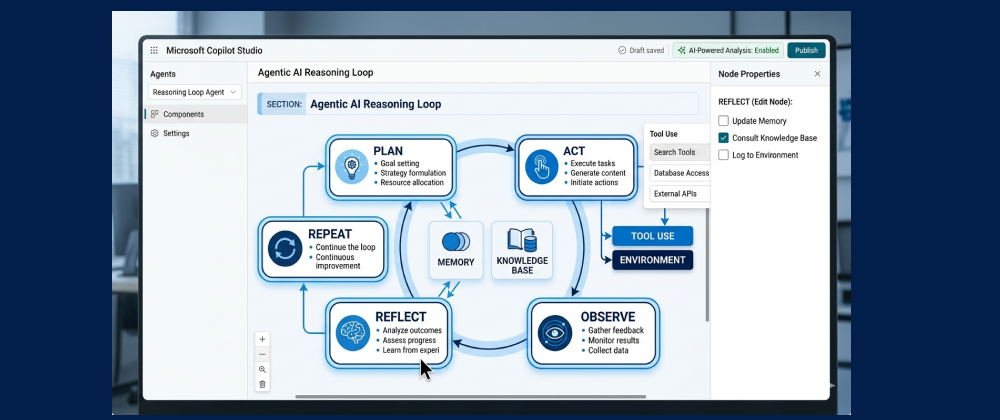
The agentic AI landscape has exploded in 2025–2026. Here are the platforms most relevant for US and European users, covering a range of skill levels and use cases.
Agentic AI Platform Comparison
| Platform | Best For | No-Code? | EU Compliant? | Multi-Agent? | Starting Price |
|---|---|---|---|---|---|
| Microsoft Copilot Studio | Enterprise teams on M365 | ✓ | ✓ | ✓ | From $200/mo |
| Salesforce Agentforce | Sales & CRM-led workflows | ✓ | ✓ | ✓ | Custom / Enterprise |
| n8n | EU businesses, self-hosted | ~ | ✓ | ~ | Free / €20/mo cloud |
| Claude API (Anthropic) | Developers, safe AI apps | ✗ | ✓ | ✓ | Usage-based |
| AutoGen (Microsoft) | Technical multi-agent builds | ✗ | ✓ | ✓ | Free (open-source) |
| Cohere Command R+ | Multilingual EU enterprise | ✗ | ✓ | ~ | Custom enterprise |
✓ = Yes · ✗ = No · ~ = Partial or with configuration. Pricing as of June 2026. Always verify current pricing on vendor websites.
Agentic AI: Pros and Cons
Like any powerful technology, agentic AI comes with real strengths and genuine limitations. Here's a balanced view.
✅ Pros
⚠️ Cons
Agentic AI Pricing: What to Expect
Agentic AI pricing varies significantly depending on the platform, usage volume, and deployment model. Here's a realistic overview for US and EU buyers.
- Free / Open-source tier: Tools like n8n (self-hosted) and AutoGen are free to use, with infrastructure costs only. Ideal for technical teams at startups or research institutions.
- SMB / Prosumer tier ($20–$200/month): n8n Cloud starts at approximately €20/month (≈ $22 / £17). Entry-level Copilot Studio plans begin around $200/month for small teams.
- Mid-market ($500–$5,000/month): Most enterprise SaaS platforms (Salesforce, ServiceNow, etc.) offer agentic AI as add-ons or bundles in this range for mid-size deployments.
- Enterprise (custom / $10,000+/month): Large-scale deployments with custom integrations, dedicated infrastructure, EU data residency, and SLAs. Cohere, Microsoft, and Salesforce all operate in this tier.
- API / usage-based: Anthropic, OpenAI, and Google Gemini charge per token processed. For agentic workflows that run many multi-step tasks, costs can range from a few dollars to thousands per month depending on volume.
Alternatives to Agentic AI
Not every task requires a full agentic AI system. Depending on your needs, one of these alternatives might be a better fit — at least to start.
Traditional RPA
Tools like UiPath and Automation Anywhere handle structured, rule-based repetitive tasks reliably — without the complexity of agentic AI. Best for stable, predictable processes.
Simple AI Assistants
For single-turn tasks — writing, summarizing, answering questions — a standard ChatGPT, Claude, or Gemini chat interface is faster and cheaper than a full agent deployment.
Workflow Automation (Zapier, Make)
For connecting apps and triggering actions based on simple conditions, tools like Zapier (US) or Make (EU) offer automation without AI complexity. Great starting point before adopting agents.
Dedicated AI Tools
For specific tasks — code generation (GitHub Copilot), writing (Jasper), or customer support (Intercom AI) — purpose-built tools often outperform general agents in narrow domains.
Expert Insights on Agentic AI
Future Trends: Where Agentic AI Is Heading
2026: Mainstream Enterprise Adoption
Agentic AI moves from pilot programs to production deployment across Fortune 500 companies and FTSE 100 firms. EU AI Act enforcement shapes responsible deployment standards.
2027: Persistent, Cross-Platform Agents
Agents that maintain memory and context across months and multiple platforms will become standard. EU regulations on persistent AI systems will drive transparency requirements.
2028: Agentic AI "Digital Colleagues"
Gartner predicts that by 2028, 15% of day-to-day work decisions in US and EU enterprises will be made autonomously by AI agents — monitored but not initiated by humans.
Near Future: Physical World Integration
The convergence of agentic AI with robotics and IoT — already underway at companies like Boston Dynamics and Siemens — will extend agent autonomy beyond digital environments into the physical world.
Frequently Asked Questions About Agentic AI
Final Verdict
Agentic AI Is the Most Important Shift in Applied AI Since 2022
Agentic AI represents a genuine step-change in what AI can do for individuals and organizations. It moves AI from a productivity tool you interact with to a productivity system that works for you. The technology is real, it's available now, and the business case is compelling — but thoughtful, governed adoption beats racing ahead carelessly, especially for EU readers navigating the AI Act.
SmartAIHuman.com Rating: Agentic AI Technology
| Capability | |
| Ease of Use | |
| Business Value | |
| Reliability | |
| Regulatory Readiness (EU) |
Conclusion: The Age of AI That Acts Has Arrived
We started this guide with a picture of a Monday morning in Amsterdam, overwhelmed by tasks. Agentic AI represents the most credible answer yet to the productivity challenges that define modern professional life in the US and Europe — not by eliminating the need for human judgment, but by handling the mechanical execution of complex processes so you can focus on the things that genuinely require a human mind.
The technology is no longer theoretical. Agentic AI is running in production at banks in Frankfurt, hospitals in London, law firms in New York, and logistics companies in Rotterdam. The question is no longer whether it will transform how we work — it already is. The question is whether you'll be ahead of that curve or behind it.
For beginners, the best time to start learning is now. Explore a no-code platform, automate one repetitive task, and build your understanding from there. For enterprise decision-makers in the EU, pair your technology adoption with governance frameworks that align with the EU AI Act — not because you have to, but because responsible AI builds the trust that creates long-term competitive advantage.
At SmartAIHuman.com, we'll keep tracking how agentic AI evolves — the tools, the regulations, the real-world case studies, and the plain-English explanations you need to stay ahead.
Here's a question worth sitting with: If an AI agent could reliably handle one significant part of your weekly workload starting next Monday — which task would you choose, and what would you do with the time you got back?
Explore More on SmartAIHuman.com
Sources & Further Reading

SmartAIHuman Editorial Team shares practical AI guides, tool reviews, productivity strategies, and beginner-friendly tech tutorials to help readers use AI effectively in everyday life.