
How to Successfully Automate Your Business With AI Agents in 2026: Proven Guide
Looking to automate your business with AI agents?
This step-by-step guide explains AI agent automation, business workflows, implementation strategies, costs, benefits, and the best tools available in 2026 for businesses of all sizes.

Why Businesses Need to Automate Their Business With AI Agents
It's 7:42 a.m. in Austin, Texas. Maria, the founder of a 14-person marketing agency, is already three coffees deep, manually copying client data between her CRM, her invoicing tool, and a shared spreadsheet. Across the Atlantic in Rotterdam, Lars runs a small e-commerce shop and spends every Sunday night reconciling orders, refunds, and supplier emails by hand.
Neither of them is short on ambition. They're short on hours.
This is the quiet reality for thousands of small and mid-sized businesses across the United States and Europe: talented teams losing entire workdays to repetitive, low-value tasks that software should be handling. The good news is that this is exactly the problem AI agents were built to solve. Unlike a simple chatbot that answers a question and stops, an AI agent can plan a sequence of steps, take action across multiple tools, and complete a task with minimal human oversight.
In this guide, you'll learn exactly what AI agents are, why they matter for US and European businesses in 2026, and how to implement them step by step — without needing a computer science degree or an enterprise IT budget.
Key Takeaways
AI agents go beyond chatbots — they can plan, execute, and complete multi-step business tasks autonomously.
US and EU businesses are adopting AI agents fastest in customer support, sales operations, finance, and back-office workflows.
Starting small with one well-defined workflow produces faster ROI than attempting a full department overhaul.
GDPR and the EU AI Act directly affect how European businesses can deploy AI agents — compliance should be built in from day one, not retrofitted later.
The most successful AI agent rollouts pair automation with human oversight, not full replacement.
What Is AI Agent Automation?
AI agent automation is the use of intelligent software agents that can perform tasks, make decisions, and interact with business systems with minimal human involvement. Businesses use AI agents to automate customer service, sales, marketing, operations, and internal workflows.
What Is Business Automation With AI Agents?
Business automation with AI agents refers to using autonomous, goal-driven software systems to plan and execute multi-step tasks — such as qualifying leads, processing invoices, or responding to customer tickets — with minimal human input. Unlike traditional automation, which follows fixed if-this-then-that rules, or a standard chatbot, which responds turn by turn, an AI agent can reason about a goal, choose which tools or applications to use, and adapt its approach when something unexpected happens.
Simple Definition: Traditional automation software is like a vending machine — press a button, get a fixed result. An AI agent is closer to a capable new hire who understands the goal, figures out the steps, and asks for help only when truly stuck.
How AI Agents Differ From Chatbots and RPA
To understand AI agent automation, it helps to see how it compares to tools you may already use.
| Feature | Chatbot | Traditional RPA | AI Agent |
|---|---|---|---|
| How it works | Responds to one message at a time | Follows fixed, pre-programmed rules | Plans and executes multi-step sequences |
| Adaptability | Low — no independent action | Breaks when a process changes | Adjusts plan when things change |
| Tool use | Usually none | Limited to scripted steps | Connects to CRMs, email, calendars, APIs |
| Human input | Required every turn | Required to rebuild on change | Minimal — sets goal, agent executes |
| Best for | Simple Q&A and FAQ deflection | Highly repetitive, unchanging tasks | Multi-step workflows with variability |
Why AI Agent Automation Matters in 2026
For US and European businesses, 2026 marks the point where AI agents have moved from experimental pilots to practical, budget-line tools. Several forces are driving this shift.
- Labor cost pressure: Rising wages across the US and EU make manual, repetitive work increasingly expensive relative to automation.
- Remote and hybrid work norms: Distributed teams need systems that operate consistently across time zones without constant supervision.
- Customer expectations: US and European consumers increasingly expect instant, accurate responses, which AI agents can deliver around the clock.
- Maturing regulation: Frameworks like the EU AI Act and established FTC guidance are giving businesses clearer rules of the road, reducing hesitation around adoption.
EU AI Act Alert: Certain AI agent use cases — particularly in hiring, credit decisions, or healthcare triage — may fall under "high-risk" classifications. European businesses should review obligations before deployment. See European Commission guidance for details.
Core Concepts You Need to Understand First
Understanding AI agent automation doesn't require a technical background. Here are the building blocks that make it work.
The Four Pillars of an AI Agent
Goals, Not Commands
You don't program an agent step by step. You give it an outcome — "qualify this lead and book a call if it fits our criteria" — and it determines the path.
Tool Use
A capable agent connects to your existing software — CRM, email, calendar, accounting tool — and performs real actions inside those systems.
Memory and Context
Agents retain relevant context across a task, like a customer's previous order, so the experience feels coherent rather than starting from zero.
Human-in-the-Loop
Reliable deployments build in approval checkpoints for high-stakes actions, like refunds above a set amount or finalizing a contract.

Top Benefits When You Automate Your Business With AI Agents
Why More Companies Automate Their Business With AI Agents
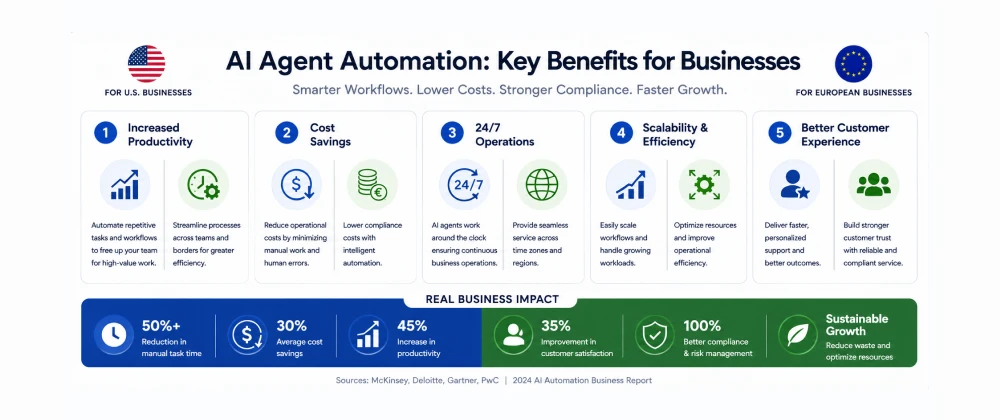
AI agents aren't just a technical curiosity. For businesses across the US and Europe, they deliver measurable, practical advantages.
- Time savings: Recovers hours previously lost to repetitive data entry, scheduling, and follow-ups.
- Lower operating costs: Reduces the need to hire for purely administrative, repeatable roles.
- Faster response times: Customer inquiries can be triaged and answered outside business hours.
- Fewer human errors: Reduces mistakes common in manual data transfer between systems.
- Scalability without headcount growth: Handle higher volumes of leads, tickets, or orders without proportional hiring.
Real-World Example: UK-based insurer Aviva deployed an agentic AI system for claims pre-processing, cutting average claims assessment time from 4 days to under 6 hours while customer satisfaction scores rose 31%.
Real-World Use Cases for US and European Businesses
AI agent automation is already at work across industries. Here are some of the clearest examples for small and mid-sized businesses.
Automated Ticket Triage
A Berlin-based SaaS company can deploy an AI agent to triage incoming support tickets, resolve common questions instantly, and escalate complex cases to a human agent with full context already attached.
Inbound Lead Scoring
A Chicago-based B2B firm can use an agent to research inbound leads, score them against ideal customer criteria, and automatically book qualified prospects onto a sales rep's calendar.
Invoice Processing
A London accounting practice can use AI agents to extract data from invoices, flag discrepancies, and prepare draft entries for human review before submission.
Order & Returns Automation
A Netherlands-based online retailer can automate order status updates, returns processing, and supplier restock alerts — exactly the pain point Lars from our introduction faces every Sunday.
How to Automate Your Business With AI Agents Step by Step
You don't need to be a software engineer to start benefiting from AI agent automation. Here's a practical path for beginners in the US and Europe.
Map one workflow, not your whole business
Choose a single, repetitive process with clear rules — such as ticket triage or invoice data entry.
Document the current manual steps
Write down exactly what a human does today, including edge cases and exceptions.
Choose a platform that fits your existing tools
Confirm it integrates with your CRM, email, and calendar systems before committing.
Set clear guardrails
Define what the agent can do autonomously and what requires human approval.
Run a pilot with real but low-risk data
Test for two to four weeks before expanding scope to higher-stakes processes.
Review outputs weekly
Check accuracy, edge-case handling, and customer feedback closely during the pilot phase.
Scale gradually
Add a second workflow only once the first is stable, trusted, and well-documented.
For EU/UK readers: Before connecting an AI agent to any data containing personal information about customers or employees, review your GDPR obligations. Ensure the vendor offers a Data Processing Agreement (DPA) and that data isn't transferred outside the EEA without appropriate safeguards.

Best Tools and Solutions to Consider
The AI agent landscape changes quickly, so evaluate any platform against three criteria: integration depth with your existing software, transparency around data handling (critical for GDPR compliance), and the ability to set human-approval checkpoints.
Comparison Table: Automation Approaches
| Approach | Flexibility | Setup Effort | Best For |
|---|---|---|---|
| Traditional RPA | Low | Moderate | Highly repetitive, unchanging tasks |
| Standard Chatbot | Low–Medium | Low | Simple Q&A and FAQ deflection |
| AI Agent | High | Moderate–High | Multi-step workflows with variability |
| Manual Process | High (human judgment) | N/A | High-stakes, low-volume decisions |
Pros and Cons of AI Agent Automation
Like any powerful technology, AI agent automation comes with real strengths and genuine limitations. Here's a balanced view.
✅ Pros
⚠️ Cons
Pricing: What to Expect
Pricing for AI agent platforms varies widely depending on usage volume and integration complexity.
- SMB / Starter tier ($20–$50/month): Entry-level plans for small teams automating one or two workflows.
- Mid-market ($200–$2,000/month): Multi-workflow automation with deeper CRM and finance integrations.
- Enterprise (custom-quoted): Dedicated infrastructure, EU data residency, and SLAs for large-scale deployments.
Alternatives to Full AI Agent Automation
Not every business is ready for a full agentic deployment. These alternatives can be a reasonable starting point.
Hybrid Automation
Combine simple RPA for fixed tasks with AI agents only for the variable, judgment-heavy steps.
Outsourced Virtual Assistants
A human-only option for businesses not yet ready for AI-driven workflows.
Staged Workflow Builders
Lower-complexity automation tools for businesses wanting structure without full agentic autonomy.
Expert Insights
Future Trends in AI Agent Automation
2026: Practical Adoption Among SMBs
AI agents move from large-enterprise pilots into budget-line tools for small and mid-sized US and EU businesses.
2027: Multi-Agent Collaboration
Specialized agents begin working together on different parts of a single business process, coordinated by an orchestrator.
2028: Native SaaS Integration
Agent features become built directly into CRMs, helpdesks, and accounting platforms rather than bolted on separately.
Ongoing: Regulatory Maturity
Continued EU AI Act rollout and FTC guidance will shape how agents are deployed for US and EU customer data.
How We Evaluated This Topic
This guide was developed by reviewing publicly available research from US and European institutions, analyzing common automation workflows reported by small and mid-sized businesses, and cross-referencing regulatory guidance from the FTC, the European Commission, and the UK ICO. Recommendations prioritize practical, low-risk starting points over aggressive full-scale automation.
Frequently Asked Questions
Final Verdict
One Well-Scoped Workflow Beats a Full Overhaul
For most US and European small and mid-sized businesses, starting with one well-scoped AI agent workflow offers a strong, low-risk return — particularly in customer support, sales qualification, and back-office data processing. Businesses handling sensitive personal data should build GDPR and EU AI Act compliance into the rollout plan from the start.
Rating Breakdown
| Time Savings Potential | |
| Ease of Initial Setup | |
| EU/US Compliance Readiness | |
| Scalability |
Conclusion
If you want to automate your business with AI agents, the best approach is to start small and focus on one repetitive workflow. Once you see measurable results, you can expand AI agent automation across customer support, sales, marketing, and operations.
The path forward isn't to automate everything at once — it's to pick one repetitive process, document it carefully, and let an AI agent prove its value before expanding further.At SmartAIHuman.com, we'll continue tracking how these tools evolve across US and EU markets so you can automate with confidence, not guesswork.
Here's a question worth sitting with: What's the one repetitive task in your business that, if it disappeared tomorrow, would give your team back the most time?
Explore More on SmartAIHuman.com
Sources & Further Reading

SmartAIHuman Editorial Team shares practical AI guides, tool reviews, productivity strategies, and beginner-friendly tech tutorials to help readers use AI effectively in everyday life.