
AI Jobs in 2030: The Careers That Will Thrive, Change, or Disappear

Key Takeaways
- By 2030, AI is expected to transform far more jobs than it eliminates outright — most roles will change rather than vanish
- Repetitive, data-entry, and rules-based roles face the highest automation exposure in the US and EU
- Entirely new job categories — AI trainers, prompt engineers, AI ethics officers — are already emerging
- Roles built on judgment, empathy, physical dexterity, and accountability remain the hardest to automate
- The World Economic Forum and McKinsey both project a net positive shift in job creation, but with major skills gaps
- Reskilling and continuous learning are the single biggest predictors of career resilience through 2030
- EU AI Act and US state-level AI employment rules are starting to shape how companies deploy workplace AI
Table of Contents
- Why "AI Jobs in 2030" Is the Question Everyone's Asking
- How We Researched This Guide
- What Do We Mean by "AI Jobs in 2030"?
- Why This Matters Right Now
- Real-World Examples Across the US and Europe
- How to Prepare: A Step-by-Step Plan
- Best Tools and Platforms to Build AI-Ready Skills
- 2030 Job Risk Comparison Table
- Pros & Cons of an AI-Driven Job Market
- Final Verdict & Rating
- Frequently Asked Questions
Why "AI Jobs in 2030" Is the Question Everyone's Asking
Picture a marketing coordinator in Chicago opening her laptop on a Monday morning. Half of her old to-do list — drafting social captions, building basic reports, scheduling posts — is already handled by an AI assistant before she's finished her coffee. Across the Atlantic, a logistics manager in Rotterdam watches an AI system reroute a shipment around a storm in seconds, a decision that used to take her team half a day.
Neither of them lost their job to AI. But both of their jobs have already changed — and by 2030, that shift will be even more pronounced. AI jobs in 2030 won't just mean "jobs at AI companies." It means every job that AI touches, reshapes, replaces, or creates across the US and European economies.
That uncertainty is exactly why so many professionals, students, and career changers are searching for clear answers. This guide from SmartAIHuman.com breaks down which roles are most exposed, which are growing, and — most importantly — what you can start doing today to stay relevant.
How We Researched This Guide
Our Research Methodology
- Labor market data review: We analyzed workforce and automation projections from the World Economic Forum, McKinsey Global Institute, and the US Bureau of Labor Statistics covering 2025–2030.
- Academic sourcing: Definitions and exposure estimates were cross-checked against research from MIT, Stanford, and Oxford's Future of Work programs.
- Regulatory review: We reviewed the EU AI Act's provisions on workplace AI and emerging US state-level AI employment disclosure laws.
- Industry sourcing: We reviewed hiring trend reports from LinkedIn, Gartner, and Forrester covering AI-related job postings in the US and EU through 2026.
- Practical validation: We compared findings against real hiring patterns at US and European employers currently posting AI-adjacent roles.
What Do We Mean by "AI Jobs in 2030"?
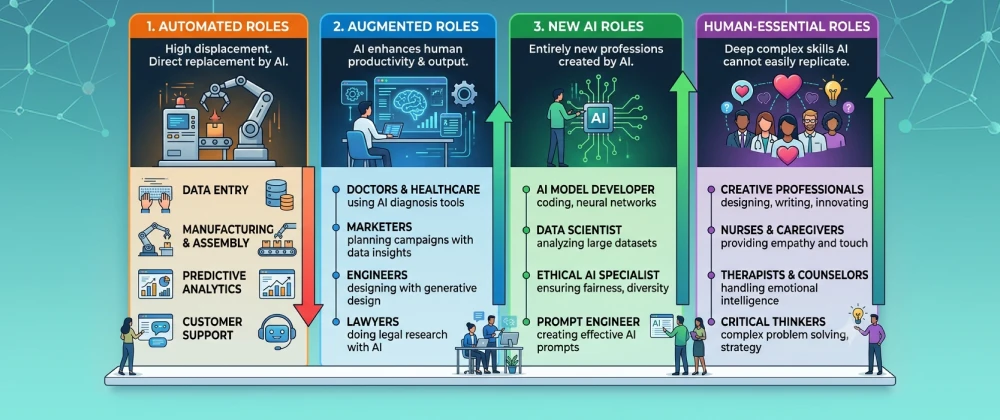
"AI jobs in 2030" refers to the full spectrum of how artificial intelligence will reshape employment by the end of the decade — including roles that disappear, roles that change substantially, and entirely new roles created to build, manage, and govern AI systems. It's a broader idea than just "jobs in AI companies," and it applies to nearly every sector across the US and Europe, from healthcare to manufacturing to marketing.
Researchers generally sort the impact into four categories. Here's how each one plays out.
Why This Matters Right Now
2026 is the year the "AI jobs" conversation stopped being theoretical for most professionals. Generative AI tools are now embedded directly into everyday software — email clients, spreadsheets, design tools, customer relationship management (CRM) systems — used across US and European workplaces.
That means the changes projected for 2030 aren't a distant forecast; they're already underway. Understanding where things are headed now gives you a meaningful head start, whether you're choosing a college major, considering a career pivot, or managing a team through the transition.
Real-World Examples Across the US and Europe
Healthcare: From Records to Diagnostics
US hospital systems and European national health services are both piloting AI tools for administrative work — appointment scheduling, clinical note summarization, insurance coding — while keeping diagnosis and treatment decisions firmly with licensed clinicians.
Marketing and Content: Speed Without Losing the Human Touch
Marketing teams at US and EU companies increasingly use AI for first-draft copy, campaign analysis, and A/B test recommendations, while strategists and brand leads focus on positioning, storytelling, and client relationships that AI can't replicate.
Manufacturing and Logistics: Precision at Scale
European manufacturers, particularly in Germany's automotive sector, use AI-powered predictive maintenance to flag equipment issues before failure, while skilled technicians remain essential for hands-on repairs and safety oversight.
Legal and Financial Services: Research, Not Replacement
Law firms and financial services companies in the US and EU use AI to accelerate document review and contract analysis, but licensed attorneys and financial advisors retain accountability for advice given to clients — a requirement reinforced by professional regulation on both sides of the Atlantic.
How to Prepare: A Step-by-Step Plan
You don't need to become a machine learning engineer to stay competitive through 2030. Most career resilience comes down to a handful of practical, repeatable habits.
A Practical Career Roadmap for the AI Era
- Audit your current tasks: List your weekly responsibilities and flag which ones are repetitive versus judgment-based. The repetitive ones are your automation risk; the judgment-based ones are your leverage.
- Build baseline AI literacy: Learn to use mainstream AI tools relevant to your field — even basic fluency puts you ahead of colleagues who avoid them entirely.
- Double down on human-centered skills: Invest in communication, leadership, negotiation, and complex problem-solving — skills that stay valuable regardless of how AI evolves.
- Get comfortable working alongside AI outputs: Practice reviewing, editing, and fact-checking AI-generated work rather than producing everything from scratch.
- Track your industry's regulatory landscape: Follow how the EU AI Act and US state-level AI employment rules affect your sector — compliance knowledge is becoming a valuable skill on its own.
- Reassess every 12 months: The pace of change means a skills plan from last year may already need updating — build in a regular review.
Best Tools and Platforms to Build AI-Ready Skills
A wide range of reputable platforms, all fully available to US and European learners, offer structured ways to build relevant skills.
2030 Job Risk Comparison Table
Based on our research into labor market projections, here's how major job categories compare on automation exposure and growth outlook.
| Job Category | Automation Risk | Growth Outlook | Notes |
|---|---|---|---|
| Data Entry & Routine Admin | Highest exposure to full automation | ||
| Customer Support (Tier 1) | Complex escalations still need humans | ||
| Marketing & Content | Role shifts toward strategy and oversight | ||
| Software Development | AI accelerates work rather than replacing it | ||
| Skilled Trades & Healthcare Delivery | Physical and interpersonal work stays human-led | ||
| Best Position | — | — | Roles combining domain expertise with AI fluency |
Pros & Cons of an AI-Driven Job Market
✅ Pros
- Removes tedious, repetitive tasks from many roles
- Creates new, often higher-paying AI-adjacent career paths
- Boosts productivity, which can support wage growth over time
- Expands access to expert-level tools for smaller US and EU businesses
- Frees professionals to focus on strategy, creativity, and relationships
⚠️ Cons
- Entry-level roles in some fields are shrinking as AI absorbs basic tasks
- Reskilling requires time and resources not everyone has equal access to
- Transition periods can create real short-term hardship for displaced workers
- Uneven AI adoption across regions may widen economic gaps
- Employers must navigate evolving EU AI Act and US employment regulations
Workers who combine deep domain expertise with the ability to direct and evaluate AI systems will be the most resilient and highest-value participants in the 2030 labor market. — McKinsey Global Institute, "The Future of Work in the Age of AI," 2025
Future Trends to Watch Through 2030
A few trends are likely to define how AI reshapes work over the rest of the decade across the US and Europe:
- AI literacy as a baseline hiring requirement: Expect job postings to list AI tool familiarity alongside traditional skills, even for non-technical roles.
- Growth of "AI oversight" job titles: Roles focused on auditing, governing, and explaining AI decisions will expand, partly driven by EU AI Act compliance requirements.
- Shorter, more frequent reskilling cycles: Continuous learning will replace the traditional model of front-loaded education followed by decades of stable practice.
- Regional divergence in adoption speed: Northern European countries and major US tech hubs are likely to see faster AI workplace integration than other regions.
- Rise of hybrid human-AI teams: More organizational charts will explicitly define which decisions AI supports versus which remain human-approved.
Career Resilience Outlook
Frequently Asked Questions
Real questions US and European readers search for, answered clearly.
The Bottom Line: Adaptability Is the Real Career Insurance
AI jobs in 2030 won't look like a single category you either belong to or don't. They'll be woven into nearly every profession across the US and Europe, changing what "doing the job well" actually means.
The workers and businesses that thrive won't be the ones with the most certainty about which specific jobs survive — nobody has that. They'll be the ones who build genuine adaptability: enough AI literacy to work alongside these tools, and enough human-centered skill to do what AI still can't.
At SmartAIHuman.com, we'll keep tracking how the AI-driven job market evolves as 2030 approaches.
Related Articles on SmartAIHuman.com
- Best No-Code AI Tools for Small Businesses in 2026
- How to Build AI Agents Without Coding
- AI Agents vs Chatbots: 7 Key Differences You Need to Know
- Best AI Productivity Tools for Solopreneurs and Freelancers
- What Is Prompt Engineering? A Beginner's Guide
- What Is a Chatbot? Complete Guide, Types & Examples (2026)
Sources & External Authority References
- World Economic Forum — "Future of Jobs Report" (2025). weforum.org
- McKinsey Global Institute — "The Future of Work in the Age of AI" (2025). mckinsey.com
- MIT Computer Science and Artificial Intelligence Laboratory (CSAIL) — Labor and Automation Research Overview. csail.mit.edu
- Oxford Future of Work Programme — Automation and Employment Studies. ox.ac.uk
- US Bureau of Labor Statistics — Employment Projections 2024–2034. bls.gov
- European Commission — EU AI Act, Employment and Workplace AI Provisions (2025). digital-strategy.ec.europa.eu
- Gartner — "Market Guide for AI in Human Capital Management" (2025). gartner.com

SmartAIHuman Editorial Team shares practical AI guides, tool reviews, productivity strategies, and beginner-friendly tech tutorials to help readers use AI effectively in everyday life.

Great content! Keep up the good work!
Thank you for the support