
What Is Prompt Engineering? A Complete Beginner's Guide for 2026

Key Takeaways
- Prompt engineering is the practice of writing clear, structured instructions to get accurate, useful results from AI models like ChatGPT, Claude, and Gemini
- It's a communication skill, not a coding skill — no programming background required
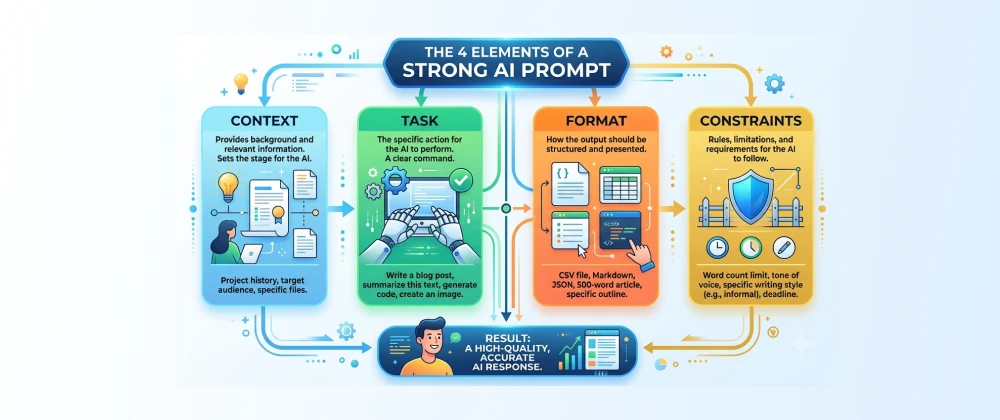
- Strong prompts generally include four elements: context, task, format, and constraints
- As AI models improve at inferring intent, the skill is shifting from a niche job title to a baseline workplace competency
- US and EU professionals across marketing, support, and operations increasingly rely on prompting to get more value from everyday AI tools
- This guide covers what it is, real examples, and how to start improving your own prompts today
Table of Contents
The Skill Everyone Suddenly Expects You to Have
What is prompt engineering? Prompt engineering is the practice of writing clear, specific instructions to get useful, accurate results from an AI system like ChatGPT, Claude, or Gemini. It involves choosing the right words, providing context, and refining instructions based on the AI's response — similar to learning how to ask a very capable but literal-minded assistant exactly what you need.
Maybe your manager in Chicago mentioned it in a team meeting. Maybe you saw a job posting in Amsterdam listing "prompt engineering" as a nice-to-have skill, right next to Excel and project management. Either way, if you've felt a small flicker of anxiety about a term you can't quite define, you're not alone — and you're not behind.
Unlike traditional programming, prompt engineering doesn't require writing code. It's a communication skill focused on structuring requests so a large language model understands the task, tone, and format you want — and it's becoming as fundamental to modern office work as knowing how to write a clear email.
This guide from SmartAIHuman.com breaks down exactly what prompt engineering is, how it works, where it's used across US and European workplaces, and how to start getting better at it today.
How We Researched This Guide
Our Research Methodology
- Model testing: We ran identical tasks through ChatGPT, Claude, and Gemini using both weak and strong prompt phrasing to observe real differences in output quality.
- Workplace use-case review: We examined how prompting is actually used in marketing, customer support, and operations roles across US and EU companies.
- Academic sourcing: Definitions and context were cross-checked against research from Stanford HAI and MIT CSAIL.
- Workforce data review: We reviewed McKinsey, OECD, and Pew Research reporting on AI skills demand in the US and Europe.
- Compliance check: We considered how EU AI Act transparency principles intersect with everyday employee use of AI prompting tools.
What Is Prompt Engineering? Core Concepts Explained
Prompt engineering is the practice of crafting clear, structured instructions to guide an AI model toward accurate, useful responses. It sits at the intersection of communication and problem-solving: you're not writing code, you're translating a goal in your head into language a model can act on precisely.
Every prompt, whether it's one sentence or ten, is doing the same basic job: telling the AI what you want, in what context, and in what form. The better you do that, the less back-and-forth it takes to get a usable answer.
The Four Elements of a Strong Prompt
Most weak prompts are missing one of four ingredients. Use this as a quick mental checklist before you hit enter:
A Real Before-and-After Example
Here's the same request, written two ways, to show why this matters in practice:
The second version gives the model everything it needs — audience, length, tone, structure, and goal — in one pass, instead of requiring three or four rounds of back-and-forth editing.
Why Prompt Engineering Matters in 2026
Generative AI tools are now embedded directly into email clients, spreadsheets, design software, and customer service platforms across the US and Europe. The tools themselves have gotten easier to use, but the quality gap between a vague request and a well-structured one hasn't closed — if anything, it's more visible now that so many more people are using these tools daily.
For US and EU professionals, that means prompting well is quietly becoming as basic a workplace expectation as writing a clear email or building a usable spreadsheet formula — not a specialized technical skill reserved for engineers.
Real-World Use Cases in the US and Europe
Marketing and Content Teams
Marketing teams at US and EU small businesses use structured prompting to draft social copy, email campaigns, and ad variations quickly, then refine tone and length rather than starting from a blank page.
Customer Support
Support teams use well-engineered prompts to turn raw customer complaints into clear, empathetic response drafts — with constraints like "acknowledge frustration first, then offer a solution in two sentences" built into a reusable prompt template.
Operations and Admin Work
Operations staff across US and EU companies use prompting to summarize long documents, extract action items from meeting notes, and draft first passes of internal policies — tasks that used to take much longer manually.

How to Get Started with Prompt Engineering
Step-by-Step
- Start with one real task: Pick something you already do weekly — drafting emails, summarizing notes — rather than experimenting abstractly.
- Apply the four-element checklist: Add context, a specific task, a desired format, and any constraints before you submit the prompt.
- Compare weak vs. strong versions: Run your original phrasing, then a rewritten version, and notice the difference in output quality.
- Iterate, don't restart: If the output is close but not quite right, refine the same prompt with added detail rather than starting over from scratch.
Best Tools to Practice This Skill
ChatGPT (OpenAI)
Widely used across US and EU workplaces, with strong general-purpose performance for drafting, summarizing, and brainstorming tasks.
Claude (Anthropic)
Known for closely following detailed, structured instructions and longer context, making it well-suited to prompts with multiple constraints.
Gemini (Google)
Integrated directly into Google Workspace tools, useful for prompting within documents, sheets, and email already in daily use.
Prompt Engineering vs. AI Agents vs. Traditional Coding
These three terms are frequently confused. Here's how they actually compare:
| Category | Prompt Engineering | AI Agents | Traditional Coding |
|---|---|---|---|
| Coding Required | |||
| Learning Curve | |||
| Autonomy of the System | |||
| Best For | Everyday communication with AI tools | Multi-step autonomous tasks | Custom software and systems |
Pros & Cons of Prompt Engineering as a Skill
✅ Pros
- No coding background required to learn it
- Immediately applicable to tools most people already use daily
- Improves output quality across nearly any AI-assisted task
- Transferable across ChatGPT, Claude, Gemini, and most other models
⚠️ Cons
- Best practices shift as models improve at inferring intent
- Can create a false sense that any AI output is fully trustworthy without review
- Formal "prompt engineer" job titles are shrinking even as the underlying skill spreads
- Requires ongoing practice — skills can get rusty without regular use
Alternatives to Formal Prompt Engineering
Learning the four-element framework isn't the only path to better AI results. Depending on how much time you want to invest, a few lighter-weight alternatives exist:
- Built-in AI assistants: Tools like Gemini in Google Workspace or Copilot in Microsoft 365 are increasingly designed to infer intent from casual, conversational requests, reducing the need for careful manual prompting.
- Prompt template libraries: Many teams use shared, pre-written prompt templates for recurring tasks (like drafting support replies), so individual staff never need to write prompts from scratch.
- AI agents: For genuinely multi-step, autonomous tasks, an AI agent that plans and executes on its own may be a better fit than refining a single prompt — see the comparison table above.
These alternatives lower the learning curve but generally trade away some of the precision and control that comes from writing your own well-structured prompts.
Expert Insights
Research groups studying AI's effect on work — including Stanford's Institute for Human-Centered Artificial Intelligence (HAI) and MIT CSAIL — have consistently tracked a shift in how generative AI is used at work: as these tools get embedded directly into everyday software, the ability to direct them clearly and precisely is looking less like a specialist skill and more like a baseline expectation across white-collar roles.
[Insert a specific, sourced quote or finding from a named Stanford HAI, MIT, or OECD report here before publishing — do not attribute an invented quote to a real institution.]
Future Trends: Where This Skill Is Headed Beyond 2026
Expect prompting to become less about clever wording and more about structured thinking — clearly defining a goal, the audience, and the constraints before involving AI at all. In the EU, expect growing attention to how employee prompting interacts with EU AI Act transparency and data-handling obligations, particularly in regulated industries like finance and healthcare.
Overall Usefulness Rating
Frequently Asked Questions
Real questions US and European readers search for, answered clearly.
The Bottom Line: A Skill, Not a Buzzword
Prompt engineering isn't a mysterious technical discipline reserved for AI specialists — it's a practical communication skill that anyone using ChatGPT, Claude, or Gemini at work can learn and improve with a bit of deliberate practice.
Whether you're a marketing coordinator in Austin, an operations manager in Rotterdam, or a student trying to get more out of your study tools, understanding the four elements of a strong prompt — context, task, format, and constraints — puts you ahead of most casual AI users immediately.
At SmartAIHuman.com, we'll keep covering how AI skills like this one evolve as generative AI becomes a standard part of everyday work across the US and Europe.
Related Articles on SmartAIHuman.com
Sources & External Authority References
- Stanford Institute for Human-Centered Artificial Intelligence — "AI Index Report" (2025). hai.stanford.edu
- McKinsey & Company — "The State of AI in the Workplace" (2025). mckinsey.com
- MIT Computer Science and Artificial Intelligence Laboratory (CSAIL) — Generative AI Research Overview. csail.mit.edu
- OECD — "AI and the Future of Skills" (2025). oecd.org
- European Commission — Digital Skills and Jobs Agenda. digital-strategy.ec.europa.eu

SmartAIHuman Editorial Team shares practical AI guides, tool reviews, productivity strategies, and beginner-friendly tech tutorials to help readers use AI effectively in everyday life.