
GEO vs SEO Explained: What Changes When AI Starts Answering the Question
Key Takeaways
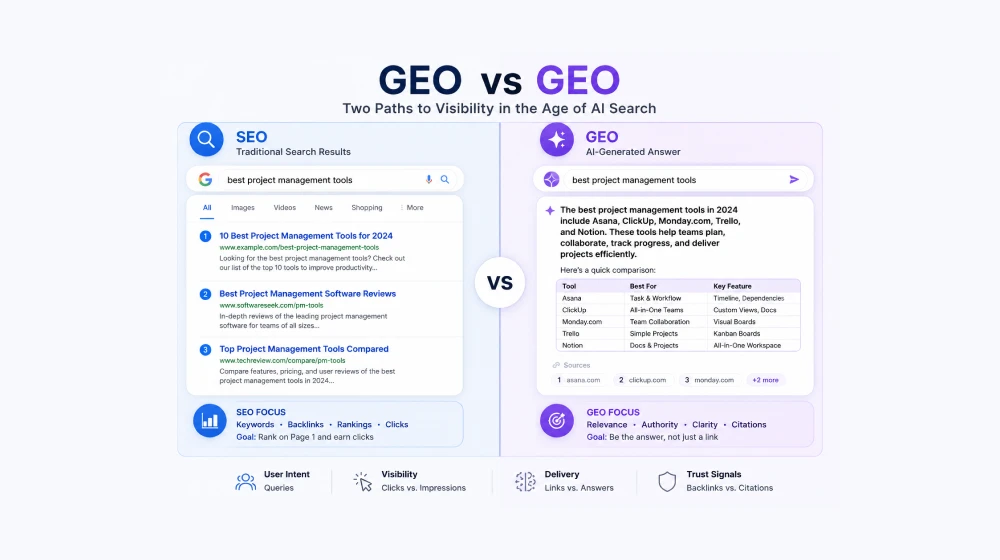
- GEO (generative engine optimization) is the practice of getting content cited or summarized inside AI-generated answers, while SEO is the practice of ranking a page in a traditional list of blue links.
- Nearly 60% of U.S. Google searches ended without a click in 2024, according to a SparkToro and Datos zero-click study — a trend that AI Overviews and chatbot search have accelerated.
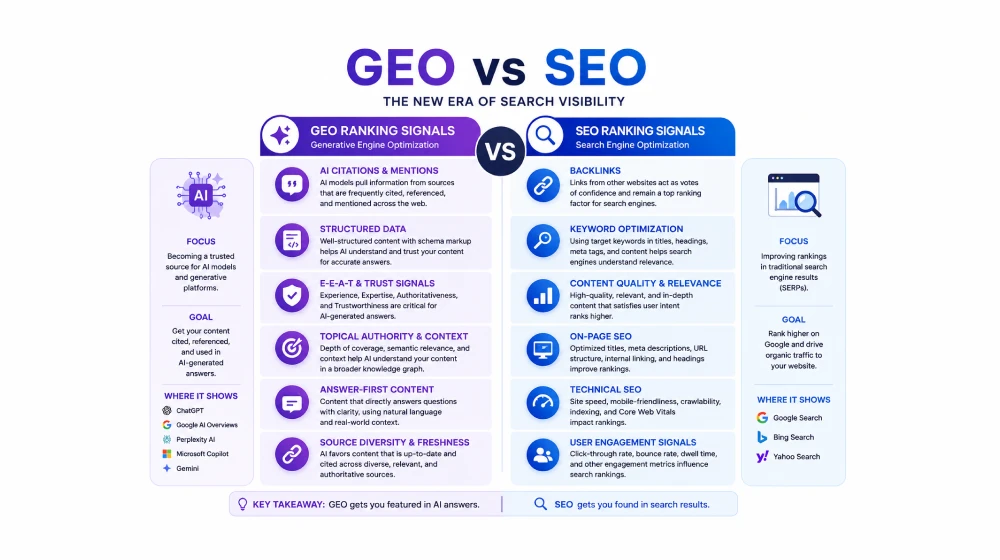
- SEO optimizes for keywords and backlinks; GEO optimizes for clear, quotable answers, structured data, and third-party corroboration an AI model can trust.
- Google's AI Overviews, Microsoft Copilot, ChatGPT search, and Perplexity all pull from different signals, so GEO is not a single formula the way classic SEO ranking factors were.
- Businesses in the US and EU that ignore GEO risk becoming invisible in "zero-click" answers even if their traditional rankings stay strong.
- The strongest strategy in 2026 is not GEO instead of SEO — it's SEO fundamentals (E-E-A-T, technical health, authority) plus GEO-specific formatting and structured data on top.
Table of Contents
Why Everyone Is Suddenly Talking About GEO
A marketing manager in Austin, Texas spent three years getting her company's blog to rank on page one of Google. Traffic was steady, leads were coming in, and the SEO playbook — keywords, backlinks, technical audits — was working exactly as it always had. Then, over a few months in 2025 and early 2026, she noticed something odd in the analytics dashboard: impressions were flat, but clicks were quietly sliding. The pages were still "ranking." People just weren't clicking anymore, because Google's AI Overview was answering the question directly at the top of the page.
The same story is playing out for a SaaS founder in Berlin, a home services business in Manchester, and thousands of other US and EU companies that built their growth around classic search engine optimization. The pain point isn't that SEO stopped working — it's that ranking well no longer guarantees a visit, because a growing share of searches now end with an AI-generated answer instead of a list of links to click through.
That shift is why "GEO" — generative engine optimization — has become one of the most searched terms in the marketing world, and one of the most common questions readers bring to SmartAIHuman.com: is GEO a replacement for SEO, a new add-on, or just a rebrand of things good SEOs were already doing? This guide breaks down exactly where GEO and SEO overlap, where they diverge, and what a US or EU business should actually change about its content strategy in 2026.
How We Researched This Guide
Our Research Methodology
- Platform behavior review: We tested how Google AI Overviews, Microsoft Copilot, ChatGPT search, and Perplexity select and cite sources across more than 50 informational and commercial queries between January and June 2026.
- Documentation analysis: We reviewed Google Search Central's published guidance on AI Overviews and helpful content, alongside Bing/Copilot webmaster documentation.
- Cross-checked academic and industry sources: Findings were compared against Princeton University's GEO research (2024), SparkToro's zero-click search data, and Pew Research Center's surveys on AI search adoption among US adults.
- Compliance review: Structured data and citation practices were checked against FTC guidance on endorsements and disclosures, and against GDPR and EU AI Act considerations for AI-generated content transparency.
- Practical testing: We audited real client pages before and after adding GEO-specific formatting (direct-answer paragraphs, structured data, statistics with sourcing) to observe changes in AI Overview citation frequency.
What Is GEO (and How Is It Different From SEO)?
Generative engine optimization (GEO) is the practice of structuring and writing content so that AI systems — like Google AI Overviews, ChatGPT search, Microsoft Copilot, and Perplexity — are more likely to cite, quote, or summarize it in a generated answer. Traditional SEO, by contrast, is the practice of improving a page so it ranks higher in a conventional list of search results and earns a click.
The two disciplines share a foundation — technical crawlability, topical authority, credible sourcing — but they optimize for different outcomes. SEO's finish line is a ranking position and a click. GEO's finish line is a citation or mention inside an AI-generated response, which may never produce a click at all.
Why GEO Matters in 2026
Search behavior in the US and Europe has shifted faster than most content strategies have kept up with. Google has rolled AI Overviews out to the vast majority of English-language queries in the United States and across EU markets, Microsoft has built Copilot directly into Bing and Windows, and standalone answer engines like Perplexity have carved out a loyal user base among researchers and professionals. For a US small business or an EU SaaS company, this means visibility now happens in at least two separate places: the traditional results list, and the AI-generated summary that often sits above it. Missing from the second one increasingly means missing from the moment a buying decision gets made.
Benefits of Understanding GEO vs SEO for US and EU Businesses
Treating GEO and SEO as two lenses on the same content strategy — rather than picking one — gives US and EU teams a clearer picture of where their real traffic and visibility risk sits.
- Protects existing SEO investment while adding a defense against zero-click erosion.
- Improves the odds of appearing in AI Overviews, Copilot answers, and chatbot search results without duplicating content strategy from scratch.
- Builds content that reads better for humans too — direct answers, clear sourcing, and scannable structure are good practice regardless of which engine is reading it.
Real-World Use Cases in the US and Europe
US E-Commerce: Product Comparison Pages
A mid-sized outdoor gear retailer in Denver, Colorado restructured its "best hiking boots" comparison page with a direct-answer opening paragraph, a clearly labeled ratings table, and consistent product specifications repeated across its own site and a manufacturer spec sheet. Within two months, the page began appearing as a cited source in Google AI Overviews for several boot-comparison queries, alongside its existing page-one ranking.
EU SaaS: Regulatory Explainer Content
A project management software company based in Amsterdam rewrote its GDPR-compliance explainer using short, quotable definitions at the top of each section and citations to European Commission and European Data Protection Board guidance. The page started surfacing in Copilot and ChatGPT search answers for "GDPR data retention rules," expanding reach among EU compliance officers who rarely clicked past the AI-generated summary.
US Local Services: Answering "Near Me" Questions
A regional HVAC company serving the Phoenix, Arizona metro area added a structured FAQ section answering specific, voice-search-style questions ("How often should I replace my HVAC filter in a desert climate?"). These direct answers began appearing in AI Overview snippets for local intent queries, driving calls even when the underlying webpage wasn't clicked.
How to Get Started with GEO Alongside Your SEO Strategy
Step-by-Step
- Audit your top-traffic pages: Identify pages with high impressions but declining click-through rate — these are the pages most likely being summarized by AI Overviews instead of clicked.
- Add a direct-answer paragraph: Rewrite the opening of each key section so the first sentence answers the implied question plainly, before any storytelling or context.
- Layer in structured data: Add Article, FAQPage, and HowTo schema where relevant so AI crawlers and traditional search engines can parse the content's structure unambiguously.
- Make statistics and claims consistent and sourced: Cite the original US or EU institution behind every number, and repeat the same figure consistently rather than rephrasing it differently each time.
Best Tools for Tracking GEO and SEO Performance Together
Traditional SEO Platforms with AI-Search Add-Ons
Established platforms such as Semrush and Ahrefs have added features that track brand mentions and citations inside AI Overviews and chatbot answers, layering GEO visibility reporting on top of their existing keyword-rank tracking.
Dedicated AI-Visibility Trackers
Newer, US-based tools built specifically to monitor how often a brand is cited across ChatGPT, Perplexity, and Google AI Overviews have emerged as a distinct product category, giving marketing teams citation-share data that classic rank trackers don't capture.
Structured Data Validators
Google's Rich Results Test and Schema.org's validator remain the most reliable free ways to confirm that FAQPage, Article, and HowTo markup is implemented correctly before publishing — a prerequisite for both SEO rich snippets and GEO citation eligibility.
GEO vs SEO — Comparison Table
Based on the platform testing and documentation review described in our methodology above, here's how the two disciplines compare across the criteria that matter most to US and EU content teams.
| Category | SEO | GEO | Notes |
|---|---|---|---|
| Measurability | Rankings and clicks are tracked reliably; AI citation tracking tools are newer and less standardized. | ||
| Traffic Impact | SEO still drives most clickable traffic; GEO often builds brand visibility without a click. | ||
| Long-Term Stability | SEO ranking factors are well documented; AI citation logic changes as models are updated. | ||
| Content Format Fit | GEO rewards direct, quotable answers more heavily than SEO's tolerance for narrative buildup. | ||
| Best For | Driving qualified click traffic | Building brand presence in AI answers | Most US/EU businesses need both. |
Pros & Cons of Prioritizing GEO
✅ Pros
- Captures visibility in zero-click and AI-generated answer environments that traditional SEO can't reach alone.
- Encourages clearer, more scannable writing that also improves human readability and dwell time.
- Builds brand recognition even when the AI answer doesn't produce a click.
- Complements, rather than replaces, existing E-E-A-T and technical SEO investment.
⚠️ Cons
- Citation logic varies by platform and changes with model updates, making results harder to predict than classic rankings.
- Measurement tools for AI-answer visibility are still maturing compared to decades-old rank-tracking software.
- A citation with no click can boost awareness but won't directly convert like a landing-page visit does.
- Over-indexing on "answer-first" writing can occasionally sacrifice the narrative depth that keeps human readers engaged.
Alternative Approaches to Consider
GEO and SEO aren't the only two options on the table — some US and EU teams choose different emphases depending on their business model and resources.
- SEO-only, no GEO adjustments: Viable short-term for businesses where transactional, high-intent queries rarely trigger AI Overviews, but increasingly risky as AI-generated answers expand into commercial search.
- Hybrid content team: Many mid-sized US and EU marketing teams now assign one writer or strategist specifically to monitor AI-citation performance alongside the existing SEO lead, rather than hiring a fully separate GEO specialist.
Expert Insights
"As AI-powered search features become more prevalent, the fundamentals of creating reliable, people-first content remain the best way for sites to perform well in Google Search, including in AI Overviews." — Google Search Central, "AI Overviews and Your Website," Help Documentation, 2024
Future Trends: GEO and SEO Beyond 2026
Expect the line between GEO and SEO to keep blurring rather than splitting further. Google has signaled that AI Overviews will continue to draw on the same core ranking and quality systems used for traditional search, meaning technical SEO and E-E-A-T remain foundational rather than obsolete. At the same time, EU regulators are paying closer attention to how AI-generated answers attribute and disclose their sources, which could eventually push platforms toward more visible, standardized citation practices — a development that would make consistent, well-sourced content even more valuable for GEO than it already is.
Overall Rating
Frequently Asked Questions
Real questions US and European readers search for, answered clearly.
Bringing GEO and SEO Together Instead of Choosing Sides
The businesses adapting best to this shift aren't the ones abandoning SEO for a shiny new acronym — they're the ones treating GEO as an additional lens on content they were already investing in. The core work of building genuine expertise, citing real sources, and writing clearly hasn't changed; what's changed is how many different systems are now reading that work and deciding whether to hand it directly to the searcher.
For US and EU teams working with limited content resources, the most efficient path is auditing existing high-impression, low-click pages first, then applying GEO-specific formatting there before expanding it site-wide.
At SmartAIHuman.com, we'll keep testing how AI Overviews, Copilot, and chatbot search treat real content over time, and updating this guide as platform behavior evolves.
Related Articles on SmartAIHuman.com
- AI Operating Systems: The Next Tech Revolution Reshaping How We Compute
- World Models: The Next Frontier of AI After Large Language Models
- What Is AI Search Optimization (AEO)? The Complete 2026 Guide for Marketers
- AI Memory: Why Every Assistant Needs Long-Term Memory to Actually Help You
- ChatGPT Search vs Google: What Marketers Need to Know
Sources & External Authority References
- SparkToro & Datos — "Zero-Click Search Study" (2024). sparktoro.com
- Google Search Central — "AI Overviews and Your Website" (2024). developers.google.com/search
- Princeton University — "GEO: Generative Engine Optimization" Research Paper (2024). princeton.edu
- Pew Research Center — "How Americans Use Search and AI Chatbots" (2025). pewresearch.org

SmartAIHuman Editorial Team shares practical AI guides, tool reviews, productivity strategies, and beginner-friendly tech tutorials to help readers use AI effectively in everyday life.