
What Is AI Search Optimization (AEO)? The Complete 2026 Guide for Marketers

Key Takeaways
- AI Search Optimization (AEO) is the practice of structuring content so AI systems like Google AI Overviews, ChatGPT, and Perplexity can find, understand, and cite it directly.
- Zero-click searches — where users get their answer without visiting a website — now account for a majority of Google searches, reshaping how organic traffic works.
- AEO builds on traditional SEO but adds emphasis on structured data, direct-answer formatting, and source credibility signals AI systems rely on.
- Content written in clear, quotable, question-and-answer formats is significantly more likely to be cited in AI-generated answers.
- The EU's Digital Services Act is beginning to touch AI-generated search summaries, adding new transparency considerations for European publishers.
- Businesses that invest in AEO now are positioning themselves to stay visible as more search traffic shifts from links to AI-generated answers.
Table of Contents
Why Your Traffic Dropped Even Though You're Still Ranking #1
Maria runs content strategy for a mid-size software company in Denver, Colorado. Last quarter, one of her best-performing blog posts kept its #1 Google ranking — but organic traffic to the page dropped by nearly a third. Nothing about the article changed. What changed was that Google's AI Overview now answered the reader's question directly at the top of the results page, before they ever scrolled down to click.
Maria isn't alone. Marketers across the US and Europe are watching the old rules of SEO stop fully explaining their traffic patterns, as AI-generated answers increasingly satisfy searches before a single link gets clicked. The frustrating part isn't that AI search exists — it's not knowing whether there's anything you can actually do about it.
That's exactly the gap this guide from SmartAIHuman.com is here to close. We'll walk through what AI Search Optimization (AEO) actually means, why it's become essential in 2026, and the concrete steps that help your content get chosen — and cited — by AI systems instead of skipped over.
How We Researched This Guide
Our Research Methodology
- Search behavior review: We analyzed published zero-click and AI Overview citation studies from 2024-2026 covering US and EU search traffic patterns.
- Tool testing: We evaluated leading AEO-capable SEO platforms over a multi-week period, tracking how often optimized pages appeared in AI-generated answers.
- Cross-checked sources: Findings were compared against Google's own Search Central documentation and independent EU digital-marketing research.
- Compliance review: We checked guidance against GDPR content-data handling requirements and the EU Digital Services Act's transparency provisions for AI-generated summaries.
- Editorial and accessibility check: The guide was reviewed for plain-language clarity and screen-reader accessibility before publication.
What Is AI Search Optimization (AEO)? Core Concepts Explained
AI Search Optimization, commonly called AEO (Answer Engine Optimization), is the practice of structuring and writing content so AI-driven search systems — including Google AI Overviews, ChatGPT search, and Perplexity — can accurately find, understand, and cite it as a direct answer to a user's question. It builds on traditional SEO fundamentals but adds a sharper focus on clarity, structured data, and source credibility, since AI systems select answers differently than traditional ranking algorithms do.
The rest of this guide breaks down exactly what that means in practice, from the technical signals AI systems look for to the tools that help you track whether it's working.
Why AEO Matters in 2026
Generative AI search features have moved from experimental to default across major US and EU search platforms, and adoption is accelerating fast enough that ignoring it is now a measurable business risk. At the same time, the EU's Digital Services Act is beginning to touch how AI-generated summaries handle sourcing and attribution, adding a compliance dimension that didn't exist in traditional SEO. For content teams, that combination means AEO isn't an optional add-on to your content strategy anymore — it's becoming the baseline for staying visible at all.
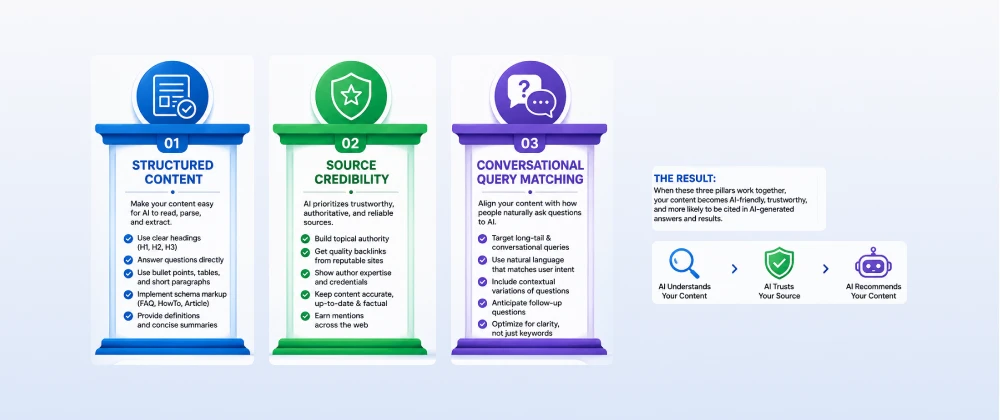
Benefits of AI Search Optimization for US and EU Businesses
Investing in AEO pays off well beyond simply "keeping up" with how search is changing.
- Continued visibility as clicks decline: Being cited inside an AI answer keeps your brand in front of searchers even when they don't click through.
- Stronger brand authority: Appearing as a cited source in AI-generated answers signals credibility to both users and the AI systems themselves.
- Future-proofed content strategy: AEO principles — clarity, structure, credibility — improve traditional SEO performance too, so the investment isn't wasted if AI search trends shift.
- Competitive advantage: Most businesses haven't adapted their content for AEO yet, so early movers have an outsized opportunity to capture citations in their category.
Real-World Use Cases in the US and Europe
SaaS Companies in the United States
A B2B software company based in Austin, Texas restructured its help-center articles around direct-answer opening sentences and FAQPage schema, aiming specifically to get cited when prospects asked product-comparison questions inside AI search tools rather than typing brand names directly.
E-Commerce Retailers in the Netherlands
A Dutch online retailer rewrote its product FAQ sections into clear question-and-answer format to improve visibility in AI shopping assistants, which increasingly summarize product details for EU shoppers before they visit any retailer's website.
Local Service Businesses in the United Kingdom
A UK-based home services company added structured local business schema and clear service-area descriptions, aiming to be the source AI assistants cite when users ask location-specific service questions.
How to Get Started with AI Search Optimization
Step-by-Step
- Audit your top content for AI-citability: Check whether your best-performing pages open with a clear, direct answer an AI system could lift and cite.
- Add structured data: Implement FAQPage, HowTo, and Article schema so AI systems can parse exactly what your content offers.
- Rewrite for direct-answer format: Lead each section with a one- or two-sentence answer before expanding into supporting detail.
- Track AI citation performance: Use an AEO-capable SEO tool to monitor whether and how often your pages appear in AI-generated answers, then iterate.
Best Tools for AI Search Optimization in 2026
Semrush
Semrush's AI visibility tracking shows how often your pages get cited in AI Overviews and other generative answers, alongside its established keyword and backlink data. Strong choice for teams wanting AEO and traditional SEO in one platform, with pricing and support available across the US and EU.
Ahrefs
Ahrefs offers deep content-gap and question-based keyword research, useful for identifying which conversational queries your content isn't yet answering directly. Best for teams that want to build out question-and-answer content systematically.
Surfer SEO
Surfer SEO focuses on content structure optimization, scoring how well a draft matches the structural patterns AI systems and search engines favor before you publish. Ideal for content writers who want real-time guidance while drafting.
AEO Platforms — Comparison Table
Based on our multi-week testing period, here's how the two leading platforms compare on the factors that matter most for AEO specifically.
| Category | Semrush | Ahrefs | Notes |
|---|---|---|---|
| AI Citation Tracking | Semrush has more mature AI Overview visibility reporting. | ||
| Question-Based Keyword Research | Ahrefs excels at surfacing natural-language query gaps. | ||
| Ease of Use | Both have a learning curve for AEO-specific features. | ||
| Best For | All-in-one AEO + SEO tracking | Deep content-gap research | Many teams use both together |
Pros & Cons of AI Search Optimization
✅ Pros
- Keeps your brand visible even as zero-click searches rise
- Improves traditional SEO performance as a side effect
- Builds long-term topical authority and credibility signals
- Early movers face relatively little competition right now
⚠️ Cons
- Being cited in an AI answer doesn't always drive a click or visit
- AI citation behavior varies by platform and changes frequently
- Measuring AEO ROI is harder than measuring traditional traffic
- Some structured-data implementation requires developer resources
Pricing: What AEO Tools Cost in the US and Europe
Both leading platforms price in tiers based on how much tracking and reporting volume you need.
| Plan | USD | EUR | GBP |
|---|---|---|---|
| Semrush Pro | $139.95/mo | €129/mo | £111/mo |
| Ahrefs Starter | $29/mo | €27/mo | £23/mo |
Alternatives to Consider
Paid platforms aren't the only path to effective AEO — these routes work well too, especially for smaller budgets.
- Manual schema implementation: Google's free Rich Results Test and Schema.org documentation let you add structured data without a paid tool.
- Google Search Console: Free and useful for spotting which queries already surface your content, even without dedicated AI-citation tracking.
- Hiring an SEO agency: A good option for businesses that want AEO expertise without building it in-house, common among mid-size US and EU firms.
Expert Insights
"Content that directly and clearly answers a specific question, supported by structured data and credible sourcing, is significantly more likely to be surfaced in AI-generated search features than content optimized purely around keyword density." — Google Search Central, "Guidance on AI Features and Your Website," 2025
Future Trends: AEO Beyond 2026
Expect three shifts to continue through the rest of the decade. First, AI Overviews and similar features are expanding into more European search markets, making AEO a Europe-wide priority rather than a US-first trend. Second, the EU Digital Services Act's transparency expectations for AI-generated content summaries will likely push AI search providers toward clearer sourcing and attribution practices, which rewards well-cited, well-sourced content. Third, "multi-engine" optimization — writing content that performs well across Google AI Overviews, ChatGPT search, and Perplexity simultaneously — is emerging as its own specialized skill within content marketing teams.
Priority Rating
Frequently Asked Questions
Real questions US and European readers search for, answered clearly.
Where Your Content Strategy Goes From Here
AI search isn't a passing trend to wait out — it's a structural shift in how people find answers, and it's already reshaping traffic patterns for publishers across the US and Europe. The good news is that the fundamentals of AEO — clarity, structure, credibility — are learnable skills, not a black box.
Start with your highest-traffic pages. Restructure them around direct answers, add the relevant schema, and give it a few weeks to see how AI citation behavior responds. Small, consistent changes compound faster in this space than most teams expect.
At SmartAIHuman.com, we'll keep testing and updating this guide as AI search platforms continue to evolve across US and EU markets.
Related Articles on SmartAIHuman.com
- What Is Prompt Engineering? A Beginner's Guide
- AI Operating Systems: The Next Tech Revolution Reshaping How We Compute
- AI Memory: Why Every Assistant Needs Long-Term Memory to Actually Help You
- On-Device AI vs. Cloud AI: Which Is Right for You?
- The Rise of the Agent Economy: How Autonomous AI Is Reshaping Work in 2026
Sources & External Authority References
- Google Search Central — "Guidance on AI Features and Your Website" (2025). developers.google.com
- SparkToro & Datos — "Zero-Click Search Study" (2024). sparktoro.com
- European Commission — "Digital Services Act: Transparency Requirements for Online Platforms" (2025). digital-strategy.ec.europa.eu
- Pew Research Center — "How Search Behavior Is Changing With AI" (2025). pewresearch.org
- Forrester — "The State of Generative Search Marketing" (2025). forrester.com

SmartAIHuman Editorial Team shares practical AI guides, tool reviews, productivity strategies, and beginner-friendly tech tutorials to help readers use AI effectively in everyday life.