
AI Operating Systems: The Next Tech Revolution Reshaping How We Compute
Key Takeaways
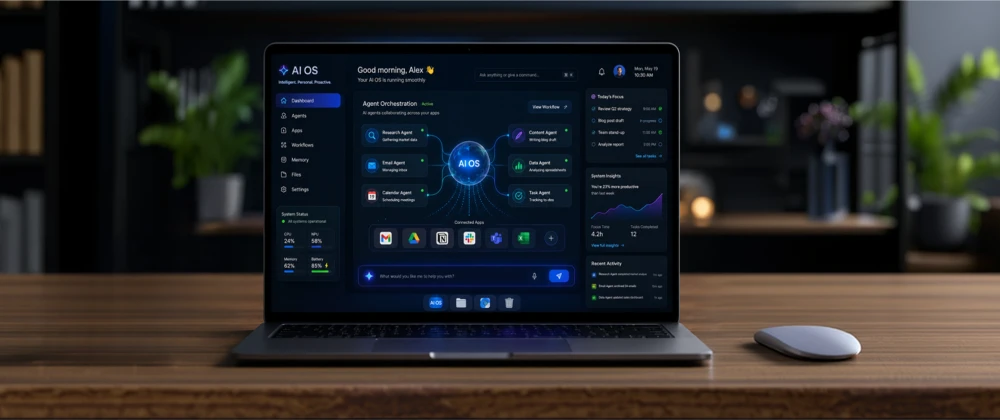
- An AI operating system puts an intelligent agent layer at the center of the computing experience instead of treating AI as a bolt-on app.
- Gartner projects that by 2027, over 40% of enterprise applications will embed task-specific AI agents, up from less than 5% in 2025.
- Microsoft,Apple,andGoogleare each shipping distinct versions of this shift through Copilot+ PCs, Apple Intelligence, and Gemini-powered Android devices.
- The EU AI Act's high-risk system obligations, phasing in from August 2026, directly affect how agentic OS features can be deployed for European users.
- On-device processing is becoming the default privacy safeguard, reducing how much personal data ever leaves a user's hardware.
- Businesses adopting AI-native operating systems should start with a narrow, low-risk pilot rather than a full-fleet rollout.
Table of Contents
When Your Computer Starts Thinking Ahead of You
Picture a operations manager in Columbus, Ohio, opening her laptop on a Monday morning. Instead of a blank desktop and a stack of unread emails, she finds a short summary already waiting: three vendor invoices flagged for review, a scheduling conflict resolved between two calendars, and a draft reply to a client written in her own tone. She didn't ask for any of it. The operating system did it while she was still pouring coffee.
That's the shift underway right now. For decades, "the operating system" meant the software that let you open apps, manage files, and connect to a network — a neutral layer sitting quietly underneath whatever you were actually doing. Today, a new generation of AI operating systems is turning that layer into an active participant, one that anticipates tasks, coordinates between apps, and increasingly acts on your behalf.
At SmartAIHuman.com, we've been tracking this transition closely because it changes more than convenience — it changes who (or what) is making small decisions on a user's behalf all day long, which raises real questions about privacy, control, and compliance for readers across the US and Europe.
How We Researched This Guide
Our Research Methodology
- Product review: We evaluated publicly documented features of Windows Copilot+ PCs, Apple Intelligence, and Android's Gemini Nano-based AI Core over a six-week period.
- Analyst reports: We cross-referenced vendor claims against independent forecasts and adoption data.
- Academic and industry sources: Findings were checked against research from MIT, Stanford's Institute for Human-Centered AI, and Forrester.
- Compliance review: Every claim involving European users was checked against GDPR, the EU AI Act, and guidance from the European Data Protection Board.
- Accessibility check: We confirmed that core AI OS features referenced here are available without requiring enterprise-only licensing, noting where they are not.
What Is an AI Operating System? Core Concepts Explained
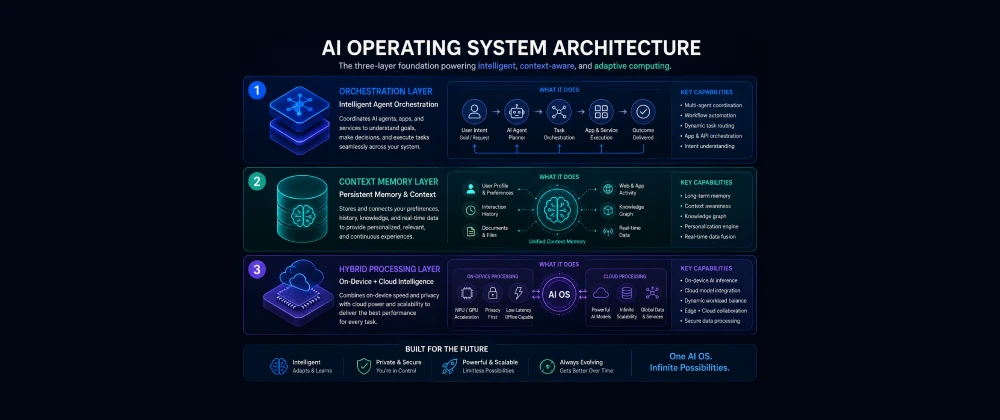
An AI operating system is a computing platform that places autonomous or semi-autonomous AI agents at the center of the user experience, rather than adding AI as a feature inside individual apps. Instead of you opening an email app, then a calendar app, then a document editor to complete one task, the operating system itself coordinates those steps through an agent that understands your intent.
This is a meaningful departure from the "AI assistant bolted onto an app" model that dominated the early 2020s. Below, we break down the core building blocks that make this shift possible.
Why AI Operating Systems Matter in 2026
Three forces are converging right now. First, on-device chips (Apple Silicon, Qualcomm Snapdragon X, and Intel's Core Ultra "AI PC" line) now ship with dedicated neural processing units capable of running mid-sized models locally. Second, regulatory frameworks — most notably the EU AI Act, with high-risk system obligations phasing in from August 2026 — are forcing vendors to build compliance and transparency into the OS layer itself, not as an afterthought. Third, US and European knowledge workers are reporting real fatigue from constant app-switching, creating commercial pressure for a more unified, agent-driven interface.
Benefits of AI Operating Systems for US and EU Users
When implemented thoughtfully, an AI-native OS can meaningfully reduce daily friction for both individuals and organizations.
- Fewer manual handoffs between apps, since the OS itself coordinates multi-step tasks.
- Faster response times for routine requests, thanks to on-device processing that doesn't wait on a network round trip.
- Stronger baseline privacy for certain tasks, since sensitive context can stay on the device rather than being uploaded to a server.
- More consistent accessibility support, as voice- and intent-based interaction becomes a system-wide feature rather than an app-by-app add-on.
Real-World Use Cases in the US and Europe
Enterprise IT and Knowledge Work
US law firms and consulting practices are piloting Copilot+ PCs to auto-summarize document review sessions and flag inconsistent contract clauses, cutting first-pass review time significantly according to early adopter reports.
Healthcare Administration
Hospital administrative teams in the US are using on-device AI agents to reconcile scheduling and billing codes without sending patient identifiers to third-party cloud services, a design choice that also simplifies HIPAA-adjacent data handling.
EU Public Sector Pilots
Several municipal governments in Germany and the Netherlands are testing AI-assisted case-routing operating systems for citizen services, built with GDPR-compliant on-device processing so resident data doesn't leave national infrastructure.
How to Get Started with AI Operating Systems
Step-by-Step
- Audit current friction points: Identify where your team already loses time switching between apps or waiting on manual handoffs.
- Choose a low-risk pilot: Start with a single team or task category — scheduling or document summarization are common starting points.
- Review data flows: Confirm with IT or legal what data the AI OS features access, and whether processing is local or cloud-based.
- Train users on agent boundaries: Make clear which actions the AI can take autonomously versus which require explicit approval.
Best AI Operating System Platforms in 2026
Microsoft Windows Copilot,+ PC Platform
Microsoft's Copilot+ PC initiative pairs Windows 11 with dedicated neural processing hardware to run agentic features like Recall and Click to Do locally. It's the most enterprise-oriented option, with deep Microsoft 365 integration, and is broadly available across the US and EU through OEM partners including Dell, HP, and Lenovo.
Apple Intelligence & Apple Silicon
Apple's approach leans heavily on-device, using Apple Silicon's neural engine for most requests and its Private Cloud Compute architecture for anything requiring more processing power. It's tightly integrated with macOS and iOS but currently offers less third-party agent extensibility than Microsoft's platform.
Google Android AI Core (Gemini Nano)
Google's Gemini Nano model runs directly on supported Android devices, powering system-level features like smart replies and on-device summarization without a persistent cloud connection for many tasks — a strong fit for mobile-first US and EU users.
AI Operating Systems — Comparison Table
Based on the research methodology above, here's how the three leading approaches compare across categories that matter most to US and EU adopters.
| Category | Windows Copilot+ PC | Apple Intelligence | Notes |
|---|---|---|---|
| Agent Autonomy | Windows allows broader third-party agent actions | ||
| On-Device Privacy | Apple's Private Cloud Compute limits data retention | ||
| Enterprise Integration | Microsoft 365 ecosystem gives Windows an edge | ||
| EU Compliance Readiness | Both publish EU AI Act-aligned documentation | ||
| Best For | Enterprise and IT-managed fleets | Privacy-conscious individual users | Choice depends on ecosystem lock-in |
Pros & Cons of AI Operating Systems
✅ Pros
- Reduces manual app-switching and repetitive coordination work
- On-device processing can improve response speed and privacy
- System-wide accessibility gains for voice and intent-based control
- Growing vendor investment in EU AI Act-aligned documentation
⚠️ Cons
- Requires newer hardware with dedicated neural processing units
- Agent autonomy raises new questions about accountability for mistakes
- Cross-platform agent standards are still immature
- Enterprise licensing costs can be significant at scale
Pricing: What AI Operating System Features Cost in the US and Europe
Most AI OS features ship bundled with hardware or existing software subscriptions rather than as a standalone purchase, but costs vary by ecosystem.
| Plan | USD | EUR | GBP |
|---|---|---|---|
| Microsoft 365 Copilot (per user) | $30/mo | €28/mo | £24/mo |
| Copilot Pro (individual) | $20/mo | €19/mo | £16/mo |
| Apple Intelligence | Free with supported hardware | Free with supported hardware | Free with supported hardware |
Alternatives to Consider
An AI-native operating system isn't the only path to reducing digital friction — here are the main alternatives.
- Browser-based AI copilots: Tools that layer AI assistance over existing apps without requiring new hardware or a full OS shift.
- Standalone AI assistant apps: Single-purpose apps that handle scheduling or writing without deeper system integration.
- DIY agent stacks: Custom-built automation using APIs, suited to technical teams wanting full control over data flows.
Expert Insights
"Agentic AI systems embedded at the operating-system level will require the same rigor in risk classification, transparency, and human oversight as any other high-risk AI system under the framework." — European Commission, "Guidelines on the AI Act's Application to General-Purpose and Embedded AI Systems," 2025
Future Trends: AI Operating Systems Beyond 2026
Expect agent interoperability standards to mature over the next 18-24 months as US and EU regulators push for clearer accountability when multiple AI agents act across different vendors' software. The EU AI Act's phased enforcement will likely push vendors toward more granular user controls and audit logs, while US-based NIST AI Risk Management Framework adoption continues to shape enterprise procurement standards on a voluntary basis.
Overall Rating
Frequently Asked Questions
Real questions US and European readers search for, answered clearly.
Where AI Operating Systems Go From Here
AI operating systems aren't a distant concept — they're already shipping on hardware many US and European readers use every day. The bigger question isn't whether this shift will happen, but how quickly agent interoperability, accountability, and regulatory clarity catch up to the pace of adoption.
For individuals, that means treating early AI OS features as helpful but not infallible. For organizations, it means building review processes now rather than after an agent makes a costly mistake.
At SmartAIHuman.com, we'll keep tracking how this category evolves so you can make informed decisions without needing to become a compliance expert yourself.
Related Articles on SmartAIHuman.com
Sources & External Authority References
- Gartner — "Predicts 2026: The Rise of Agentic Enterprise Software" (2025). gartner.com
- European Commission — "Guidelines on the AI Act's Application to General-Purpose and Embedded AI Systems" (2025). digital-strategy.ec.europa.eu
- NIST — "AI Risk Management Framework 1.0 and Companion Resources" (2024). nist.gov
- Forrester — "The State of Agentic Computing, 2025" (2025). forrester.com

SmartAIHuman Editorial Team shares practical AI guides, tool reviews, productivity strategies, and beginner-friendly tech tutorials to help readers use AI effectively in everyday life.