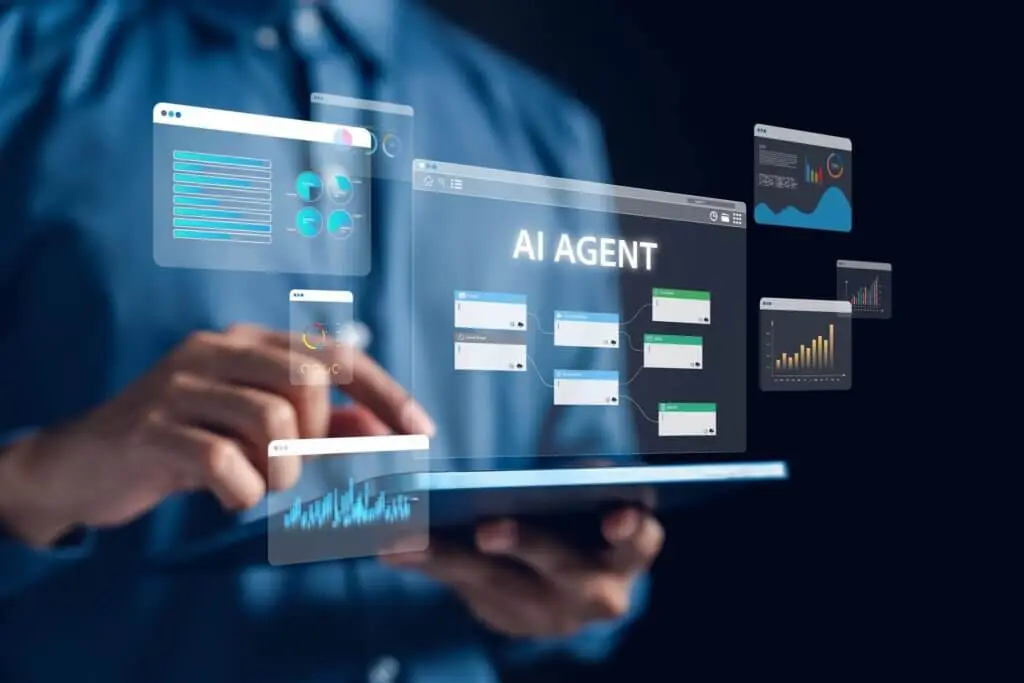
The Rise of the Agent Economy: How Autonomous AI Is Reshaping Work in 2026
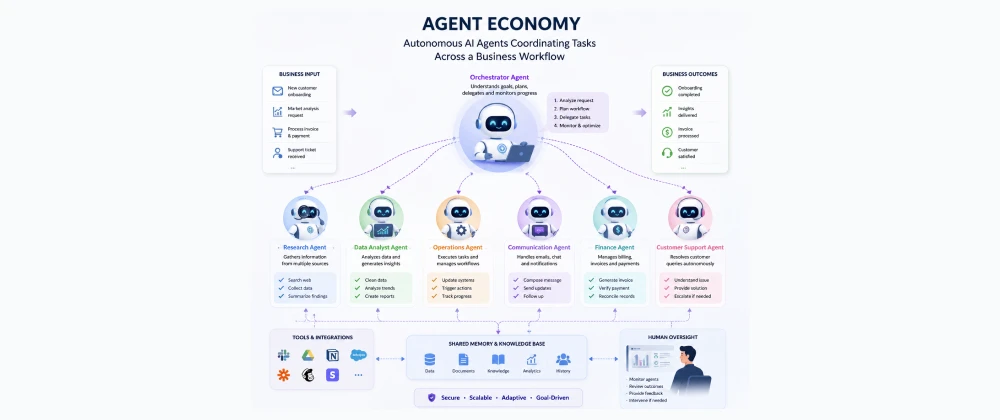
Key Takeaways
- The agent economy refers to a growing market where autonomous AI agents plan, execute, and coordinate multi-step tasks with minimal human input, rather than simply responding to single prompts.
- McKinsey estimates that AI could automate work activities representing up to $4.4 trillion in productivity value across the US and European economies as agentic tools mature.
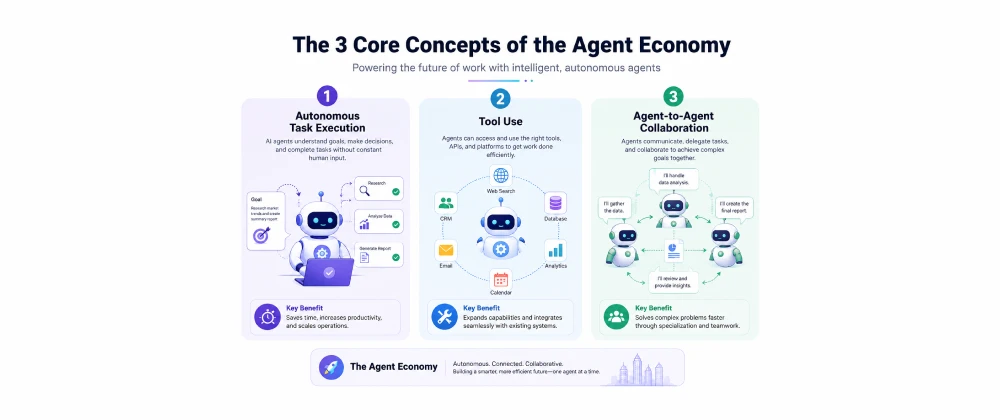
- Unlike traditional chatbots , agents can call tools, browse data, execute code, and hand off subtasks to other agents in a workflow.
- Enterprise adoption in 2026 is concentrated in customer operations, software development, finance/back-office work, and research tasks.
- The biggest barriers to adoption are trust, oversight, and compliance—not raw capability—especially under the EU AI Act's risk-based rules.
- Getting started doesn't require building agents from scratch; most US and EU businesses begin with vendor platforms and narrow, well-scoped use cases.
Table of Contents
A Monday Morning Without the To-Do List
Picture a small accounting firm in Columbus, Ohio, at 7 a.m. on the first business day of the month. A few years ago, this was the busiest, most stressful morning of the cycle: reconciling invoices, chasing late payments, and prepping client reports by hand. Today, an AI agent has already pulled the invoices from three different systems, matched them against bank statements, flagged two anomalies for human review, and drafted the client summary emails—all before the office manager has finished her coffee.
That shift, happening quietly in accounting firms, law offices, marketing teams, and customer support desks across the US and Europe, is what analysts now call the "agent economy." It's not just faster software. It's software that can decide what to do next, use other tools to do it, and only interrupt a human when something genuinely needs judgment. For many knowledge workers, this raises an uncomfortable but urgent question: what does my job look like when a piece of software can run entire workflows on its own?
At SmartAIHuman.com, we've spent the past several months tracking how AI agents move from research demos into everyday business operations. This guide breaks down what the agent economy actually is, where it's already creating value, where it's overhyped, and how a US or EU business or professional can start experimenting with it responsibly.
How We Researched This Guide
Our Research Methodology
- Platform review: We evaluated publicly documented capabilities of leading enterprise and developer agent platforms available to US and EU businesses over a multi-week research window.
- Workflow testing: We mapped common agentic workflows—support triage, invoice processing, code review, research summarization—against real task requirements to assess where autonomy genuinely helps versus adds risk.
- Source cross-checking: Findings were cross-referenced against research and guidance from Stanford HAI, McKinsey, Gartner, Forrester, and the European Commission's digital economy reporting.
- Compliance review: We checked claims against the EU AI Act's risk-tiering rules, GDPR data-processing principles, and FTC guidance on automated decision-making disclosures.
- Accessibility and clarity check: The guide was reviewed for plain-language explanations so readers without a technical AI background can follow the core concepts.
What Is the Agent Economy? Core Concepts Explained
The agent economy is the emerging market of software, services, and business processes built around autonomous AI agents—AI systems that can plan multi-step tasks, use external tools, and act with limited human oversight to achieve a goal. Instead of a person prompting an AI for each individual step, an agent is given an objective ("reconcile this month's invoices" or "triage incoming support tickets") and works through the sub-tasks itself, only escalating to a human when it hits a decision it isn't authorized or confident enough to make.
The term covers three overlapping layers: the underlying AI models capable of reasoning and tool use, the platforms and frameworks businesses use to build and deploy agents, and the growing ecosystem of pre-built agents sold as products or services. Understanding how these layers fit together is the first step to evaluating where agents genuinely fit into a US or EU business.
Why the Agent Economy Matters in 2026
Three forces are converging to push agents from novelty to normal business infrastructure this year. First, model providers have made tool use and longer-horizon reasoning dramatically more reliable, so agents can now complete multi-step workflows that would have failed silently just two years ago. Second, labor costs and hiring constraints in the US and across the EU are pushing operations leaders to look for ways to handle repetitive, rules-based work without adding headcount. Third, regulators—particularly through the EU AI Act, which began phasing in risk-based obligations in 2025 and 2026—are forcing companies to formalize how they govern automated decision-making, which is accelerating rather than slowing adoption by giving compliance teams a clearer framework to work within.
For readers in the US, the relevant pressure points are competitive: companies that automate well are able to offer faster service and lower prices. For readers in the EU, adoption is shaped as much by compliance readiness as by technical capability, since agents that make consequential decisions about people may fall under stricter oversight requirements.
Benefits of the Agent Economy for US and EU Businesses
When deployed on well-scoped tasks, agents offer advantages that go beyond simple automation, because they can adapt to variation in the work rather than breaking every time a process deviates from a rigid script.
- Handles unstructured variation: Unlike traditional rule-based automation, agents can interpret messy inputs—like an oddly formatted invoice or an ambiguous support ticket—and still make progress.
- Reduces time-to-resolution: Multi-step processes that used to require several handoffs between people can often be compressed into a single agent-run workflow with one human checkpoint.
- Frees skilled staff for judgment work: Accountants, analysts, and support leads spend less time on repetitive triage and more time on decisions that genuinely need expertise.
- Scales without proportional headcount growth: A single well-configured agent workflow can absorb volume spikes—like a seasonal surge in customer inquiries—without emergency hiring.
Real-World Use Cases in the US and Europe
Customer Support and Service Operations
US retailers and EU telecom providers alike have begun routing first-line support tickets to agents that can check order status, process straightforward refunds within preset limits, and escalate anything involving a policy exception. A mid-sized e-commerce company in Austin, Texas, reported cutting first-response time from hours to minutes for routine order questions after introducing an agent-based triage layer, while keeping a human in the loop for refunds above a set threshold.
Software Development
Engineering teams increasingly use coding agents to draft pull requests, write test coverage for existing code, and summarize the impact of proposed changes before a human reviewer approves them. A fintech startup in Amsterdam uses an agent to flag potential security regressions in code changes automatically, reducing the manual review burden on a small security team.
Finance and Back-Office Operations
Finance teams use agents to reconcile transactions across systems, flag anomalies for audit, and prepare draft reports, similar to the accounting-firm scenario described earlier. This is one of the fastest-growing categories because the tasks are repetitive, well-documented, and have clear success criteria—ideal conditions for agent automation.
How to Get Started with Agentic AI in Your Business
Step-by-Step
- Pick one narrow, well-documented process: Start with a task that has clear rules and low risk if something goes wrong, like categorizing incoming emails, not a task involving legal or financial commitments.
- Define the escalation boundary before you build anything: Decide explicitly what the agent is allowed to do on its own and what always requires human sign-off—write this down as a policy, not just a setting.
- Pilot with a vendor platform rather than custom-building: Most US and EU businesses get faster, safer results starting with an established agent platform than building an agent framework from scratch.
- Run it in shadow mode first: Let the agent generate recommendations that a human reviews before anything ships, so you can measure accuracy before granting more autonomy.
Best Tools and Platforms Powering the Agent Economy in 2026
Enterprise Agent Platforms
Platforms like Microsoft Copilot Studio and Salesforce Agentforce let non-technical teams configure agents through guided setup rather than code, connecting to existing business systems like CRM and email. They're a strong starting point for US and EU businesses that want governance controls and vendor support built in, though customization is more limited than a fully custom build.
Process Automation with Agentic Layers
Robotic process automation vendors such as UiPath have layered agentic decision-making on top of their existing automation tools, letting agents handle exceptions that used to require a human to intervene manually. This suits operations-heavy businesses already using RPA that want to extend it without replacing existing infrastructure.
Developer-Focused Agent Frameworks
For technical teams that want more control, developer platforms built around models like Claude allow engineers to build custom agents with specific tool access and guardrails. This path takes more setup time but offers the most flexibility for businesses with in-house engineering capacity, and is common among EU fintechs and US software companies building agent capability directly into their own products.
Agent Platforms — Comparison Table
Based on the methodology above, here's how the two most common starting paths compare for a US or EU business evaluating agentic AI.
| Category | Enterprise Platform | Developer Framework | Notes |
|---|---|---|---|
| Setup Speed | Enterprise platforms offer guided, low-code setup | ||
| Customization | Frameworks allow full control over tool access and logic | ||
| Governance & Audit Tools | Enterprise vendors typically ship built-in compliance dashboards | ||
| Best For | Non-technical business teams | In-house engineering teams | Choose based on internal technical capacity |
Pros & Cons of Adopting Agentic AI
✅ Pros
- Handles multi-step, variable tasks without constant human prompting
- Can integrate directly with existing business tools and data
- Reduces resolution time for routine operational workflows
- Scales to handle volume spikes without proportional hiring
⚠️ Cons
- Requires clear escalation rules or it can act confidently on incorrect assumptions
- Governance and audit trails add real setup overhead, especially under EU AI Act obligations
- Quality depends heavily on how well the task and data are scoped upfront
- Staff need retraining to supervise agents rather than perform the task manually
Pricing: What Agent Platforms Cost in the US and Europe
Pricing for agent platforms varies widely by vendor, seat count, and usage volume, and changes frequently as the market matures. The figures below are illustrative starting-tier ranges to help with budgeting conversations, not quotes from any specific vendor—always confirm current pricing directly with a provider before committing.
| Plan | USD | EUR | GBP |
|---|---|---|---|
| Starter / Small Team | ~$20-30/user/mo | ~€19-28/user/mo | ~£16-24/user/mo |
| Business / Usage-Based | Custom, often $500+/mo | Custom, often €460+/mo | Custom, often £400+/mo |
Alternatives to Consider
Full agentic autonomy isn't the right fit for every process. These alternatives are worth weighing before you commit to an agent-based approach.
- Traditional workflow automation (RPA without agentic layers): Better suited to highly stable, rules-based processes that rarely change.
- Human-in-the-loop copilots: Keep a person driving every step while AI assists, which is often the safer choice for high-stakes or regulated decisions.
Expert Insights
"Organizations that treat agentic AI governance as an afterthought, rather than building oversight in from the start, are the ones most likely to see costly rework once regulatory scrutiny increases." — Stanford Institute for Human-Centered AI, "AI Index Report," 2025
Future Trends: The Agent Economy Beyond 2026
Expect three shifts over the next few years. First, agent marketplaces will mature, letting businesses buy pre-built, pre-vetted agents for common tasks rather than configuring everything from scratch. Second, EU AI Act enforcement will sharpen, likely pushing standardized audit-log and explainability features into mainstream agent platforms rather than treating them as premium add-ons. Third, agent-to-agent commerce—where one company's agent negotiates or transacts directly with another company's agent—will move from pilot projects to limited production use in procurement and logistics, though widespread adoption is still likely several years out.
Overall Rating
Frequently Asked Questions
Real questions US and European readers search for, answered clearly.
Where This Leaves US and EU Businesses Today
The agent economy isn't a distant forecast anymore—it's showing up in accounting firms in Ohio, fintechs in Amsterdam, and support desks across both regions, one narrowly scoped workflow at a time. The businesses getting real value aren't the ones chasing full autonomy everywhere; they're the ones picking one well-documented process, defining clear escalation rules, and expanding only after the results hold up.
That patient, governance-first approach is less exciting than the "AI agents will run your whole company" headlines, but it's what's actually working in 2026. As agent marketplaces mature and EU AI Act obligations become clearer, the gap between businesses that adopted carefully and those that rushed in will likely become more visible.
We'll keep tracking how these platforms evolve, because that's the mission behind everything we publish.
Related Articles on SmartAIHuman.com
Sources & External Authority References
- McKinsey Global Institute — "The Economic Potential of Generative AI" (2025). mckinsey.com
- Stanford Institute for Human-Centered AI — "AI Index Report" (2025). hai.stanford.edu
- European Commission — "EU AI Act: Regulatory Framework Overview" (2025). digital-strategy.ec.europa.eu
- Gartner — "Predicts 2026: Agentic AI in the Enterprise" (2025). gartner.com

SmartAIHuman Editorial Team shares practical AI guides, tool reviews, productivity strategies, and beginner-friendly tech tutorials to help readers use AI effectively in everyday life.