
Types of AI Agents: A Clear Guide to Every Category in 2026
Key Takeaways
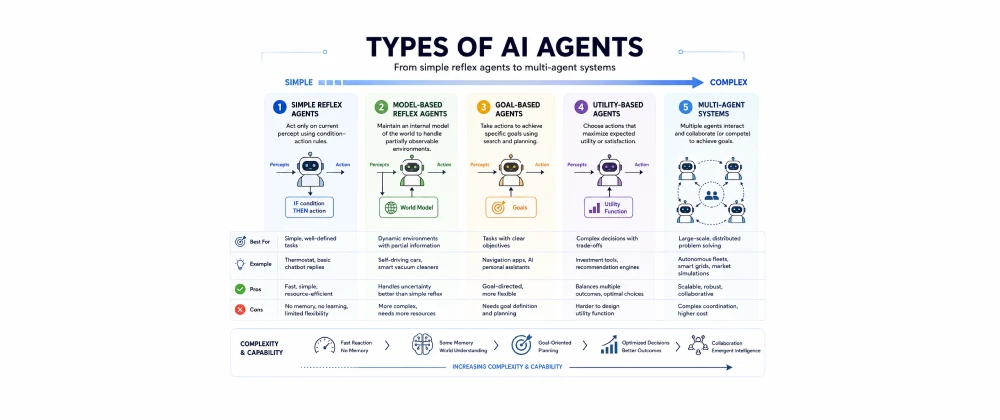
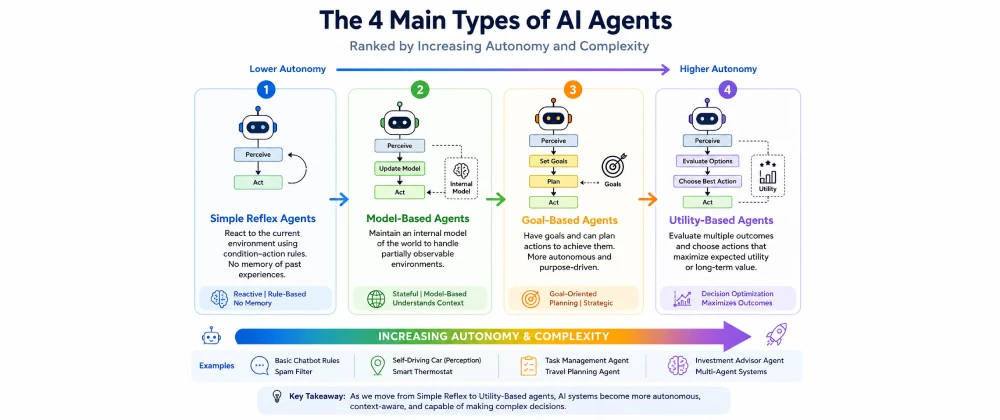
- AI agents are typically grouped into five classical categories: simple reflex, model-based reflex, goal-based, utility-based, and learning agents.
- Modern "agentic AI" products, from customer service bots to coding assistants, are usually goal-based or learning agents underneath the marketing language.
- Gartner projects that by 2028, a third of enterprise software applications will include agentic AI, up from less than 1% in 2024.
- Multi-agent systems — where several agents coordinate on a task — are becoming common in research and complex workflow automation.
- Choosing the right agent type depends on how predictable your task is, not on which type sounds most advanced.
- The EU AI Act treats more autonomous, higher-risk agents with stricter obligations than simple, narrow-task automation.
Table of Contents
Why "AI Agent" Means Five Different Things
An operations manager at a mid-sized logistics firm in Rotterdam sat through three vendor pitches in one week, each one describing its product as an "AI agent." One was a chatbot that answered shipping questions from a script. Another planned multi-step delivery routes on its own. The third coordinated several smaller bots to handle an entire customer complaint from start to finish. All three used the same word. None of them worked the same way.
That confusion is common, and it's not the manager's fault — "AI agent" has become a catch-all marketing term that glosses over real, meaningful differences in how these systems actually behave. Some agents just react to input. Others plan ahead, weigh tradeoffs, or learn from experience. Knowing which type you're actually being sold matters for budgeting, risk assessment, and figuring out what the tool genuinely can and can't do.
At SmartAIHuman.com, we get versions of this question constantly from readers across the US and Europe. This guide breaks AI agents down into the categories that actually matter, using plain language instead of vendor jargon.
How We Researched This Guide
Our Research Methodology
- Foundational review: Grounded the taxonomy in the established computer-science classification of agent types, then mapped it to how the term is used commercially today.
- Product comparison: Reviewed publicly available documentation for major US and EU agent-building platforms as of mid-2026.
- Cross-referenced sources: Verified market projections against Gartner and McKinsey & Company research.
- Regulatory review: Checked classification against EU AI Act risk-tiering guidance for autonomous AI systems.
- Editorial screening: Simplified technical AI terminology for a non-specialist business audience.
What Is an AI Agent? Core Concepts Explained
An AI agent is a system that perceives information from its environment and takes actions to achieve a goal, with varying degrees of autonomy and complexity depending on its type. That single definition covers everything from a simple rule-based chatbot to a system that plans multi-step tasks and learns from outcomes over time.
Computer science has classified agents into a handful of categories for decades, well before the current AI boom. Understanding those categories cuts through marketing language and helps you evaluate what a given AI product can actually do.
Why Understanding Agent Types Matters in 2026
Enterprise AI spending has shifted heavily toward "agentic" products over the past year, and US and EU businesses are being pitched agent-based tools for everything from customer support to supply chain planning. At the same time, the EU AI Act applies different obligations depending on how autonomous and high-risk a system is — a simple reflex agent answering FAQs faces very different scrutiny than a learning agent making autonomous decisions in a regulated industry. Knowing which type of agent you're evaluating isn't academic; it directly affects compliance requirements, reliability expectations, and what happens when something goes wrong.
Benefits of Knowing AI Agent Types for US and EU Businesses
Understanding the taxonomy isn't just academic — it has practical payoffs for anyone evaluating or deploying AI tools.
- Better vendor evaluation: you can ask precise questions instead of accepting "AI agent" as a self-explanatory feature.
- More accurate risk assessment: simpler agent types generally carry lower operational risk than learning agents that adapt in production.
- Smarter compliance planning: EU AI Act obligations scale with autonomy, so knowing your agent's category helps predict compliance burden early.
- Realistic expectations: understanding what a goal-based agent can and can't do prevents over-promising to stakeholders or customers.
Real-World Use Cases in the US and Europe
Customer Service Automation (Goal-Based Agents)
Many US retail and telecom companies now deploy goal-based conversational agents that can resolve a support ticket end-to-end — checking an order status, issuing a refund, or rebooking a service appointment — rather than just answering static FAQs.
Compliance and Fraud Monitoring (Learning Agents)
European banks, operating under strict GDPR and financial regulatory requirements, use learning agents to flag suspicious transactions, refining their risk models as new fraud patterns emerge, with human review built in for regulatory accountability.
Multi-Agent Coordination (Complex Workflows)
Some US software companies now use multi-agent systems — several specialized agents working together — to handle complex tasks like automated code review, where one agent writes code, another tests it, and a third summarizes results for a human engineer.
How to Choose the Right Type of AI Agent
Step-by-Step
- Map task predictability: if the task follows fixed rules with little variation, a simple reflex agent is often sufficient and easier to audit.
- Identify planning needs: if the task requires weighing multiple steps or options, look at goal-based or utility-based agents.
- Assess whether learning is actually needed: learning agents add power but also unpredictability — don't default to them if a simpler type solves the problem.
- Check regulatory exposure: for EU deployments, confirm how the EU AI Act's risk tiers apply to your chosen agent's level of autonomy before rollout.
Best Platforms for Building AI Agents in 2026
Microsoft Copilot Studio
Strong for goal-based agents integrated into Microsoft 365 workflows, with enterprise-grade governance controls and EU data residency options for European customers.
Salesforce Agentforce
Focused on goal-based and utility-based customer service and sales agents, built for businesses already using the Salesforce ecosystem, with GDPR-aligned data handling documentation.
Google Vertex AI Agent Builder
Flexible platform for building goal-based and multi-agent systems, with strong support for enterprises wanting to combine agents with Google's broader cloud and data infrastructure.
Agent Platforms — Comparison Table
Based on the platform documentation reviewed in our methodology above, here's how two contrasting platforms compare for US and EU businesses.
| Category | Copilot Studio | Agentforce | Notes |
|---|---|---|---|
| Ease of Setup | Copilot Studio benefits from Microsoft 365 familiarity. | ||
| Multi-Agent Support | Agentforce has stronger native multi-agent orchestration for sales/service. | ||
| EU Data Residency | Both offer EU-region hosting options. | ||
| Best For | Microsoft-centric enterprises | Salesforce-centric sales/service teams | Choice largely depends on existing ecosystem. |
Pros & Cons of Adopting More Advanced Agent Types
✅ Pros
- Goal-based and learning agents can handle far more complex, multi-step tasks than rule-based automation
- Reduces manual handling of repetitive decisions, freeing up staff time
- Learning agents improve over time without constant manual reprogramming
- Multi-agent systems can tackle tasks too complex for a single agent
⚠️ Cons
- More autonomous agents are harder to audit and predict than rule-based systems
- Learning agents can drift in behavior in ways that require ongoing monitoring
- Higher-autonomy agents face stricter EU AI Act compliance obligations
- Multi-agent systems introduce coordination failure points that simple agents don't have
Pricing: What AI Agent Platforms Cost in the US and Europe
Pricing varies widely by vendor, usage volume, and contract terms. These figures are illustrative starting points based on typical published tiers as of mid-2026 — confirm current pricing directly with each vendor before budgeting.
| Plan | USD | EUR | GBP |
|---|---|---|---|
| Starter / per-seat tier | ~$30/mo | ~€28/mo | ~£24/mo |
| Enterprise / usage-based tier | Custom pricing | Custom pricing | Custom pricing |
Alternatives to Off-the-Shelf Agent Platforms
Not every business needs a commercial agent-building platform. A few other paths are worth considering.
- Open-source agent frameworks: developer-led teams can build custom goal-based agents without platform licensing fees, at the cost of more engineering effort.
- Traditional rule-based automation: for genuinely simple, predictable tasks, a basic reflex-style automation tool may outperform a more complex agent on cost and reliability.
Expert Insights
"By 2028, agentic AI will be embedded across a third of enterprise software, but organizations that treat all agents as equally autonomous will underestimate the governance work required for the more capable categories." — Gartner, "Predicts 2025: The Future of AI Agents," 2025
Future Trends: AI Agent Types Beyond 2026
Expect multi-agent systems — several specialized agents coordinating on one task — to move from research settings into mainstream enterprise products over the next few years, particularly for complex workflows like software development and financial analysis. On the regulatory side, expect the EU AI Act's risk-tiering framework to become a more explicit reference point for classifying agent autonomy, potentially pushing vendors toward clearer disclosure of which agent type a product actually is. In the US, expect continued growth in industry-specific agent platforms tailored to sectors like healthcare and financial services, where predictability and auditability remain priorities even as agent capabilities grow.
Overall Rating
Frequently Asked Questions
Real questions US and European readers search for, answered clearly.
Choosing Clarity Over Jargon
"AI agent" will keep getting used as an umbrella term in vendor marketing, but the underlying categories haven't actually changed — they're the same distinctions computer scientists have used for decades, now applied to far more capable systems. Knowing whether you're evaluating a simple reflex agent or a learning agent tells you far more about what to expect than any product's tagline does.
The right choice isn't always the most advanced type. A predictable, auditable reflex agent might genuinely outperform a flashier learning agent for a narrow, well-defined task — while a complex, evolving workflow might need the adaptability only a learning or multi-agent system can provide.
SmartAIHuman.com will keep tracking how this terminology evolves as agentic AI products mature across the US and EU markets, so you can evaluate new tools with the right framework instead of the marketing copy.
Related Articles on SmartAIHuman.com
Sources & External Authority References
- Gartner — "Predicts 2025: The Future of AI Agents" (2025). gartner.com
- McKinsey & Company — Research on agentic AI and enterprise adoption (2025). mckinsey.com
- European Commission — EU AI Act risk-tiering and autonomous systems guidance (2025–2026). digital-strategy.ec.europa.eu

SmartAIHuman Editorial Team shares practical AI guides, tool reviews, productivity strategies, and beginner-friendly tech tutorials to help readers use AI effectively in everyday life.